

Penile prosthesis revision may be necessary if the device is not handled correctly.
Men with an indication for the implant often have doubts about whether penile prosthesis revision is necessary.
Maintenance may be necessary in situations such as not performing reconstruction before the implant and incorrect handling.
Below, have your questions on the subject answered.
When penile prosthesis revision is necessary
The need for revision or maintenance of the penile prosthesis depends on the model, mechanical failures, and difficulty in handling.
The penile prosthesis of the malleable type, for example, is made of silicone and has an internal metal rod. This rod has as its raw material Nitinol, a very resistant special metal made of nickel and titanium.
This greatly reduces the risk of fracture of the metal alloy. However, if the malleable prosthesis is not bent from the base, it may suffer damage.
In turn, revision or replacement of an inflatable prosthesis occurs when there is pump locking or leakage of the saline solution.
Pain or loss of rigidity during penetration are also reasons for evaluation or replacement of the inflatable penile prosthesis.
How long does a penile prosthesis last?
The model, the material, and the surgeon’s experience are variables that directly influence how long the penile prosthesis lasts.
Durability of the inflatable prosthesis
The durability of the inflatable prosthesis is between 10 and 15 years.
According to this literature review, the survival rate of the prostheses is 76.8% after 10 years, 63.7% after 15 years, and 52.9% after 20 years.
Durability of the semirigid prosthesis (inflatable)
The durability of the semirigid prosthesis is 5 to 10 years.
This type of prosthesis was first described in 1973 and has a shorter duration compared to the inflatable prosthesis.
According to a review article, the survival rate is 88.8% after 5 years and 84.3% after 10 years.

Infographic on penile prosthesis duration
Factors that influence penile prosthesis durability
The durability of the penile prosthesis depends on factors such as the type and quality of the material.
In addition, the experience of the professional in the area of implants is fundamental, because an experienced professional will know how to choose the prosthesis appropriate to the patient’s anatomy.
Another aspect that reinforces the importance of medical expertise is in cases of Peyronie’s disease.
In this condition, the prosthesis implant must be accompanied by penile reconstruction, because not correcting the curvature or thinning can significantly compromise the functional and aesthetic result, affecting the longevity of the penile prosthesis.
Type and quality of the material
The materials used in semirigid prostheses are developed to offer resistance to mechanical tension, which allows the device to withstand the handling needed to position it in erection and then return it to the resting position.
Components such as silver or stainless steel help prevent deformation, while the silicone coating aims to provide greater anatomical comfort.
Inflatable prostheses are made with high-resistance silicone, which offers strength. The scrotal pump and the reservoir are produced with flexible and durable materials, with the aim of contributing to a longer service life of the device.
In both types, manufacturers apply antimicrobial coatings, such as layers of silver ions, to reduce the risk of infection.
This care is fundamental, because infections in penile prostheses are among the main causes of implant replacement before the expected time.
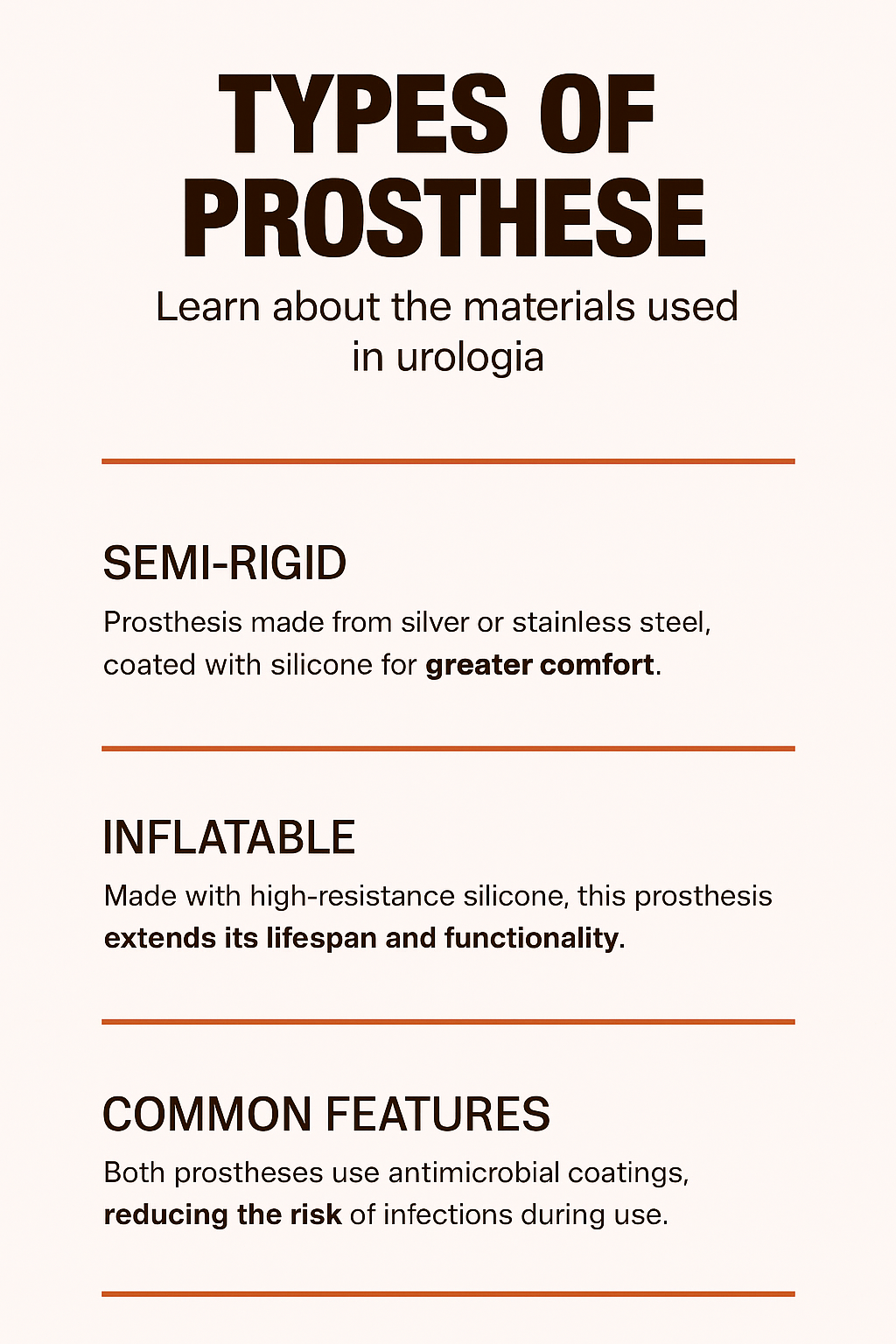
Infographic on types and materials of penile prostheses
Surgeon’s experience
The surgeon’s experience can influence the appropriate indication of the type of prosthesis, the conduct of the technique, and postoperative follow-up.
Professionals with experience in penile prosthesis surgery are in better conditions to assess the case and indicate the option most compatible with the patient’s anatomical and functional profile.
In addition to choosing the type of prosthesis, a physician knowledgeable in the area understands that, in cases of Peyronie’s disease, the penile implant must be associated with penile reconstruction. Correcting penile curvature and thinning is usually important for the aesthetic and functional result.
In some cases, patients may present associated emotional issues, such as anxiety or insecurity. Psychological follow-up may be considered as part of a multidisciplinary approach.
Penile anatomy and reconstruction
To increase the chances of good durability of the penile prosthesis, it is important to consider the anatomy of the penis in order to adopt personalized strategies.
In cases of longer penises, for example, it is necessary to use prostheses with a compatible diameter, because very thin cylinders may not be firm enough, which increases the risk of bending during sexual intercourse.
When the penis is thin and does not support an implant with a larger diameter, penile reconstruction may be indicated.
This procedure is performed with relaxing incisions in the tunica albuginea, the inner layer of the penis. The incisions will relax the tissue, allowing the penis to expand for a wider penile prosthesis.
Patient’s lifestyle
Lifestyle and usage habits also influence durability.
In the case of the semirigid prosthesis, the way the man positions it in his underwear may affect the integrity of the device.
For the inflatable prosthesis, excessive force to activate the pump or handle the cylinders may wear out the components more quickly.
Technology applied to the model
The evolution of penile prostheses in recent years is due to the materials used in their manufacture. This technological evolution aims to offer vertical firmness with comfort and flexibility for everyday movements.
In the case of the malleable prosthesis, for example, the core may be made of silver or stainless steel, materials of recognized resistance. The inflatable prosthesis, in turn, is produced with high-resistance silicone.
In more advanced models, the cylinders receive polyurethane layers to reduce the risk of leakage, one of the most common failures of this model.
Some models have antimicrobial coatings, whose purpose is to reduce the risk of infection.
Have an initial assessment with Dr. Paulo Egydio and find out which prosthesis is most suitable for your case
Dr. Paulo Egydio is a specialist in penile prosthesis and has already performed more than 6,000 surgeries. Therefore, he brings together the technical knowledge needed to help his patients in a personalized way.
Have your initial assessment today and receive Dr. Paulo’s response by e-mail within 24 hours.