

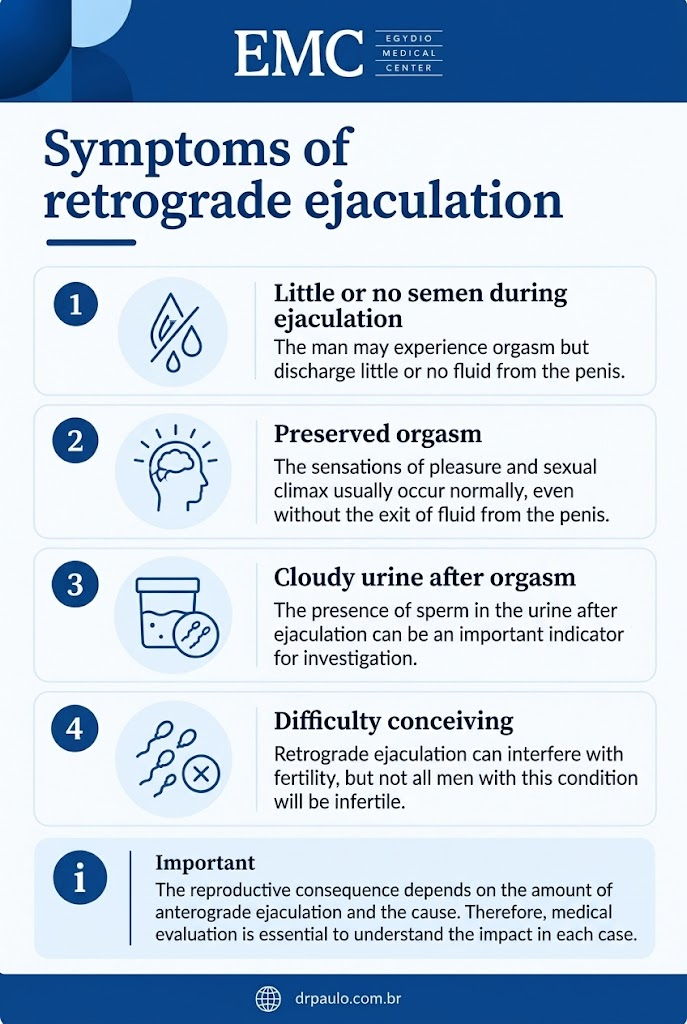
Retrograde ejaculation occurs when semen flows back into the bladder instead of being expelled through the urethra during orgasm. The man may continue to have a normal orgasm but have little or no semen.
The condition may be associated with pelvic surgeries, neurological damage, hormonal changes and the use of certain medications.
In some cases, retrograde ejaculation can interfere with male fertility and may require assisted reproduction treatments for men who wish to have children.
In this article, you will learn the main causes of retrograde ejaculation, its symptoms, how diagnosis is made and what treatment options are available.
What is retrograde ejaculation?
In normal ejaculation, called “anterograde ejaculation, the semen produced by the testes, prostate and seminal vesicles travels through the urethra and is expelled through the penis. In this process, the bladder neck – the neck of the bladder – closes and prevents the semen from being diverted to the bladder.
By contrast, the definition of retrograde ejaculation, according to the guideline of EAU – Disorders of Ejaculation is the passage of semen into the bladder because the bladder neck does not close properly during ejaculation. As a result, the semen goes into the bladder and is not expelled through the penis.
What happens during orgasm?
Orgasm and ejaculation are related phenomena, but not identical. Orgasm is the sensation of intense pleasure accompanied by bodily responses such as increased heart and respiratory rate, increased muscle tension and subsequent relaxation, among others.
Ejaculation, on the other hand, is the release of semen through the urethra during orgasm after sexual intercourse or masturbation.
Although they are associated and generally occur together, it is possible to have an orgasm without ejaculation.
This can occur in retrograde ejaculation when semen goes into the bladder instead of exiting the tip of the penis. Another possibility is anejaculation, a condition in which there is no release of ejaculate fluid.
What causes retrograde ejaculation?
The EAU guideline on neuro-urology states that the causes of retrograde ejaculation may include prostate and pelvic region surgeries, diabetes, the use of certain medications and neurological changes. Understand how each condition may be related to this ejaculatory alteration.
Prostate and pelvic region surgeries
Surgeries and procedures on the prostate and pelvic region, such as transurethral resection of the prostate (TURP) and open radical prostatectomy, may be associated with retrograde ejaculation because they can affect the bladder neck, a structure that participates in the mechanism responsible for preventing semen from entering the bladder during ejaculation.
In transurethral resection of the prostate, the surgeon removes part of the prostate tissue that obstructs the urethra and makes urination difficult. Although the procedure is useful to facilitate urination, it can affect the functioning of the bladder neck. As a result, the bladder neck may not close properly during ejaculation, allowing semen to be diverted into the bladder instead of exiting through the penis.
In open radical prostatectomy, the prostate and adjacent structures are removed, and a connection between the bladder and the remaining urethra is subsequently created to restore urinary flow. Because the procedure alters the anatomy and the structures involved in ejaculation, semen may no longer follow the usual path.
Diabetes
Recent studies describe a possible association between diabetes and ejaculatory changes, such as delayed ejaculation, retrograde ejaculation and anejaculation. The EAU guideline on epidemiology and prevalence includes diabetes among the factors that may be associated with these changes.
The document explains that diabetes may be associated with autonomic neuropathy, which can compromise the nerves involved in ejaculation. This alteration may influence the functioning of the bladder neck during ejaculation and contribute to the passage of semen into the bladder.
The same publication cites a study conducted with 54 diabetic men with sexual dysfunction, in which 6% of participants presented retrograde ejaculation.
Medications
Some medications can contribute to ejaculatory dysfunctions, such as retrograde ejaculation. Among the classes associated with medication-induced retrograde ejaculation are some thiazide diuretics, alpha-1 adrenergic blockers, antidepressants and antipsychotics.
Neurological disorders
Neurological diseases, such as Parkinson’s and multiple sclerosis, can affect the nerves responsible for control of ejaculation, altering this process.
Ejaculation depends on signals sent by the nerves that control contraction of the structures that convey semen and the closing of the bladder neck.
When these nerves are affected, ejaculatory changes may arise, such as retrograde ejaculation, a condition in which the bladder neck does not close and semen moves into the bladder and is not expelled during orgasm.
Can retrograde ejaculation happen because of medications?
Yes. Some medications can interfere with ejaculatory function, especially drugs that alter bladder neck tone.
Certain antihypertensives, for example, can reduce sympathetic nervous system activity and interfere with the nerve signals responsible for contraction of the structures involved in ejaculation. As a result, changes such as decreased ejaculatory volume, retrograde ejaculation or absence of ejaculation may occur.
But do not stop a medication on your own. When there is suspicion of a relationship between the treatment and the ejaculatory change, the physician should evaluate the possibility of adjustment or substitution.
Is retrograde ejaculation dangerous?
Generally, the condition does not mean that the semen inside the bladder causes harm to the body. Retrograde ejaculation is a change that is usually related to sexual impact, because the situation can cause discomfort or concern.
In addition, retrograde ejaculation should be investigated to identify the causes and, depending on the case, determine treatment, which may include assisted reproduction techniques, if retrograde ejaculation impairs fertility.
Does retrograde ejaculation cause infertility?
Retrograde ejaculation can make natural conception difficult, but that does not mean every man with this condition will face fertility problems or become infertile.
In this ejaculatory dysfunction, part or the total amount of semen is directed to the bladder. This results in little or no semen available to carry the sperm to the female reproductive tract. But, in many cases the sperm continue to be produced normally by the testes
The impact of retrograde ejaculation on male fertility depends on the causes and the quality of sperm production.
How is retrograde ejaculation diagnosed?
The diagnosis of retrograde ejaculation is made by the urologist, based on the clinical and sexual history, on the analysis of post-ejaculatory urine and, when indicated, on the semen analysis.
Clinical and sexual history for retrograde ejaculation
At the consultation, the urologist evaluates the patient’s health and sexual history to obtain clues that may help with the diagnosis. The professional generally asks:
- When the symptom began;
- Whether there was surgery or procedures on the prostate or pelvic region;
- Which medications are being taken;
- Presence of diabetes or high blood pressure;
- Neurological diseases;
- Semen volume;
- Presence of orgasm.
Post-ejaculatory urine analysis?
Post-ejaculation urine analysis is one of the tests used in the diagnosis. The identification of sperm in the urine after orgasm can help confirm that the semen was diverted to the bladder.
However, finding sperm in the urine is not always sufficient to establish the diagnosis of retrograde ejaculation, and complementary tests are necessary, such as seminal plasma and fructose analysis, in addition to imaging studies.
Semen analysis (spermogram) for retrograde ejaculation
A semen analysis is indicated when there are doubts about male fertility, especially when the couple has been trying to conceive without success for 12 months, or after 6 months, if the partner is 35 years or older. In this case, the urologist may request tests to evaluate:
- Semen volume;
- Sperm concentration
- Motility (movement of the sperm)
- Morphology (shape of the sperm), as clinically indicated.
It is important to note that these tests do not, by themselves, determine whether the semen is entering the bladder nor do they directly assess the functioning of the bladder neck and the nerves involved in ejaculation.
Is retrograde ejaculation curable?
It depends on the cause. Some cases of retrograde ejaculation may improve with treatment of the cause or medication adjustment; in situations associated with anatomical or neurological changes, management may be more complex.
How is retrograde ejaculation treated?
Treatment of retrograde ejaculation should be individualized according to the cause and the patient’s goal. A review study published in 2025notes that treatment is especially important for men who wish to have children.
Another point cited is that it is essential to check the use of medications associated with ejaculatory dysfunctions.
When the goal is to treat the ejaculatory alteration (retrograde ejaculation)
Treatment includes controlling the condition that originated the problem and may also involve reviewing medications that may contribute to the development of changes in ejaculation.
In some cases, the doctor may consider medications aimed at influencing the function of the bladder neck and reducing the diversion of semen into the bladder. The response is variable; these medications may not be suitable for everyone and can cause adverse effects, such as headache, dizziness, nausea, dry mouth, insomnia and changes in blood pressure or heart rate.
If retrograde ejaculation is the result of a permanent alteration caused by surgery, bladder neck medications may have little usefulness.
When the main goal is to have children
When the goal is paternity, treatment may involve retrieval of sperm present in the urine after ejaculation and assisted reproduction techniques, according to specialized evaluation.
It is important to emphasize that these strategies do not guarantee pregnancy, because the outcome depends on different factors related to the couple’s fertility.
Retrograde ejaculation after prostate surgery
Some surgeries, such as a prostatectomy, may be associated with retrograde ejaculation because they modify structures involved in the passage of semen or in the closing of the bladder neck.
However, a man can continue to have erections and orgasms normally, even when the procedure alters the exit of semen. This occurs because erection is related to increased penile blood flow, while ejaculation involves the contraction of different structures to conduct the semen to the urethra to be expelled through the penis.
Another change that may occur after certain procedures is dry ejaculation. Dry ejaculation, also called dry orgasm, occurs when a man has an orgasm but there is no release of semen.
If preservation of fertility is important, the patient should talk to the urologist about the possible impact of the procedure and discuss alternatives to reduce this risk.
Is retrograde ejaculation the same as dry ejaculation?
No. Retrograde ejaculation and dry ejaculation are not the same thing.
In anejaculation, there is no release of semen during orgasm. In retrograde ejaculation, the semen goes to the bladder instead of exiting through the urethra, which can result in little or no semen being expelled. The reduction or absence of semen can occur because:
- Semen is produced, but it may enter the bladder, which can be compatible with retrograde ejaculation;
- There is no ejaculation, which may indicate anejaculation;
- Changes after surgery that alter the production, storage, or release of semen;
- Other conditions, such as medication use.
retrograde ejaculation vs anejaculation
| Characteristic | retrograde ejaculation | anejaculation |
|---|---|---|
| Orgasm | May be present | May be present or altered |
| Semen outside the body | Reduced or absent | Absent |
| Semen destination | May enter the bladder | No semen is emitted externally. |
| Post-ejaculatory urine | May contain sperm and components of semen | Depends on the cause and may not contain sperm |
| Fertility | May be impaired | May be impaired |
| Investigation | Clinical assessment and analysis of post-ejaculatory urine | Investigation of the cause and assessment of ejaculatory function |
When to see a urologist for retrograde ejaculation?
You should seek urological care if you notice:
- Sudden or persistent reduction in ejaculate volume;
- Absence of semen;
- Orgasm without ejaculation;
- Cloudy urine after orgasm;
- Infertility;
- Changes after surgery;
- use of potentially related medications;
- Diabetes or associated neurological disease.
If you have noticed a persistent change in ejaculation, an absence or marked reduction of semen—especially after surgery, during the use of certain medications, or together with other changes—urological evaluation can help identify the cause, such as retrograde ejaculation, and determine appropriate management.
If you notice a persistent reduction or absence of semen, especially after surgery or during the use of certain medications, seek urological evaluation to investigate the cause and discuss appropriate management.


