
Understand what the penile implant is for, what the main types are, how each model works, and in which situations it may be indicated for men with erectile dysfunction.
The penile implant is a surgically implanted device to assist erectile function, by placing its components inside the corpora cavernosa.
During the procedure, the penis and surrounding structures are evaluated to guide, when necessary, the correction of deformities and the proper positioning of the implant.
When penile reconstruction is necessary, this step is performed before the insertion of the penile implant.
The penile implant is not a cosmetic procedure nor is it intended to increase penis size. Its purpose is to assist the penile rigidity necessary for sexual activity, according to the clinical indication and each patient’s response..
The prosthesis can
| The prosthesis does not aim to |
Provide rigidity
| Enlarge the penis
|
Allow for penetration
| Increase libido
|
Restore erectile function
| Treat all causes of erectile dysfunction
|
Make erections predictable
| Alter hormone levels |
There are two types of penile implant: the malleable penile implant and the inflatable penile implant.
Each type of penile implant has distinct characteristics, as well as advantages and disadvantages. The choice of model is made by the urologist based on clinical features, anatomy, the needs and preferences of each patient
The malleable penile implant consists of two flexible rods implanted inside the corpora cavernosa. These rods keep the penis in a semi-rigid position.
The functioning of the malleable penile implant is simple. To obtain an erection, the patient manually positions the penis upward. After sexual activity, the penis should be repositioned downward.
The inflatable penile implant is generally composed of cylinders implanted in the corpora cavernosa, a pump implanted in the scrotum and a reservoir that contains saline solution.
The inflatable penile implant is activated via the scrotal pump. When indicated, the patient can operate the pump to transfer the fluid to the cylinders of the penile implant, which expand and can produce penile rigidity for sexual activity.
To deactivate the device, the patient uses the pump deflation mechanism located in the scrotum, according to the instructions received from the medical team.
| Characteristic | Malleable implant | Inflatable implant |
|---|---|---|
| Operation | Keeps the penis in a semi-rigid state. | Has a hydraulic system that produces rigidity when activated. |
| Penile rigidity | Maintains a semi-rigid position, allowing manual positioning of the penis according to instructions and the situation. | It can be activated, when necessary, via a pump implanted in the scrotum, depending on the operation of the penile implant model used. |
| Appearance at rest | May be less discreet, due to constant rigidity. | Has an appearance closer to a flaccid penis when deactivated. |
| Mechanism of operation | Simpler: just position the rod upward for sexual intercourse. | More complex: utiliza a penile implant with a pump, cylinders and reservoir to produce an erection. |
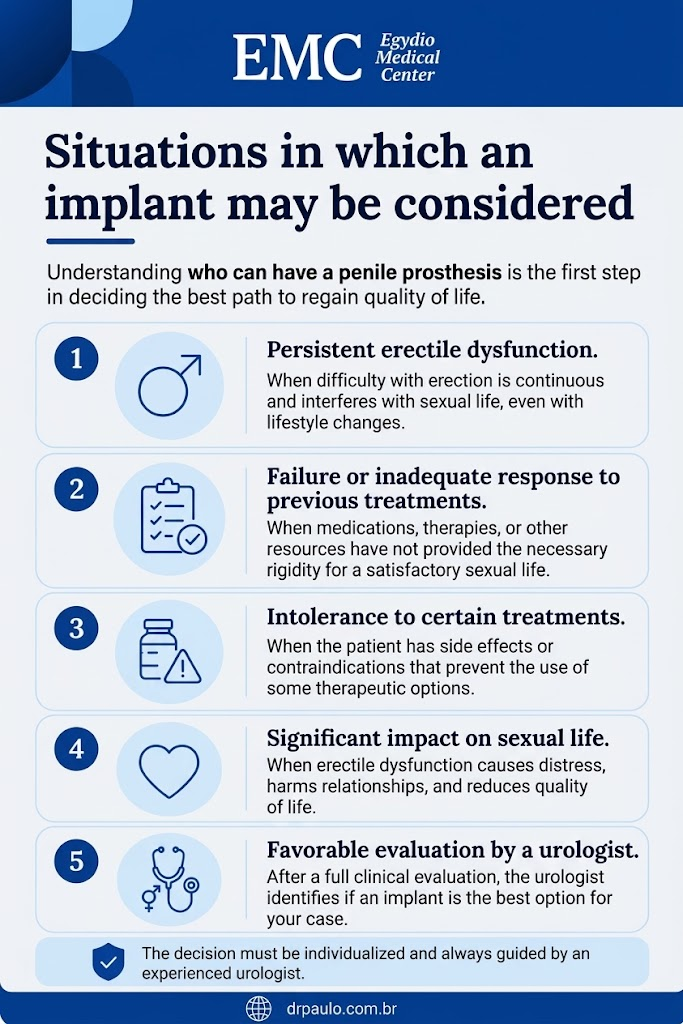
The recommendation depends on the cause of the erectile dysfunction, treatment history, and each patient’s individual characteristics. A specialized assessment allows for an understanding of the alternatives and the determination of the most appropriate approach.