
The penile prosthesis extender used in penile prosthesis surgery is a component that can supplement the length of the implant relative to the dimensions of the corpora cavernosa. Its use should be determined based on measurements taken during surgery, the anatomy, and the type of prosthesis; when necessary, its length and positioning should be carefully assessed, because an inappropriate choice can affect the stability of the implant.
The use of penile prosthesis extenders during placement of the penile prosthesis is primarily intended to adjust the prosthesis length to the corpora cavernosa. In some cases, when it is noted that the implant falls short of the adequate length, the surgeon may use extenders to adapt the prosthesis to the actual size of the penis.
Although they provide additional support to the internal structure of the penis, they can also excessively tension the tissues, increase the risk of surgical complications, impair healing, and compromise the optimal positioning of the prosthesis.
The decision to use or not use a penile prosthesis extender during placement of the penile prosthesis should be evaluated with caution. Below, learn what the surgeon should consider to properly use this resource in penile implant surgery:
What is the penile prosthesis extender?
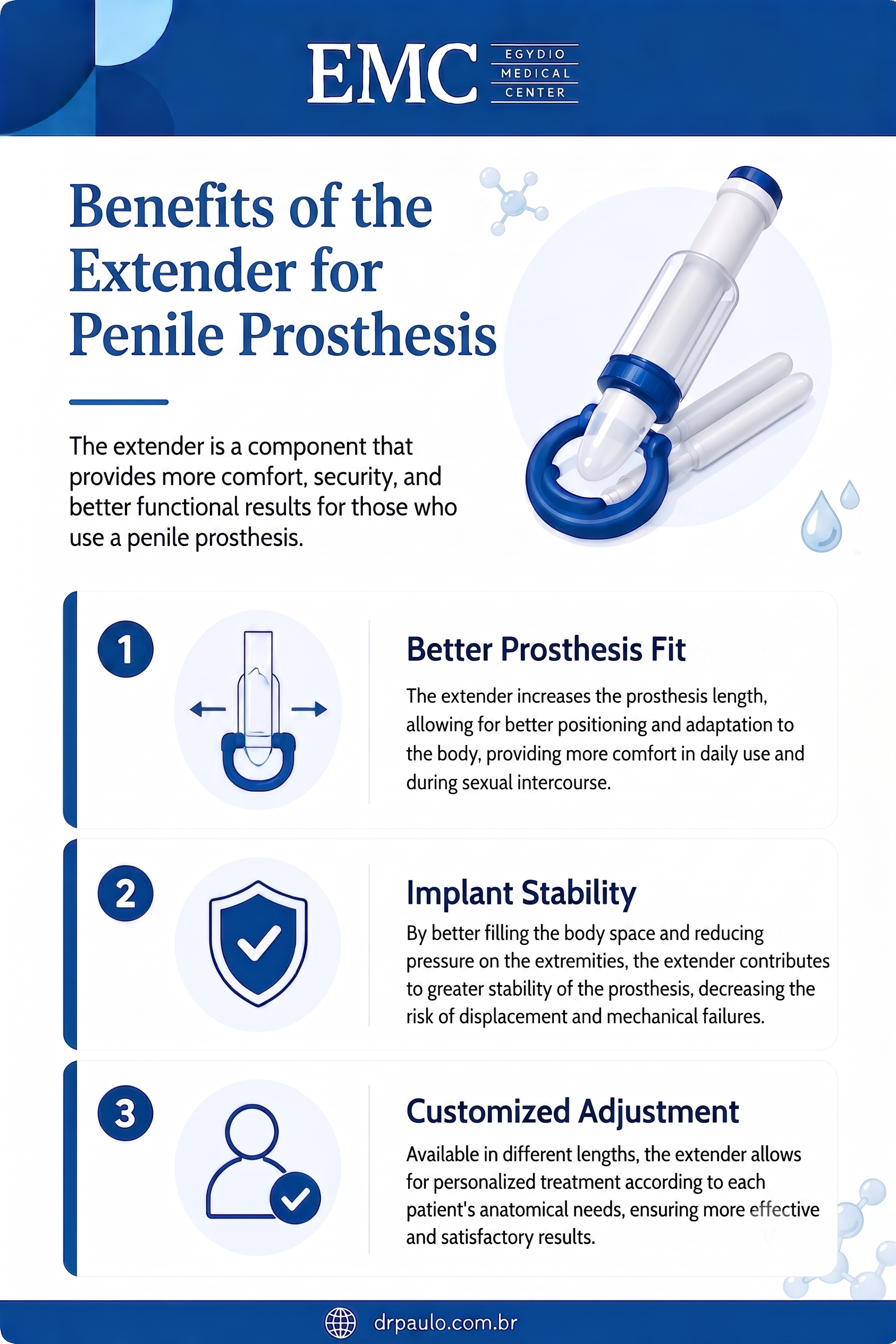
The extender for penile prosthesis is a component used to adjust the implant’s length to the dimensions of the patient’s corpora cavernosa. It is placed during surgery when, after the measurement performed by the urologist, a need is identified to supplement the prosthesis rods’ length to ensure an appropriate fit.
Not all patients need to use penile prosthesis extenders. The indication depends on individual anatomy and the measurements obtained during the procedure.
Studies on the mechanics of penile prosthesis extenders indicate that their use should aim only at adjusting the positioning of the prosthesis. Longer penile prosthesis extenders should be used with caution, as they may compromise the implant’s rigidity. When possible, choosing longer cylinders may be considered a more appropriate alternative, according to anatomy and the surgeon’s assessment.
How does the penile prosthesis extender work?
The penile prosthesis extender is a component used to supplement the implant rod’s length when necessary, according to measurements of the corpora cavernosa. Its placement occurs during surgery, after the urologist’s assessment of the appropriate prosthesis size and the patient’s anatomy. When well indicated, the extender assists in positioning the implant, but its use must be individualized to preserve the prosthesis’ stability and function.
In which situations can a penile prosthesis extender be considered in penile prosthesis surgery?
When is the penile prosthesis extender indicated?
| Clinical situation | Consideration regarding the penile prosthesis extender |
|---|---|
| Anatomy and intraoperative measurement | It may be considered during surgery when measurements of the corpora cavernosa justify adjusting the implant length. |
| Peyronie’s disease | Peyronie’s disease alone does not dictate use of the penile prosthesis extender; the decision depends on the anatomy, intraoperative measurements and the surgical plan. |
| Reconstructive surgeries | In reconstructive procedures, any use of the penile prosthesis extender should be determined by intraoperative assessment and individualized planning. |
| Implant revision | In revision surgeries, it may be considered if intraoperative assessment demonstrates a need to adjust the implant. |
Does the penile prosthesis extender increase penis size?
No. The penile prosthesis extender does not increase penis size. Its function is only to complement the prosthesis length to adapt it to the patient’s anatomy. Thus, the component assists in correct positioning of the implant and in adapting the prosthesis during surgery.
Are there risks in using the penile prosthesis extender?
The main risk of using the penile prosthesis extender is related to the use of components that are too long or inappropriate for the patient’s anatomy. Excessively long penile prosthesis extenders can compromise the rigidity of the prosthesis.
Therefore, whenever possible, the surgeon should evaluate alternatives, such as using longer cylinders, when compatible with the patient’s characteristics. When correctly indicated and used based on precise intraoperative measurements, the penile prosthesis extender can assist in the adjustment and stability of the implant.
Possible complications
- Prosthesis extrusion: occurs when the implant or any of its components exerts excessive pressure on the tissues, potentially causing displacement or injury to the skin or mucosa.
- Excessive tissue tension: an inadequate penile prosthesis extender can increase pressure on the area and promote complications.
In addition, factors such as incorrect selection of implant size, changes in healing, and infections can also contribute to problems after surgery.
How can the risks be reduced?
Appropriate selection of the prosthesis, precise measurement of the corpora cavernosa during surgery, and correct selection of the penile prosthesis extender, when necessary, are important factors to reduce the risk of complications.
A urologist experienced in penile prosthesis has the technical knowledge to individualize the procedure according to each patient’s anatomy and needs.
This knowledge allows selecting the most appropriate implant, performing precise measurements during surgery, and assessing whether the use of the penile prosthesis extender is truly necessary.
Clinical evaluation, surgical planning, and adherence to postoperative care are relevant components of treatment. Even with these measures, complications may occur, such as infection or changes in prosthesis positioning, which require medical follow-up.
How is the recovery after implantation with a penile prosthesis extender?
Recovery follows the same care as conventional implantation, including adequate hygiene, rest, use of prescribed medications, and gradual return to activities.
The main difference lies in the component used: the penile prosthesis extender is made of silicone and does not have an internal rigid structure. Therefore, when used inadequately or in an excessive size, it can compromise the stability of the prosthesis. In the malleable penile prosthesis, it may reduce the firmness of the base of the implant. In the inflatable penile prosthesis, very long penile prosthesis extenders can affect the stability and alignment of the glans.
For this reason, the indication and the size of the penile prosthesis extender must be carefully determined by the surgeon.
What care is necessary after surgery?
- Follow the instructions on dressings and medications correctly;
- Avoid strenuous physical activity during the recommended period;
- Attend follow-up appointments;
- Watch for warning signs such as severe pain, fever, redness, excessive swelling, discharge, or difficulty using the penile prosthesis.
If any of these symptoms are identified, it is important to contact the urologist for evaluation.
When is it possible to resume sexual intercourse?
Return to sexual activity generally occurs between 4 and 8 weeks after surgery, provided that healing is adequate and there are no complications.
Respecting this period is essential to allow tissue recovery and reduce the risk of implant-related problems.
What results to expect from a penile prosthesis with a penile prosthesis extender?
When the use of a penile prosthesis extender is considered, the objective is to adjust the implant length to the patient’s anatomy.
The functional outcome may vary according to individual factors, the type of prosthesis, the procedure, and the recovery. The penile prosthesis extender aims to adjust the implant length to the patient’s anatomy. It does not increase penile size, but may assist in correct positioning of the prosthesis when its use is necessary.
Results may vary according to factors such as prosthesis type, individual anatomy, surgical technique, and recovery process.
When to consult a urologist?
Consult a urologist if there is progressive increase in pain, discharge from the incision, redness, excessive swelling, or fever, as these signs may indicate complications that require evaluation. It is also important to seek care in cases of loss of rigidity, pain during activation of the prosthesis, difficulty functioning, change in positioning, or a sensation of implant displacement.
To obtain information about urological assessment and appointment scheduling, you can use the pre-assessment form. Learn more: