

What is the recovery like after inflatable penile prosthesis surgery?
| Recovery stage | What to expect | Medical guidance |
|---|---|---|
| First days after surgery | Mild to moderate pain, swelling, bruising, and tenderness in the genital area are common. These symptoms usually decrease gradually over the first few weeks. | Maintain relative rest, use prescribed medications, keep the local area clean, and avoid physical exertion or heavy lifting. |
| Return to work | Return depends on recovery and the type of work. For administrative work, it generally occurs between 1 to 3 weeks. Activities that require physical exertion may require 4 to 6 weeks or more. | Return should be authorized by the urologist, taking into account the progress of healing and individual limitations. |
| Return to sexual activity | In most cases, sexual activity is permitted between 4 to 8 weeks, after complete healing and training in the use of the inflatable penile prosthesis. | Sexual intercourse should only be resumed after medical evaluation to reduce the risk of pain, complications, or displacement of the prosthesis. |
| Adaptation to using the prosthesis | In the first weeks, it is normal to need a learning period to inflate and deflate the device. Most patients progressively gain confidence with training provided by the urologist. | Follow the prosthesis usage instructions, attend follow-up appointments, and clarify any questions before resuming sexual activity. |
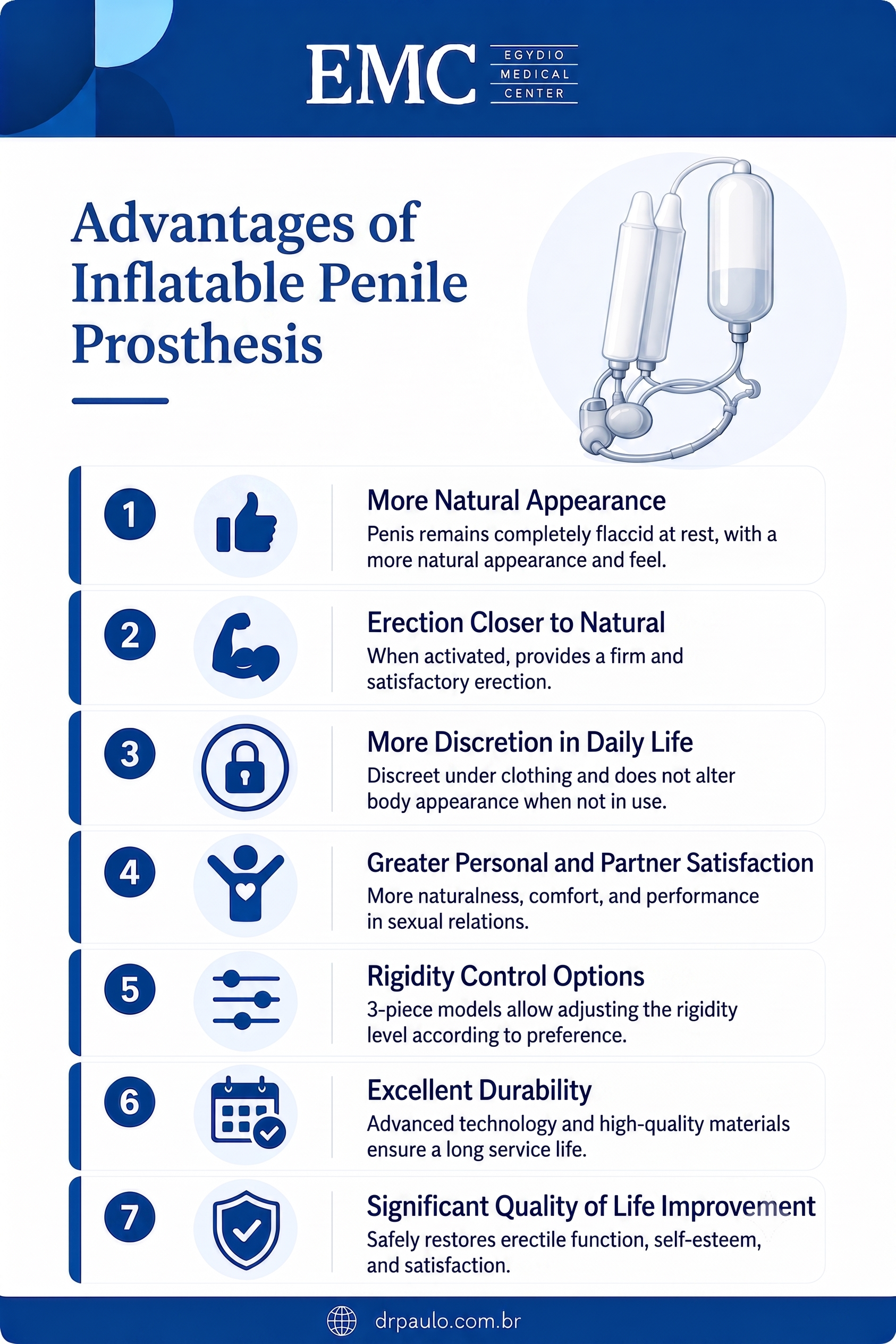
Does an inflatable penile prosthesis carry risks?
As with any surgical procedure, insertion of an inflatable penile prosthesis involves risks, limitations, and the need for medical follow-up.
The main risks and limitations of the surgery include:
Permanent alteration of natural erectile function
Placement of the inflatable penile prosthesis causes changes to the corpora cavernosa. Therefore, if the prosthesis is removed, recovery of natural erection may be limited. The procedure should be recommended only after careful evaluation.
Need to adapt to the device
After surgery, the patient needs to learn to use the scrotal pump and the inflation and deflation mechanisms of the inflatable penile prosthesis. This process is guided by the urologist and, in most cases, allows progressive adaptation to the prosthesis.
Possibility of future revision or replacement
Despite the durability of modern devices, the inflatable penile prosthesis has mechanical components that can wear over time and may require a revision surgery.
Importance of medical follow-up
Follow-up appointments allow assessment of healing, monitoring of adaptation to the prosthesis, and early identification of possible signs of infection, inflammation, or other changes that require evaluation.
Frequently asked questions
Is the inflatable penile prosthesis visible?
In general, the inflatable penile prosthesis is implanted inside the penis and is not visible externally. The appearance of the penis may vary depending on the anatomy, the type of implant, and each patient’s postoperative course.
Does ejaculation change?
The inflatable penile prosthesis itself generally does not prevent ejaculation when it is already preserved. However, ejaculation may be absent or altered due to clinical conditions or previous surgeries, such as radical prostatectomy and procedures involving the seminal vesicles. This issue should be discussed individually with the urologist.
Is sensation preserved?
In many cases, the inflatable penile prosthesis is implanted with the goal of preserving the nerve structures related to sensation. However, sensory perception and sexual experience can vary among patients, and expectations about sensation should be discussed individually with the urologist.
Does the inflatable penile prosthesis interfere with tests?
In general, the inflatable penile prosthesis does not interfere with laboratory tests. For imaging studies, especially magnetic resonance imaging, it is important to inform the team responsible about the presence and model of the implant so that applicable safety conditions can be confirmed.
Current models of penile prostheses are manufactured from biocompatible materials, such as medical-grade silicone, which do not compromise laboratory or imaging test results.
Regarding magnetic resonance imaging, many modern prostheses are considered compatible. However, it is important to always inform the team responsible for the exam about the presence of the implant so that safety conditions can be confirmed.
When to see a urologist?
See a urologist when you have questions about the inflatable penile prosthesis or when conventional treatments for erectile dysfunction do not produce the expected results.
Specialized evaluation is essential to assess the patient’s clinical status, identify the causes of erectile dysfunction, and determine whether the inflatable penile prosthesis may be an appropriate therapeutic option for their case.
For information on scheduling a consultation and urological assessment, use the clinic’s contact channels. The recommendation of any treatment depends on individualized medical evaluation.
The inflatable penile prosthesis works through a hydraulic system. When the scrotal pump is activated, fluid fills the cylinders in the penis, producing an erection. After use, the fluid returns to the reservoir and the penis returns to a flaccid state.
The inflatable penile prosthesis is a treatment indicated for men with severe erectile dysfunction who have not obtained results with oral medications, intracavernosal injections, or who have contraindications to those therapies.
It may also be recommended in cases of advanced Peyronie’s disease, when there is associated erectile dysfunction and significant deformities, such as marked curvature, thinning, or shortening of the penis.
In this guide, we explain how an inflatable penile prosthesis works, how the surgery is performed, what to expect from recovery, and answer the main questions about the procedure.
How Does an Inflatable Penile Prosthesis Work?
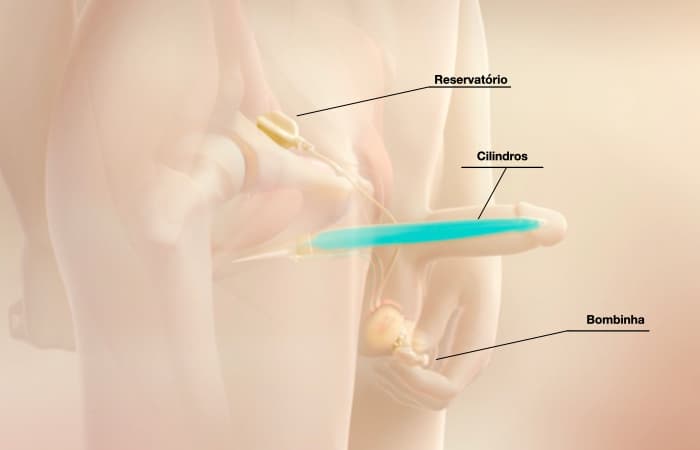
The inflatable penile prosthesis functions through a hydraulic system made up of two cylinders implanted inside the penis, a fluid reservoir placed in the lower abdomen, and a small scrotal pump.
How does the hydraulic system work?
The hydraulic system of the inflatable penile prosthesis is filled with sterile saline. When the scrotal pump is pressed, the fluid is transferred to the cylinders in the penis, producing an erection.
After sexual activity, the pump’s deflation mechanism is activated so that the fluid returns to the reservoir, causing the penis to return to a flaccid state.
What are the types of inflatable penile prostheses?
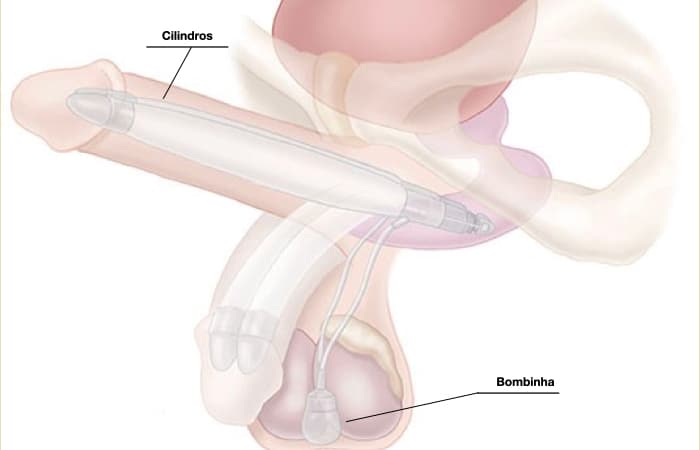
There are two types of inflatable penile prosthesis: two-piece and three-piece. Both operate on the same hydraulic principle, but differ in the location of the reservoir and in the circulation of the fluid.
1 – Two-piece inflatable penile prosthesis
- The scrotal pump also functions as the reservoir.
- When it is pressed, the sterile saline is transferred to the cylinders, producing an erection.
- After sexual activity, the fluid returns to the pump-reservoir.
- It may result in less natural rigidity and flaccidity.
2 – Three-piece inflatable penile prosthesis
- It has a separate reservoir in the lower abdomen.
- When the pump is pressed, the sterile saline is transferred to the cylinders, producing an erection.
- After sexual activity, the fluid returns to the reservoir.
- It tends to provide a firmer erection and a more natural flaccid state.
How does the penis return to the flaccid state?
It is necessary to perform deflation of the implant. The process is simple and consists of:
- Locate the deflation valve on the scrotal pump implanted in the scrotum.
- Activate the release valve to allow the fluid to return from the cylinders.
- Wait for the sterile saline to return to the reservoir, causing the cylinders to empty.
- Repeat the process until the prosthesis is completely deflated and the penis returns to the flaccid state.
The deflation of the inflatable penile prosthesis is usually a simple process that should be performed according to the instructions provided by the medical team. If pain, difficulty handling the device, unexpected changes, or questions arise, the patient should contact the urologist responsible for evaluation.
Who can have an inflatable penile prosthesis placed?
An inflatable penile prosthesis may be indicated for men with erectile dysfunction who do not have a satisfactory response to other treatments or who have contraindications to certain therapies. Indication depends on individualized medical evaluation.
The main situations in which an inflatable penile prosthesis may be considered include:
- Severe erectile dysfunction: Indicated for men who have not obtained satisfactory results with oral medications, intracavernosal injections, or other available treatments.
- Diabetes: It may be an option when the disease causes changes in the nerves or blood vessels involved in the erection mechanism, leading to persistent erectile dysfunction.
- After prostate surgery: Men who developed erectile dysfunction after procedures such as prostatectomy may be evaluated for placement of a prosthesis when other approaches do not restore a functional erection.
- Peyronie’s disease: It may be considered in cases with erectile dysfunction associated with penile curvature and significant deformities, and may contribute to correction of the curvature during the surgical procedure, according to the specialist’s assessment.
- Spinal cord injury: Changes in the spinal cord can compromise the nerve signals responsible for erection. In these cases, an inflatable penile prosthesis allows achieving an erection through a mechanism controlled by the device itself.
How is the surgery performed?
The penile prosthesis surgery is generally performed under general anesthesia and has an average duration of about 1.5 hours. The procedure time may vary depending on the complexity of the case, the type of implant chosen and the patient’s individual characteristics.
During surgery, the penis may be placed in an induced erection to assist in the assessment of the structures.
Next, the surgeon makes an incision to insert the components of the prosthesis into the corpora cavernosa, preserving the surrounding tissues.
When associated changes are present, such as penile curvature, thinning or loss of volume, penile reconstruction may be necessary before placing the prosthesis.
This step may include correction of:
- Penile curvature: to improve the alignment of the penis.
- Thinning or narrowing: to correct shape changes.
- Loss of volume: to facilitate adaptation and stability of the implant.
Correcting these changes may help improve prosthesis stability, function, and the overall outcome of the procedure.
Hospitalization usually lasts about 24 hours after surgery. During this period, the medical team monitors:
- Recovery from anesthesia;
- Pain control;
- Possible signs of bleeding or infection;
- Instructions on care for the prosthesis and the surgical incision.
The length of hospitalization may be prolonged depending on the patient’s clinical conditions, such as:
- Diabetes;
- Cardiovascular diseases;
- Occurrence of complications during the procedure.
Hospital discharge and postoperative follow-up are determined according to the course of each case and the specialist’s recommendations.
What is recovery like?
What is the recovery like after inflatable penile prosthesis surgery?
| Recovery stage | What to expect | Medical guidance |
|---|---|---|
| First days after surgery | Mild to moderate pain, swelling, bruising, and tenderness in the genital area are common. These symptoms usually decrease gradually over the first few weeks. | Maintain relative rest, use prescribed medications, keep the local area clean, and avoid physical exertion or heavy lifting. |
| Return to work | Return depends on recovery and the type of work. For administrative work, it generally occurs between 1 to 3 weeks. Activities that require physical exertion may require 4 to 6 weeks or more. | Return should be authorized by the urologist, taking into account the progress of healing and individual limitations. |
| Return to sexual activity | In most cases, sexual activity is permitted between 4 to 8 weeks, after complete healing and training in the use of the inflatable penile prosthesis. | Sexual intercourse should only be resumed after medical evaluation to reduce the risk of pain, complications, or displacement of the prosthesis. |
| Adaptation to using the prosthesis | In the first weeks, it is normal to need a learning period to inflate and deflate the device. Most patients progressively gain confidence with training provided by the urologist. | Follow the prosthesis usage instructions, attend follow-up appointments, and clarify any questions before resuming sexual activity. |
Does an inflatable penile prosthesis carry risks?
As with any surgical procedure, insertion of an inflatable penile prosthesis involves risks, limitations, and the need for medical follow-up.
The main risks and limitations of the surgery include:
Permanent alteration of natural erectile function
Placement of the inflatable penile prosthesis causes changes to the corpora cavernosa. Therefore, if the prosthesis is removed, recovery of natural erection may be limited. The procedure should be recommended only after careful evaluation.
Need to adapt to the device
After surgery, the patient needs to learn to use the scrotal pump and the inflation and deflation mechanisms of the inflatable penile prosthesis. This process is guided by the urologist and, in most cases, allows progressive adaptation to the prosthesis.
Possibility of future revision or replacement
Despite the durability of modern devices, the inflatable penile prosthesis has mechanical components that can wear over time and may require a revision surgery.
Importance of medical follow-up
Follow-up appointments allow assessment of healing, monitoring of adaptation to the prosthesis, and early identification of possible signs of infection, inflammation, or other changes that require evaluation.
Frequently asked questions
Is the inflatable penile prosthesis visible?
In general, the inflatable penile prosthesis is implanted inside the penis and is not visible externally. The appearance of the penis may vary depending on the anatomy, the type of implant, and each patient’s postoperative course.
Does ejaculation change?
The inflatable penile prosthesis itself generally does not prevent ejaculation when it is already preserved. However, ejaculation may be absent or altered due to clinical conditions or previous surgeries, such as radical prostatectomy and procedures involving the seminal vesicles. This issue should be discussed individually with the urologist.
Is sensation preserved?
In many cases, the inflatable penile prosthesis is implanted with the goal of preserving the nerve structures related to sensation. However, sensory perception and sexual experience can vary among patients, and expectations about sensation should be discussed individually with the urologist.
Does the inflatable penile prosthesis interfere with tests?
In general, the inflatable penile prosthesis does not interfere with laboratory tests. For imaging studies, especially magnetic resonance imaging, it is important to inform the team responsible about the presence and model of the implant so that applicable safety conditions can be confirmed.
Current models of penile prostheses are manufactured from biocompatible materials, such as medical-grade silicone, which do not compromise laboratory or imaging test results.
Regarding magnetic resonance imaging, many modern prostheses are considered compatible. However, it is important to always inform the team responsible for the exam about the presence of the implant so that safety conditions can be confirmed.
When to see a urologist?
See a urologist when you have questions about the inflatable penile prosthesis or when conventional treatments for erectile dysfunction do not produce the expected results.
Specialized evaluation is essential to assess the patient’s clinical status, identify the causes of erectile dysfunction, and determine whether the inflatable penile prosthesis may be an appropriate therapeutic option for their case.
For information on scheduling a consultation and urological assessment, use the clinic’s contact channels. The recommendation of any treatment depends on individualized medical evaluation.