Modern penile prostheses are durable and can function for many years, but there is no guarantee they will last a lifetime. Replacement may be necessary in the event of mechanical failure or complications.
In many cases, the implant can remain functional for many years, even decades. Durability, however, varies according to the model, the materials used, the surgical technique and the individual characteristics of each patient.
Different models of penile prosthesis may have distinct technical features and components. Durability and any features related to complication prevention depend on the specific device, the indications for its use and the patient’s clinical conditions; it is not appropriate to assume superiority solely because a model is newer.
Below, understand when a penile implant may be indicated for younger patients, its durability and how the urologist evaluates the most suitable model for each case.
Penile implant in a young man: how long does it last and when should it be replaced?
Yes. Age alone does not preclude placement of a penile prosthesis. Indication depends on theclinical condition, the cause of erectile dysfunction and the response to treatments previously undertaken.
Men who do not achieve satisfactory results with medications for erectile dysfunction or who have contraindications to those options may be candidates for the implant.
Those who do not tolerateintracavernosal injections may also be candidates for the procedure. Repeated use of these injections, especially when associated with other factors, can contribute to changes in penile tissues.
Another possible indication is thepresence of penile curvature associated with other deformities, such as loss of length or thinning.
Is age a contraindication for a penile prosthesis?
Not necessarily. There is no specific age that by itself determines indication or contraindication for the surgery.
The decision depends on an individualized assessment by the urologist, taking into account health conditions, erectile function, prior treatments and each patient’s needs.
This assessment may include tests to investigate erectile function and the condition of the penile blood vessels, such as the erection test andultrasonography with penile Doppler, when indicated.
In which situations can the prosthesis be considered?
Persistent erectile dysfunction is one of the main situations in which the implant may be considered.
This can occur when oral medications, intracavernosal injections or other treatment options do not achieve satisfactory results, are not tolerated or are contraindicated.
The implant aims toprovide the rigidity necessary for sexual activity by activating the device. How that rigidity is obtained depends on the type of prosthesis used.
Penile implant in a young man: how long does it last?
The penile prosthesis does not have a single expiration time that applies to all patients. The implant can remain functional for many years, but its durability varies according to several factors.
Among them are:
- the type of device,
- the materials used,
- the individual characteristics of the patient,
- the surgical technique and the occurrence of complications or mechanical failures.
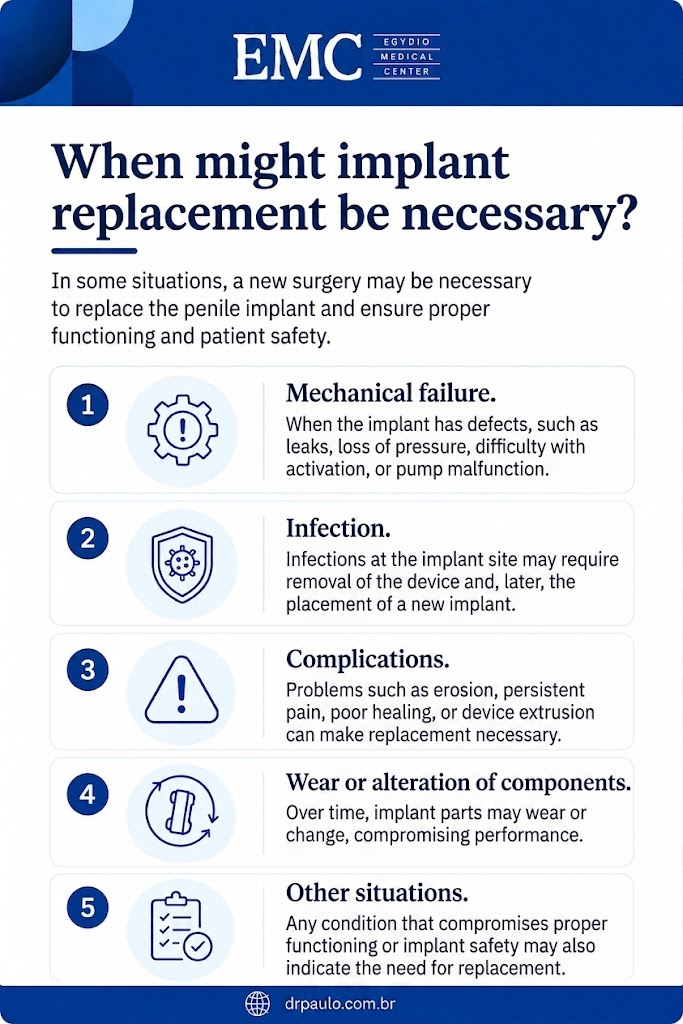
In the event of mechanical failure or another complication that compromises the device’s function, a new surgery to replace the prosthesis may be necessary.
What can influence prosthesis durability?
| Factor | Possible impact |
|---|---|
| Type of prosthesis | Different models have distinct mechanisms and components that can influence durability. |
| Device model | Materials, components and systems used can vary according to the model and manufacturer. |
| Surgical technique | Appropriate planning and execution, taking into account anatomical and clinical characteristics, contribute to the outcome and safety of the procedure. |
| Surgeon’s experience | Can contribute to planning, surgical execution and postoperative follow-up. |
| Complications | Infections and other intercurrences may require treatment, revision or implant replacement. |
| Mechanical failure | Problems in the cylinders, pump, reservoir or other components can compromise function and lead to the need for replacement. |
| Individual conditions | Anatomy, clinical conditions and each patient’s course can influence follow-up and treatment outcome. |
Until what age does a penile prosthesis work?
There is no defined maximum age for a penile prosthesis to function. Aging itself does not mean the implant will stop working.
Over the years, new health conditions may arise and require medical follow-up, but this does not necessarily mean the device needs to be replaced.
If I develop another disease in the future, can the prosthesis stop working?
Not necessarily. The onset of another health condition does not usually make the device stop working automatically.
However, some diseases or clinical situations can affect overall health and increase the risk of complications, making appropriate medical follow-up necessary.
| Situation | Can it affect the prosthesis? |
|---|---|
| Aging | Does not imply automatic device failure. |
| New disease | Depends on the type and severity of the condition. |
| Disease affecting overall health | May influence clinical status and recovery. |
| Mechanical failure | May require evaluation, surgical revision or implant replacement. |
| Infection | May require medical treatment or surgery, depending on the case. |
Can a disease affect sexual function even with the prosthesis working?
Yes. A health condition can affect different aspects of sexual function even when the implant is functioning properly.
The main function of the penile prosthesis is to provide sufficient rigidity for sexual intercourse. However, sexual function involves other factors that do not depend directly on the device.
- Rigidity: depends on the proper functioning of the implant.
- Sexual desire: can be influenced by hormones, emotional factors, diseases and medications.
- Sensation: the perception of stimuli depends on nerves and penile tissues.
- Orgasm: can be affected by hormonal and neurological changes, psychological factors and medications.
- Ejaculation: changes in the reproductive system or other structures can interfere with ejaculation.
- Sexual well-being: emotional, relational and psychological factors can influence sexual satisfaction.
What is the best penile prosthesis for a young man?
There is no single penile prosthesis model that is best for all young men. The choice depends on factors such as anatomy, clinical conditions, needs, expectations, lifestyle and the urologist’s assessment.
| Feature | Inflatable | Malleable |
|---|---|---|
| Mechanism | Uses a hydraulic system that transfers fluid to the cylinders, producing rigidity. | Uses semirigid rods that allow manual positioning of the penis. |
| Activation | Rigidity is achieved by means of a pump, usually positioned in the scrotum. | The penis is positioned manually for sexual intercourse. |
| State at rest | Can be deflated after use, leaving the penis closer to a flaccid state. | Keeps the penis in a semirigid state, although it can be repositioned manually. |
| Complexity | Has a hydraulic system with different components that must work together. | Has a simpler structure, consisting of the semirigid rods. |
| Components | Includes cylinders, a pump and, in three-piece models, a separate reservoir. | Consists of semirigid rods implanted in the corpora cavernosa. |
| Indication | Considers anatomy, clinical conditions, needs, expectations and patient preferences. | Also considers anatomy, clinical conditions, needs, expectations and patient preferences. |
What is the prognosis of a penile prosthesis in young patients?
Prognosis after implantation should be analyzed individually, considering the indication for the procedure, the chosen model, anatomical characteristics and the patient’s health conditions.
Factors such assurgical planning, the technique used and urological follow-up after the procedure can also influence functional outcome and the course of treatment.
A urological assessment allows investigation of the causes of erectile dysfunction, review of treatment alternatives and analysis of the factors that should be considered before a possible implant.
If there are doubts about the indication for a penile prosthesis, an individualized urological assessment can help clarify the alternatives, expected benefits, limitations and possible risks of the treatment.