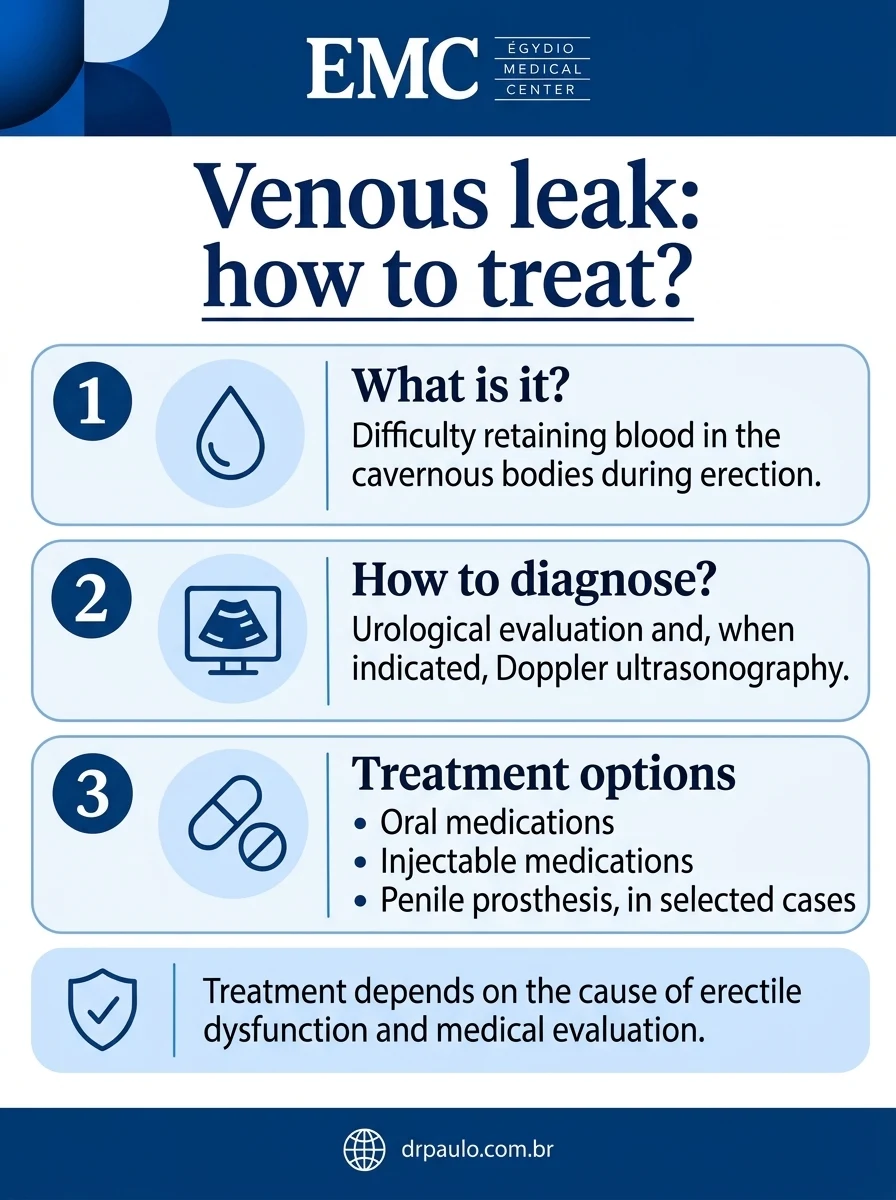
Venous leak, also called veno-occlusive dysfunction, occurs when the mechanism responsible for retaining blood in the corpora cavernosa during erection does not function properly. This alteration can make it difficult to maintain penile rigidity and may be associated with erectile dysfunction.
Loss of rigidity alone does not confirm the diagnosis of venous leak. Identification depends on medical assessment and specific tests.
What is the difference between venous leak and erectile dysfunction?
Penile venous leak is a dysfunction of the mechanism that helps retain blood within the corpora cavernosa during an erection. When this mechanism does not work properly, blood may not remain in the penis long enough to sustain rigidity.
Erectile dysfunction is the persistent difficulty in obtaining or maintaining an erection sufficient for satisfactory sexual activity. Venous leak is one possible cause of this condition, but it is not the only one.
How can I tell if I have a venous leak?
Difficulty achieving or maintaining an erection during sexual activity may be associated with a venous leak. However, these signs also occur in other forms of erectile dysfunction and are not sufficient to confirm the diagnosis.
To investigate the cause of the problem, the urologist reviews the medical history and may perform a physical examination to assess penile anatomy and identify possible abnormalities.
When indicated, a penile Doppler ultrasound can be ordered to evaluate arterial and venous blood flow. Interpretation of the test depends on the clinical context and the conditions under which it was performed.
Also see Main causes of erectile dysfunction and available treatment options.
What types of treatment are available for venous leak?
There are different approaches to treating erectile dysfunction, and the choice depends on the cause of the problem and each patient’s response. The video below presents general information about treatment options and the factors that should be considered, and the factors that should be considered.
Oral medications
Medications for erection, such as sildenafil and tadalafil, may be indicated to treat erectile dysfunction in certain patients. They enhance the erectile response but do not directly correct the veno-occlusive mechanism. Indication should take into account clinical assessment and any possible contraindications.
Injectable treatment
Injectable treatment may be considered when a patient’s response to oral medications has been unsatisfactory, or when oral agents are contraindicated, always following medical evaluation. Administration requires individualized guidance on dose, injection technique and potential complications. Learn more about the penile pump and penile injections and understand the differences between these approaches.
Penile prosthesis
A penile prosthesis may be considered in selected cases of erectile dysfunction, particularly when other treatments have not produced a satisfactory response, are not tolerated, or are not appropriate for the patient.
The device can provide mechanical rigidity to the penis without relying exclusively on the natural vascular mechanism to maintain an erection. Indication and choice of model depend on the clinical circumstances, patient expectations, and individualized assessment.
Learn about the Types of penile prostheses, their indications and how they work.
If you have persistent difficulty achieving or maintaining an erection, seek evaluation by a urologist to investigate possible causes. A Pre-assessment with Dr. Paulo Egydio can be a first step to discuss your case, and to learn about the options available.
Learn more:
- 09 Main Causes of Male Impotence and How to Treat
- How can erectile function be improved?
- See 12 practices to help achieve firmer erections
- Medication-Induced Erectile Dysfunction: Available Treatments
- Top 5 Supplements for Male Libido According to Studies
- Erectile Dysfunction: What It Is, Main Symptoms and Treatments (including causes such as venous leak)
- Sexologist or Urologist: Which Specialist to Consult First?
- Penile Pump and Penile Injections