
Penile enhancement is an aesthetic procedure that can use hyaluronic acid to increase circumference and improve penile symmetry.
The procedure is sought by men who wish to modify the appearance and penile proportions. Although hyaluronic acid is one of the most used materials, there are different techniques and substances, with differences in results, duration and risks.
In this article, understand how penile enhancement works, what results can be expected, how long the effects last and what the main risks are.
What is penile enhancement?
Penile enhancement comprises procedures intended to modify the appearance, proportion and symmetry of the penis, mainly by increasing circumference.
Changes can be performed with fillers, such as hyaluronic acid, or by surgical techniques. The indication and choice of material depend on individual characteristics and the patient’s goals.
How does penile enhancement work?
The technique varies according to the material used and the objective of the procedure.
Penile filler
Penile filler consists of the application of substances such as hyaluronic acid to increase the volume and circumference of the penis and, in some cases, improve asymmetries.
Before the procedure, an individual evaluation is required that considers physical examination, clinical history, expectations and possible risks.
Other materials
Male intimate penile enhancement may also use poly-L-lactic acid (PLLA) and autologous fat.
PLLA acts as a collagen biostimulator and cannot be dissolved after application. The effects are temporary and have variable duration.
Autologous fat, on the other hand, involves harvesting fat from the patient, usually from areas such as the abdomen and flanks, followed by application to the penile region.
A comparative analysis of studies on the hyaluronic acid and poly-L-lactic acid showed differences in circumference increase results in penile enhancement, but interpretation depends on the included studies, the protocols used and the follow-up period. More consistent data are needed to draw conclusions about comparative efficacy and long-term effects.
Permanent materials, such as PMMA (polymethylmethacrylate), are associated with risks of complications, including nodules and chronic inflammation.
The possibility of use should be evaluated according to applicable regulations, the clinical indication and the patient’s risk profile.
Penile harmonization techniques for penile enhancement
| Technique/material | Objective | Duration | Main point of attention |
|---|---|---|---|
| Hyaluronic acid | Increase circumference | Temporary | Need for reapplication |
| Poly-L-lactic acid | Increase volume | Temporary/semi-permanent | Evidence still limited |
| Autologous fat | Increase volume | Variable | Reabsorption and irregularities |
| Permanent materials | Volume increase | Permanent | Greater difficulty of reversal and complications |
Does penile enhancement increase the penis?
It can increase circumference, but penile enhancement does not aim to increase penis length.
Does it increase thickness?
Yes. The main goal of fillers for penile enhancement is to increase circumference or penile volume, although results vary between patients.
Increases length
No. Filler techniques do not lengthen the penis. The procedure can increase thickness, but that does not mean tissue elongation.
Read more: How to increase the penis: myths and truths about what you can do
How many centimeters can penile enhancement add?
There is no single number of centimeters that can be guaranteed. The result depends on the material, amount used, anatomy, technique and individual response.
A meta-analysis published in 2026, which pooled 23 studies and 2,620 participants, described results of circumference and complication rates for penile enhancement that varied according to modality and the studies included.
The values presented should be interpreted in light of methodology, protocol heterogeneity, follow-up time and evidence quality, and do not necessarily represent the risk or expected outcome for each patient.
Comparisons between materials are indirect and the certainty of the evidence varies.
How long does penile enhancement last?
Duration depends on the material used and individual characteristics. The most recent literature shows that protocols are heterogeneous and that standardized long-term studies are still lacking.
The initial result can also change after edema reduction and accommodation of the material in the tissues.
In the case of resorbable substances, effects gradually diminish as the body absorbs the material, and reapplication may be necessary for maintenance.
What are the risks of penile enhancement?
The risks of penile enhancement vary according to technique, material used and individual characteristics. Knowing them is important before deciding on the procedure.
Most common adverse effects of penile enhancement
May occur:
- pain;
- swelling;
- bruising;
- increased sensitivity;
- contour irregularities;
- nodule formation.
Complications requiring attention
A 2024 review analyzed 33 studies on penile enhancement and identified adverse events that were generally uncommon, but also serious complications in isolated cases.
Included among the events described are acute hypersensitivity, glans necrosis, sepsis, nodules, numbness and abscesses.
Depending on the complication, an intervention may be necessary to attempt to reverse the procedure.
What increases the risk?
Some factors can increase the likelihood of complications, such as:
- use of permanent materials or those without scientific support;
- inadequate amount of product;
- incorrect technique;
- performed by an unqualified professional;
- lack of medical follow-up.
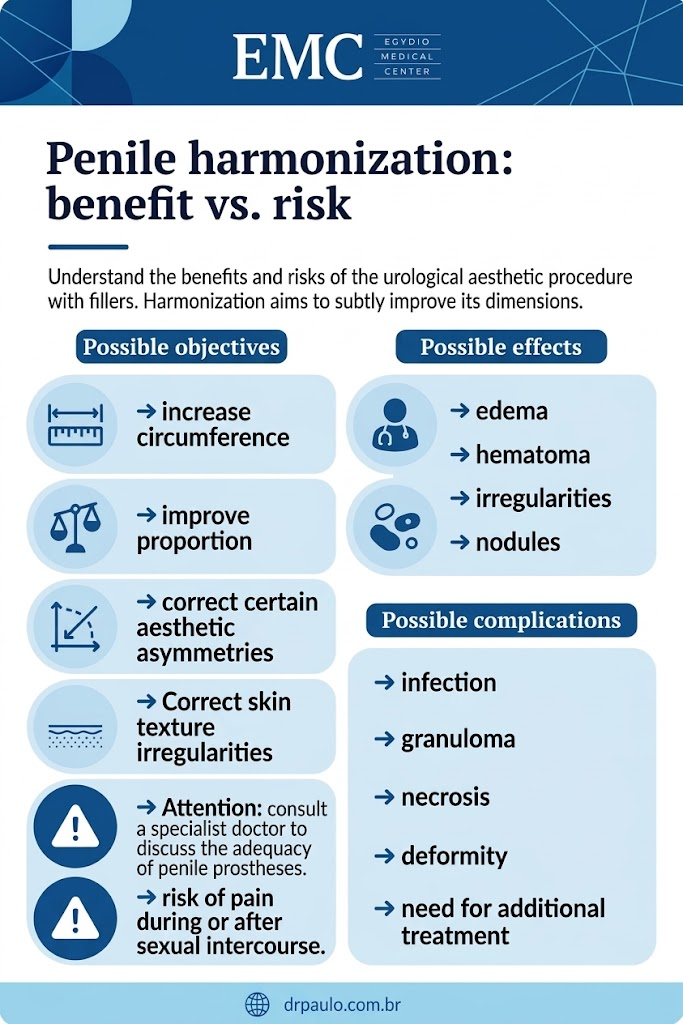
Which factors influence the safety of penile enhancement procedures for increasing circumference?
Safety in penile enhancement depends on several factors, including indication, material, technique, practitioner qualification and follow-up after the procedure.
Even with these precautions, complications can occur. Therefore, individual assessment is essential before undergoing penile enhancement.
What is the recovery like after penile enhancement?
Recovery time varies depending on the patient, the technique and the materials used for penile enhancement. There is no single timeframe for all cases.
Edema, bruising and sensitivity can influence recovery after penile enhancement. Hygiene measures, gradual resumption of activities and the period of sexual abstinence should follow the doctor’s instructions.
How much does penile enhancement cost?
The price depends on the technique, the material used, the practitioner’s experience, the clinic’s location and the necessary follow-up for penile enhancement.
Therefore, the cost should be determined after an individual assessment, before the procedure.
For whom can penile enhancement be considered?
The literature on penile enhancement highlights the importance of differentiating subjective dissatisfaction from conditions such as small penis syndrome.
Procedures intended for penile enhancement to modify circumference or correct asymmetries can be discussed with men who present this complaint, provided there is individual clinical assessment, information about risks and limitations, and realistic expectations.
The decision should not be based solely on aesthetic dissatisfaction.
When dissatisfaction is mainly related to the perception of size, and not necessarily to an anatomical alteration, a medical and, when indicated, psychological evaluation may be important before any penile enhancement procedure.
It is also necessary to check for possible contraindications and factors that increase the risk of complications.
When is penile enhancement not the best option?
Procedures aimed predominantly at modifying penile circumference should not be presented, by themselves, as treatment for erectile dysfunction, Peyronie’s disease, local lesions, penile curvature or deformities that may require reconstruction. When these conditions are present, specific medical investigation is necessary to define the appropriate management.
If the main complaint is related to erection, curvature or deformity, the investigation should first seek the cause.
The procedure is also not indicated for those seeking to increase penile length, as fillers act primarily on circumference.
Does penile enhancement treat erectile dysfunction?
No. Penile enhancement is primarily aesthetic and should not be presented as a treatment for erectile dysfunction.
Does penile enhancement treat Peyronie’s disease?
It is not considered a standard treatment for Peyronie’s disease. The disease involves a scarring and fibrotic alteration in the penis, which can cause penile curvature.
Is penile enhancement worthwhile?
Penile enhancement can be considered when the goal is to increase girth for aesthetic reasons, provided there is an indication, realistic expectations and no contraindications.
| It may make sense when… | Warrants caution when… |
|---|---|
| The goal is aesthetic | The expectation is to increase length |
| There are realistic expectations | There is a promise of guaranteed results |
| There is an individual medical evaluation | It is presented as a treatment for erectile dysfunction |
| The material is known and approved for medical use | The product is not clearly identified or is not approved |
| There is follow-up after the procedure | There is no post-procedure follow-up |
If you have questions about penile anatomy or male genital aesthetic procedures, seek information from a consult a qualified healthcare professional about penile enhancement and request a clinical assessment before making any decision.


