

Fluoxetine (fluoxetine for premature ejaculation) may be considered in some cases of premature ejaculation. Before prescribing the medication, however, it is important to investigate and treat possible underlying causes.
Fluoxetine (fluoxetine for premature ejaculation) is a medication used primarily in the treatment of depression. Its mechanism of action can also contribute to delaying ejaculation in some cases of premature ejaculation.
The prescription must be made by a physician, who can assess the indication, the possible benefits, the risks and the adverse effects of the medication.
Can fluoxetine be used for premature ejaculation?
Fluoxetine can increase the time to ejaculation in some men with premature ejaculation, but the response varies and the medication is not considered one of the main first-line options. The recommendations of the EAU should be interpreted in the context of clinical assessment and medical indication.
The guideline classifies oral SSRIs, including fluoxetine, as second-line alternatives and stresses that this is an off-label use, that is, outside the indications approved in the medication label.
Fluoxetine belongs to the class of selective serotonin reuptake inhibitors. Its effect on ejaculation is related to the modulation of serotonin activity in the nervous system, that is, the regulation of the activity of this neurotransmitter.
The indication depends on the type of premature ejaculation and on the clinical assessment.
In acquired premature ejaculation, which arises after a period of satisfactory ejaculatory function, the EAU advises first the investigation and treatment of possible associated causes, such as anxiety, urinary symptoms, hyperthyroidism, erectile dysfunction or prostatitis.
Fluoxetine (fluoxetine for premature ejaculation) is not considered a first-line treatment for acquired premature ejaculation. For lifelong premature ejaculation, present from the beginning of sexual life, the EAU recommends, as first-line options, dapoxetine or lidocaine/prilocaine spray, when indicated and available.
What is fluoxetine? (fluoxetine for premature ejaculation)
Fluoxetine is a medication used in the treatment of depression with or without associated anxiety, panic disorder, obsessive-compulsive disorder and for the prevention of episodes of bulimia nervosa.
Fluoxetine belongs to the class of selective serotonin reuptake inhibitors (SSRIs), which act by modulating the availability of this neurotransmitter in the nervous system. Serotonin participates in various processes, including the regulation of mood, appetite and sleep.
How can fluoxetine delay ejaculation? (fluoxetine for premature ejaculation)
The use of fluoxetine to delay ejaculation is related to the modulation of serotonin activity in the central nervous system.
As an antidepressant of the selective serotonin reuptake inhibitor (SSRI) class, the medication can influence the mechanisms involved in control of the ejaculatory reflex and, in some cases, increase the time to ejaculation.
However, the effect of fluoxetine on ejaculation does not occur simply by increasing serotonin in the brain. The medication also modifies the action of this neurotransmitter in areas of the nervous system involved in the control of ejaculation.
As a result, the ejaculatory reflex, which is the automatic bodily response that results in ejaculation, may take longer, delaying ejaculation.
What do studies say about fluoxetine and premature ejaculation? (fluoxetine for premature ejaculation)
| Evidence | What was evaluated | Main finding | Limitation |
|---|---|---|---|
| Clinical studies with fluoxetine | Fluoxetine vs. placebo | Increased time to ejaculation in some studies | Older studies and small samples |
Meta-analysis 2022 — fluoxetine for premature ejaculation |
Fluoxetine vs. other medications — fluoxetine for premature ejaculation |
More effective than placebo, but inferior to some SSRIs, such as sertraline and paroxetine | Only 10 comparative studies |
| Cochrane review | SSRIs in general | Improvement in symptoms and satisfaction | Lower certainty for IELT |
Umbrella review 2025 — fluoxetine for premature ejaculation |
Pharmacological treatments | Confirms benefit of pharmacological treatments, but notes heterogeneity | Variable study quality |
Is fluoxetine an approved treatment for premature ejaculation?
No. The use of fluoxetine for premature ejaculation is off-label. This means that the medication is authorized to be prescribed for a purpose different from that described in the package insert, but it should not be presented as a drug specifically for premature ejaculation.
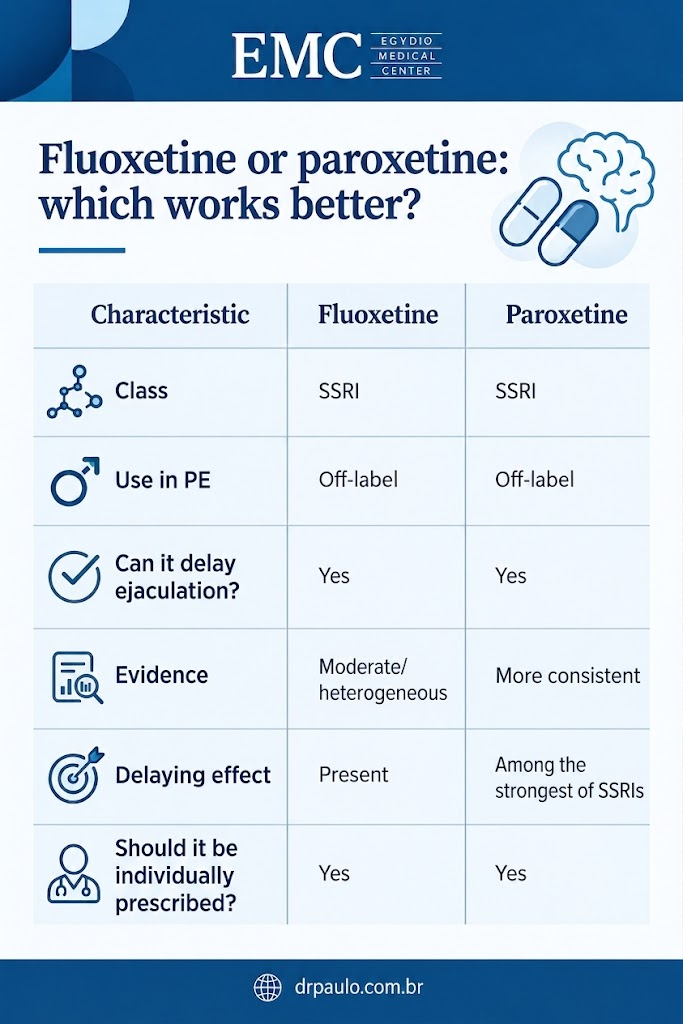
The EAU points to paroxetine as the SSRI with the greatest ejaculatory-delaying effect, although fluoxetine, sertraline and other SSRIs can also be used off-label.
Can fluoxetine cause sexual side effects?
Fluoxetine can cause sexual side effects, mainly changes in libido, difficulty achieving orgasm, changes in ejaculation and erectile dysfunction. These effects may vary according to the person and the dose used.
Can fluoxetine decrease libido?
Yes. Fluoxetine can cause unwanted effects on sexual function, including decreased libido. In men with depression, assessment of this effect may be more difficult, since the disorder itself can also affect sexual desire.
Can fluoxetine for premature ejaculation cause erectile dysfunction?
Fluoxetine can cause erectile dysfunction in some men. This effect may be related to changes in serotonin and dopamine activity, neurotransmitters that participate in the brain mechanisms involved in sexual desire and arousal and that influence the nerve responses necessary for erection.
Moreover, penile rigidity depends on vascular and neural mechanisms, including the participation of nitric oxide in the relaxation of blood vessels and the increase of blood flow to the penis.
Fluoxetine may be associated with changes in erectile function in some men, although the relationship may depend on several factors, including the condition being treated, other medications and individual characteristics.
Can fluoxetine make orgasm or ejaculation difficult?
Yes. Fluoxetine can make orgasm or ejaculation difficult in some men. As an SSRI antidepressant, the drug increases serotonin activity and this can interfere with the mechanisms associated with the sexual response.
Although fluoxetine for premature ejaculation can be used to help delay ejaculation, this effect can be excessive in some cases, making orgasm and ejaculation difficult or even preventing them.
How long does fluoxetine for premature ejaculation take to delay ejaculation?
Although the guideline of EAU – Sexual and Reproductive Health describes that fluoxetine can take between one and two weeks to delay ejaculation, the action of the medication is related to its effect on the nervous system, which can vary between patients.
Therefore, fluoxetine should not be understood as an immediate-effect drug, similar to a medication used exclusively before intercourse, such as drugs for erectile dysfunction.
Another factor that explains why it is not possible to determine when fluoxetine’s effects on ejaculation begin is that studies on SSRI antidepressants use different doses and treatment regimens.
Therefore, determining the dosage and treatment regimen, possible adjustments in drug administration or substitution should be evaluated by the physician.
Should fluoxetine for premature ejaculation be taken before intercourse?
Fluoxetine should not be used as an occasional medication or taken specifically before intercourse without medical guidance.
The use of fluoxetine for premature ejaculation is off-label, that is, it corresponds to a use for a purpose that is not specifically approved in the drug’s leaflet.
The indication, dose and therapeutic regimen must be defined by the physician after evaluation of the case.
Does fluoxetine cure premature ejaculation?
Fluoxetine does not cure premature ejaculation.
The medication can help control the symptom, but before prescribing it is necessary to assess whether premature ejaculation has been present since the beginning of sexual life or if it appeared after a period of satisfactory ejaculatory function.
It is also important to investigate possible associated factors, such as prostatitis, infections and other sexual or psychological aspects.
What are the treatments for premature ejaculation?
The EAU 2026 maintains the guidance to treat erectile dysfunction first, other sexual dysfunctions or genitourinary infections when present, and recommends dapoxetine or lidocaine/prilocaine spray as first-line for lifelong premature ejaculation.
| Treatment | Role in treatment |
|---|---|
| Dapoxetine | First-line in contexts where approved/available — fluoxetine for premature ejaculation |
| Lidocaine/prilocaine spray | First-line |
| SSRIs such as fluoxetine | Off-label alternative |
| Paroxetine | SSRI with a strong delaying effect, off-label |
| Behavioral/sexual therapy | Can complement treatment |
| Treatment of erectile dysfunction | Should be addressed when present |
| Treatment of associated causes | Priority in acquired premature ejaculation |
How to know if premature ejaculation needs treatment?
To determine whether premature ejaculation requires treatment, seek urological guidance; options may include behavioral approaches, topical anesthetics, or pharmacotherapy (e.g., fluoxetine for premature ejaculation) when appropriate.
At the consultation, the clinician will ask whether the problem has been present since the first experiences or developed over time.
They may also investigate the presence of erectile dysfunction or other sexual symptoms, the level of control over ejaculation, the time between the start of sexual activity and ejaculation, and the psychological impact caused by the problem.
When to see a urologist?
See a urologist when:
- premature ejaculation is recurrent;
- in cases of distress or impact on the relationship;
- recent onset;
- if associated with erectile dysfunction;
- if there is pain on ejaculation;
- presence of urinary symptoms;
- suspected prostatitis;
- use of medications that altered sexual function.
If symptoms are persistent, recurrent or cause distress, seek medical or urological evaluation, including consideration of fluoxetine for premature ejaculation.


