

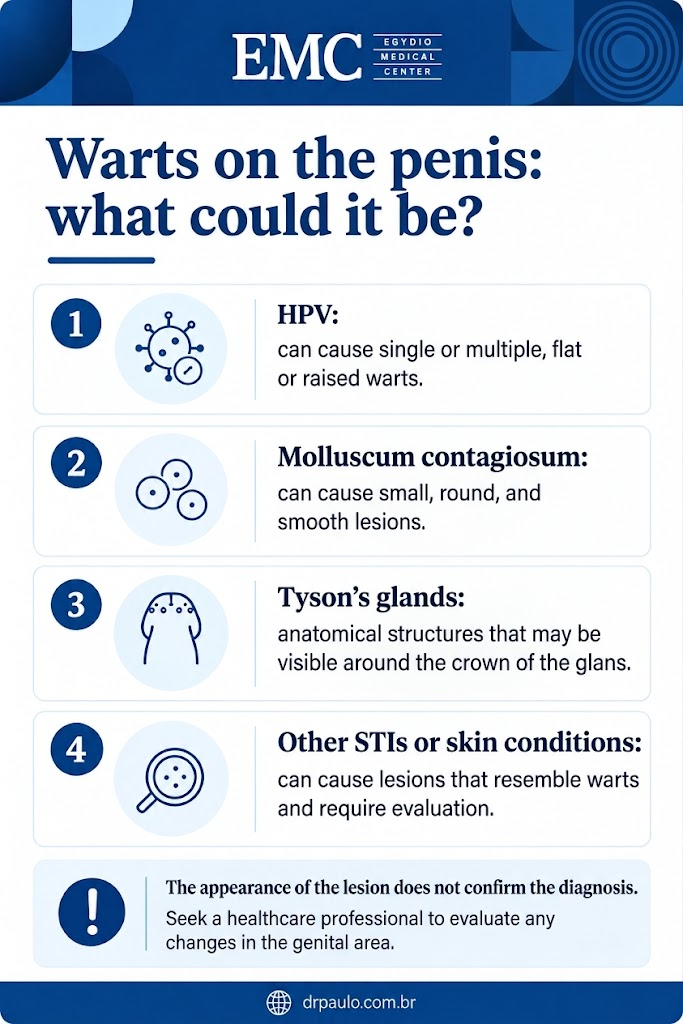
Warts on the penis (penile wart) may be associated with sexually transmitted infections such as HPV. Benign dermatological changes are other possible causes.
The appearance of the lesion alone does not confirm the cause. Evaluation by a healthcare professional helps differentiate the possibilities and determine whether treatment is necessary.
In this article, you will understand which conditions can cause these changes, how diagnosis is made, and what forms of treatment and prevention are available.
Is every penile wart caused by HPV?
No. Not every penile wart is caused by genital HPV.
HPV is a sexually transmitted infection caused by the human papillomavirus. The most characteristic symptoms are genital warts, which can have an irregular surface resembling a cauliflower. However, these lesions do not usually appear in the initial phase of the infection.
In addition, not every genital lesion is caused by HPV or another STI.
Other conditions can also cause lesions that resemble warts. One of them is molluscum contagiosum, a viral dermatological infection that causes small rounded bumps without the wrinkled appearance of HPV.
Tyson’s glands can also be mistaken for genital warts. These structures are small whitish or skin-colored bumps located around the head of the penis. Tyson’s glands produce an oily substance that contributes to lubrication of the area.
Although not every penile wart is a sign of an STI, it is important to seek medical advice as soon as any change is identified in the genital area. Evaluation allows identification of the cause of the lesions and recommendation of appropriate treatment, if necessary.
What do penile warts caused by HPV look like?
Genital warts caused by HPV can be single or multiple, flat or raised, and vary in size. Some have an irregular surface that may resemble a cauliflower. They can appear on the shaft of the penis, on the glans, under the foreskin, on the scrotum, and in other genital areas or near the anus.
Many lesions do not cause symptoms, but some may cause itching, irritation, or discomfort. The absence of pain does not rule out the need for evaluation, and appearance alone is not sufficient to confirm that it is HPV.
What other conditions can resemble a penile wart?
Molluscum contagiosum, Tyson’s glands, and syphilis are conditions that can cause genital lesions similar to warts.
Molluscum contagiosum is a viral dermatological infection caused by a poxvirus. The lesions resemble small pearls, usually the patient’s skin color, and can become reddened if they become inflamed.
Tyson’s glands can also be mistaken for genital warts. These structures are small whitish or skin-colored elevations located around the glans. Their appearance can vary and, if there is any doubt about a genital change, it is advisable to seek evaluation by a healthcare professional.
Finally, syphilis can also cause lesions that resemble warts. Syphilis is a sexually transmitted infection transmitted by the bacterium Treponema pallidum.
According to the Ministry of Health, a sore appears between 10 and 90 days after infection. This lesion is called a “hard chancre”, initially painless, which does not itch, does not burn, and has no pus.
Genital lesions can have numerous causes and similar appearances. Identifying the cause requires evaluation by a qualified healthcare professional.
What are the other symptoms of HPV in men?
HPV can remain asymptomatic for a prolonged period. When manifestations appear, the most characteristic are genital warts, including penile warts, which may not cause pain but, in some cases, cause itching or irritation.
To determine whether a penile wart is caused by HPV, medical evaluation is necessary. Even when the diagnosis confirms the infection, it is not possible to determine when the virus was acquired.
How is HPV transmitted?
HPV is transmitted mainly through direct contact with infected skin or mucous membranes during vaginal, anal, or oral sex, even without penetration.
The incubation period of HPV varies from person to person, but the virus can also remain without clinical manifestations for years.
Using a condom reduces the risk of HPV transmission and of other sexually transmitted infections, but it does not completely eliminate that possibility.
This is because the virus can be present in areas not covered by the condom, such as the pubic region and the scrotal sac.
How is a penile wart diagnosed?
The diagnosis of genital warts is usually made through a clinical examination performed by a urologist or another qualified health professional. During the consultation, the physician examines the genital lesions considering characteristics such as shape, texture, and location.
Because the infection is often asymptomatic in many cases, there are not always visible lesions that allow identification of HPV by clinical examination. For this reason, the physician may request complementary tests, such as a biopsy. Tests for other sexually transmitted infections may also be indicated.
How to treat a penile wart?
Treatment of genital warts varies according to the type, size, number, and location of the lesions.
Options include topical medications, cryotherapy, cauterization, or surgical removal. Understand:
- Topical medications: ointments, creams, or chemical substances, such as acids, prescribed by the doctor and that should be applied directly to the lesion area;
- Cryotherapy: uses freezing to destroy the wart tissue;
- Cauterization or surgical removal: may be considered when lesions are advanced or have not been eliminated with topical medications or cryotherapy;
- Other local treatments: the application of fractional CO2 laser therapy, for example, is a therapeutic alternative in cases of extensive lesions. Although the CO2 laser is presented as more precise, a 2019 meta-analysis highlights that there is still no evidence to establish a hierarchy among treatments.
Another important factor is that removal of the lesions does not necessarily mean elimination of the virus nor does it completely prevent transmission. The treatment aims to control or remove the lesions, but they may reappear.
It is also important to emphasize that some genital warts (including a penile wart) disappear spontaneously, but it is not possible to reliably predict which will regress without treatment.
What can happen if genital warts, including a penile wart, are not treated?
When HPV-associated warts are not treated, they can increase in size or appear in nearby areas, although the course varies from person to person (for example, a penile wart may enlarge or spread). Itching, pain, bleeding or discomfort may occur, especially with local irritation.
The need for—and the type of—treatment depends on clinical assessment.
In more severe cases, persistent infection with high-risk HPV can be associated with the development of genital cancer, such as penile cancer, according to the WHO information sheet updated in 2024. However, this does not mean that every case of HPV will progress to cancer.
The presence of genital warts, including a penile wart, can be associated with an increased risk of transmitting HPV to sexual partners. The absence of treatment for lesions alone does not allow one to conclude that the virus will remain active or that transmission will occur, but guidance on prevention and medical evaluation is important.
Therefore, genital warts should be assessed by a healthcare professional, who can discuss the need for treatment, preventive measures and appropriate follow-up for each case.
How can HPV and genital warts, including a penile wart, be prevented?
Using condoms helps reduce the risk of HPV transmission but does not provide full protection against the virus. Vaccination is also an important preventive measure, according to the Ministry of Health guidelines.
Check the current schedule or contact a health unit to verify whether vaccination is recommended for you.
If genital warts appear, including a penile wart, it is essential to seek specialized care for lesion assessment and investigation of other sexually transmitted infections when indicated.
Medical evaluation can also clarify the relationship between certain HPV types and changes that, in some contexts, are associated with penile cancer.
The presence of HPV does not mean that a man will develop cancer, and the risk depends on the virus type, persistence of infection and other clinical factors.
When to see a doctor for a penile wart?
It is important to seek urological evaluation when bumps, sores, spots or other changes that may affect penile health, even when there is no itching, pain or change in appearance.
It is also essential to avoid attempts to remove lesions on your own and not to use medications without medical guidance, as these practices may worsen the condition.
Warts on the penis can be associated with different conditions, including sexually transmitted infections such as HPV. Urological evaluation allows identification of the causes of the lesions and the most appropriate therapeutic approach for each case.
In case of genital changes, seek evaluation by a healthcareprofessional qualified to clarify the cause and discuss appropriate management.
Learn more:
- What are the most common prostate diseases and their symptoms?
- Types of penis: what they are, differences, myths and curiosities
- Male Masturbation: Benefits and Myths Debunked
- Male Hormones That Influence Your Health
- 10 Tips to Improve Sexual Performance When It Counts
- What Is Ejaculation? Answers to Your Main Questions
- What Is Andropause? Signs, Symptoms and Treatments
- Get to Know the 4 Penile Surgeries: Are They Effective?
- Anatomy of the Penis: Structure, Erection and Ejaculation
- Top 10 penile diseases, including penile wart: what they are, how to identify and treat
- Penile Pain: 12 Causes, Symptoms and Treatments (including penile wart)
- Male sexual health: 7 habits that affect your performance and how to improve


