
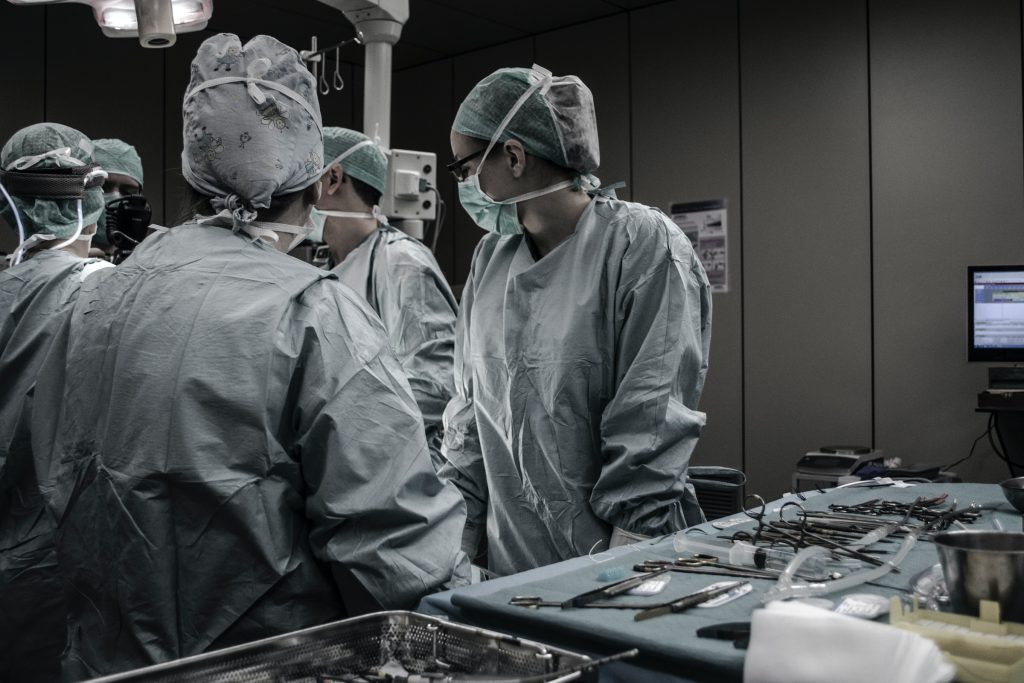
Penile reconstruction surgery aims to restore the penis, treating deformities that may affect it. The technique varies according to each case, and recovery usually requires specialized follow-up.
Penile reconstruction surgery is a procedure indicated to restore the anatomy and functionality of the penis in cases of thinning, curvature, shortening, or other deformities resulting from severe penile curvature, trauma, congenital alterations, or complications from previous surgeries.
The procedure may also be recommended for men with erectile dysfunction associated with penile curvature, allowing correction of deformities before penile prosthesis implantation.
Below, understand how penile reconstruction surgery is performed, learn about the main techniques used, what recovery is like, and what results can be expected.
What is penile reconstruction surgery?
Penile reconstruction surgery is a procedure that aims to restore penile anatomy and functionality, correcting deformities such as curvature, thinning, and shortening that can compromise sexual function.
Additionally, the surgery is also an alternative for men who have not achieved results with erectile dysfunction medications or who cannot use them due to contraindications.
When is penile reconstruction surgery indicated?
Penile reconstruction surgery is indicated for severe cases of Peyronie’s Disease to correct pronounced curvature, thinning, and shortening.
The procedure may also be recommended for men with congenital curvature, who have suffered trauma to the organ, or who present complications resulting from previous surgeries.
In addition to correcting anatomical alterations, penile reconstruction surgery may be indicated for men with erectile dysfunction who have not achieved satisfactory results with medications, experience significant side effects, or have contraindications to these treatments, such as certain cardiovascular diseases, for example.
Regardless of the indication, penile reconstruction does not aim to increase the size of the member. The procedure seeks to recover penile anatomy and functionality, allowing an erection with adequate rigidity and improving sexual function.
Advanced Peyronie’s Disease
In many cases, the advanced stage of Peyronie’s Disease occurs when the angle of penile curvature reaches 50º or more, especially if there is difficulty with sexual intercourse. At this stage, the penis may present thinning, narrowing, or shortening, alterations that compromise anatomy and functionality.
However, Peyronie’s Disease can also be considered in an advanced stage even when the curvature is less than 50º. Compromise of sexual function and quality of life also determine the severity of the condition.
Trauma and penile accidents
Post-trauma penile reconstruction may be recommended for men who have suffered trauma or accidents with potential to affect anatomy and functionality.
Injuries resulting from traffic accidents, gunshot wounds, or burns are examples of trauma that may require reconstructive surgery.
Congenital deformities
Congenital curvature occurs due to a failure in the development of penile tissues during gestation. This type of curvature becomes noticeable during puberty, the phase when erections begin to occur.
Penile correction surgery for congenital curvature is indicated when the deviation is pronounced and compromises sexual function, making or preventing penetration difficult.
Complications from previous surgeries
Thinning, shortening, and scar tissue formation are complications that may occur after surgery for Peyronie’s Disease, correction of congenital curvature, penile prosthesis surgery, or urethral reconstruction procedures.
In these situations, penile reconstruction surgery aims to restore anatomy and functionality, providing better conditions for urination and sexual activity.
What conditions may require penile reconstruction?
Severe curvatures, penile shortening, urethral injuries, and loss of penile tissue are conditions that may require penile reconstruction. Understand:
Severe penile curvatures
Severe penile curvatures are characterized by significant deformities that compromise both anatomy and functionality, such as thinning, hourglass-shaped narrowing, and shortening.
When the curvature is severe, loss of penile tissue may occur and the use of medications or performance of exercises are not sufficient. Penile reconstruction surgery recovers the structure and, in patients with associated erectile dysfunction, the procedure can prepare the penis for penile prosthesis implantation.
Penile shortening
Penile reconstruction may be indicated when shortening is associated with severe deformities or when it limits sexual activity.
The objective of reconstruction surgery is not to increase size, but to correct structural alterations and, when possible, attempt to recover part of the lost length.
Urethral injuries
Urethral injuries can occur after urological surgeries, penile fractures, and accidents. These injuries cause urethral narrowing, recurrent infections, and compromise of sexual function.
Penile reconstructive surgery may be necessary when urethral injury compromises penile anatomy. The procedure aims to restore the structure of the penis and urethra to recover urinary and sexual function.
Loss of penile tissue
Loss of penile tissue means that the skin, subcutaneous tissue, or internal structures of the penis suffer damage or are removed.
Depending on the extent of the loss, the man may present deformities, have difficulty urinating, and present erectile dysfunction.
Penile reconstruction may involve the use of grafts and its objectives are to correct deformities and provide improvement in sexual function.
How is penile reconstruction surgery performed?
The way penile reconstruction surgery is performed depends on the cause of the deformity, the degree of anatomical compromise, and the presence or absence of erectile dysfunction. Understand:
Evaluation and surgical planning
The evaluation consists of analyzing factors such as the angle of curvature, thinning, shortening, tissue loss, the presence of urethral injuries, and the impact of these complications on sexual and urinary functions.
Based on this information, the urologist develops an individualized surgical strategy, defining the most appropriate technique to restore penile anatomy and functionality.
Techniques used by the urologist
The technique used depends on the cause of the deformity, severity of the problem, and treatment objectives.
The urologist may combine techniques to correct curvature, restore part of the length and thickness, reconstruct the urethra, or recover areas with tissue loss.
One of the main techniques consists of using grafts to repair defects in the tunica albuginea and flaps for reconstruction of areas with loss of skin or subcutaneous tissue.
Use of grafts and prostheses
Grafts and penile prostheses are resources of penile reconstruction surgery in cases of severe curvatures, shortening, tissue loss, or associated erectile dysfunction. The choice of technique or combination depends on the origin of the deformity and the degree of anatomical and functional compromise.
Penile reconstruction with graft aims to reverse tissue loss and repair the tunica albuginea without causing greater penile shortening.
Penile prosthesis is indicated for men with Peyronie’s Disease who present compromise of erectile function. Reconstruction repairs penile anatomy and prepares the member for prosthesis insertion. Performing reconstruction before the prosthesis increases the chances of recovery of penile functionality.
Surgery time and hospitalization
Penile reconstruction surgery time varies according to the complexity of the case and techniques employed.
Simpler procedures usually last between 2 and 3 hours, while more complex surgeries, involving use of grafts, urethral reconstruction, or penile prosthesis implantation, may take more than 4 hours.
Hospitalization time is 24 to 48 hours, and may be longer in cases of extensive reconstructions or when the patient presents a condition requiring hospital follow-up, such as cardiovascular diseases.
Medical discharge occurs after evaluation of initial recovery, pain control, and absence of complications.
What techniques can be used in penile reconstruction?
- Reconstruction with grafts: penile reconstruction with graft is indicated for men with Peyronie’s Disease or defects in the tunica albuginea. The surgeon removes the fibrosis plaque and the defect produced by this action is corrected with tissue removed from the patient’s own body or with some acellular biomaterial, which are biological materials processed to reduce the risk of rejection.;
- Correction of penile deformities: can be done with plication, a technique where the tunica albuginea is folded and sutured on the side opposite the curvature to align the penis in less severe cases. Another surgical alternative is incisions in the hardened area to relax the site.
- Urethral reconstruction:indicated when the urethra – the channel through which urine exits – suffers injuries, narrowing, or loss of a section. Urethral reconstruction can be done by joining the two ends of the urethra, with the use of grafts.
- Association with penile prosthesis: recommended in cases of erectile dysfunction associated with Peyronie’s Disease, or in contexts where the man presents difficulties with erection without penile curvature, but does not respond to medications or has some restriction to this type of treatment.
How much does penile reconstruction cost?
It is not possible to establish a fixed value for penile reconstruction surgery. This is because each procedure is highly personalized, according to the severity of the deformity, type of prosthesis, and penile surgical techniques employed.
Additionally, it is necessary to consider in this calculation the value of medical consultations, performance of exams, medications, hospital costs, medical team, and anesthesia, if there is no health insurance coverage.
Taking into account all expenses, penile reconstruction surgery can have a high cost, varying according to the complexity of the procedure and resources used.

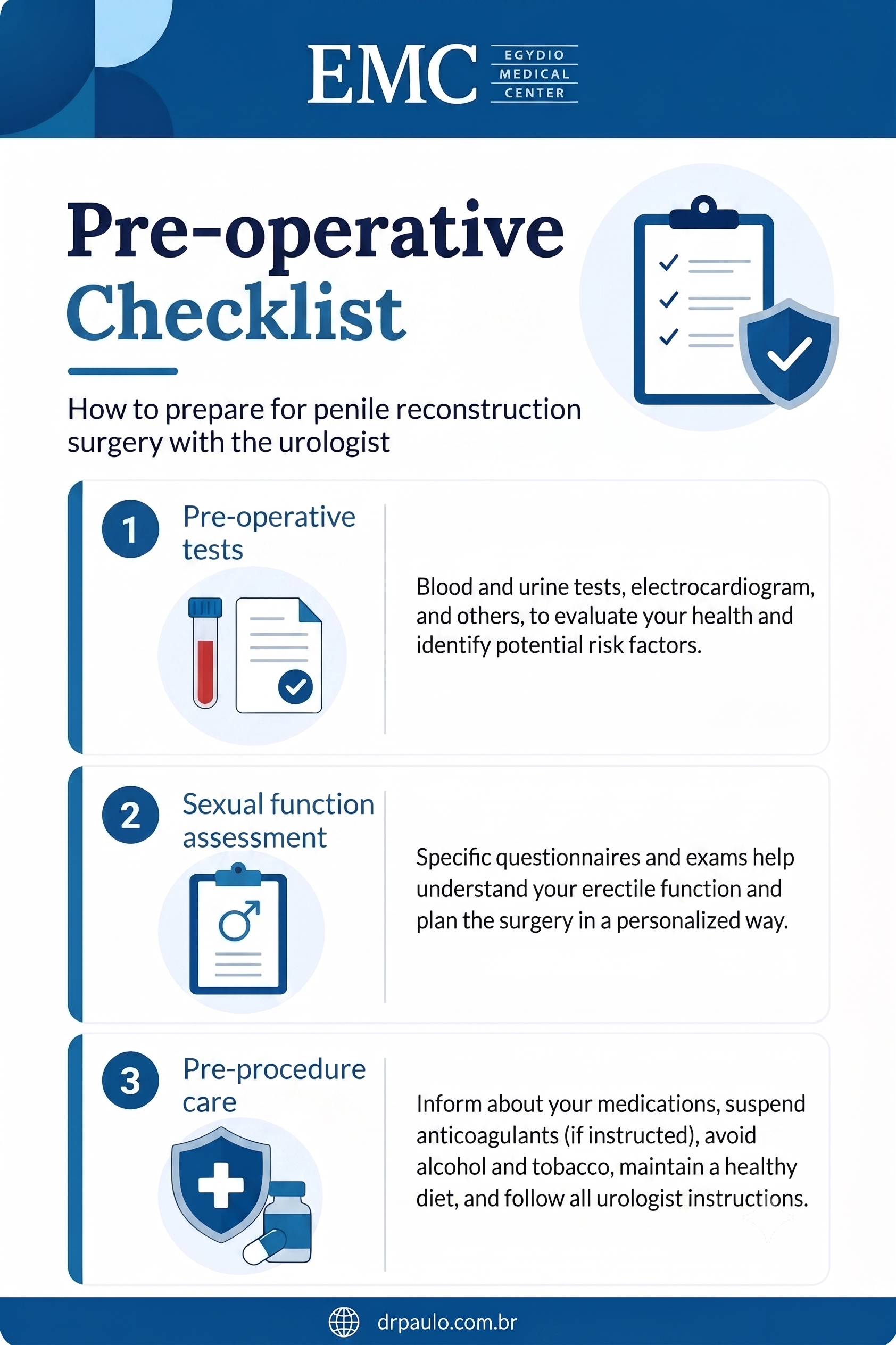
How to prepare for surgery?
What is the recovery from penile reconstruction surgery like?
Penile reconstruction surgery recovery timeline
| Period | What to expect | Recommended care |
|---|---|---|
| First days after surgery (1st week) | Swelling, bruising, local sensitivity, and mild to moderate discomfort are common. The patient usually remains in relative rest. | Strictly follow medical guidelines, maintain local hygiene, use prescribed medications, and avoid physical exertion. |
| Wound care (2nd to 4th week) | Swelling tends to decrease gradually and healing progresses progressively. Stitches may begin to be absorbed or removed, depending on the technique used. | Avoid intense physical activities, trauma to the genital region, and maintain wound care and hygiene as directed by medical staff. |
| Return to work (2nd to 6th week) | The timeframe varies according to the type of surgery and professional activity performed. Administrative work usually allows earlier return than activities requiring physical exertion. | Return only with medical authorization and respect any limitations during recovery. |
| When to resume sexual activity (4th to 8th week or more) | Clearance for sexual relations depends on complete healing and surgeon evaluation. In more complex procedures, this period may be longer. | Do not resume sexual activity without medical guidance, as this may compromise healing and surgery results. |
What are the risks of penile reconstruction surgery?
Penile reconstruction surgery is considered a safe procedure when performed by a urologist with experience in reconstructive surgery.
However, like any surgical procedure, it presents risks and possible complications. Learn what are the main risks of penile reconstruction surgery and what can be done to minimize them.
Possible complications
Complications of penile reconstruction surgery vary according to the technique used, the complexity of the procedure, and the patient’s health conditions.
The most common complications are infection, bleeding, bruising, stitch opening, persistent pain, prolonged swelling, altered sensation, and recurrence of curvature and residual shortening.
Specifically in penile reconstruction with graft, the main complication is persistence of the deformity. When reconstruction is associated with penile prosthesis, infections and mechanical failures of the device may occur.
Altered sensation
After surgery, some men may experience changes in penile sensation due to nerve manipulation during the procedure. Generally, these changes are temporary and improve gradually throughout penile reconstruction recovery.
Need for new procedures
Although most patients achieve good results with just one surgery, some cases require complementary procedures.
Such need is common in complex reconstructions performed on men with significant tissue loss, or when Peyronie’s Disease progresses after surgery.
Therefore, post-operative follow-up is essential to evaluate recovery progress and identify early complications that may require another intervention.
What results can be expected?
- Functional recovery: penile reconstructive surgery seeks to restore penile anatomy and functionality, correcting deformities that interfere with erection, penetration, or urination.
- Aesthetic improvement: penile reconstruction does not increase penis size, however, it corrects deformities, which provides a more symmetric and natural appearance.
- Impact on quality of life: by restoring anatomy and functionality, surgery can improve the patient’s sexual life, positively impacting well-being and self-esteem.
When to see a specialized urologist?
See a urologist whenever there are persistent changes in penile anatomy or function. Progressive curvature, pain during erection, difficulty with erection, thinning, narrowing, shortening, and difficulty urinating are signs that need to be investigated.
Early diagnosis is essential to identify the cause of the problem and indicate the most appropriate treatment before alterations worsen or compromise sexual life and urinary function.
Fill out the pre-analysis form to schedule your consultation with Dr. Paulo Egydio, urologist specialist in penile reconstruction surgery.
Learn more:
- What are the most common prostate diseases and their symptoms?
- Types of penis: what they are, differences, myths and curiosities
- Male Masturbation: Benefits and Myths Unveiled
- Male Hormones that Influence Your Health
- 10 Tips on How to Improve Sexual Performance in the Moment
- What Is Ejaculation? Answers to Your Main Questions
- What is Andropause? Signs, Symptoms and Treatments
- Penis Anatomy: What is the Structure, Erection and Ejaculation
- 10 main penile diseases: what they are, how to identify and treat
- Penis Pain: 12 Causes, Symptoms and Treatments
- Men’s sexual health: 7 habits that affect your performance and how to improve