
Penile traction therapy for Peyronie’s Disease can help reduce penile curvature, preserve or recover penile length and improve sexual function.
Penile traction therapy is a non-surgical treatment that applies continuous and controlled force on the penis, either manually or with the aid of a specific device.
Below, understand when penile traction therapy may be indicated for Peyronie’s Disease, what scientific studies show and what results can be expected.
What is penile traction therapy?
Penile traction therapy is a non-surgical treatment that applies controlled force on the penis to stimulate tissue remodeling.
In Peyronie’s Disease, it can help preserve penile length and reduce the progression of curvature, especially when combined with other treatments.
In addition to Peyronie’s Disease, the therapy can also be indicated for men who experience penile shortening after prostate removal surgery.
Who is the treatment indicated for
Penile traction therapy is indicated mainly in cases of patients with Peyronie’s Disease.
In general, this alternative is recommended when the fibrosis is not yet scarred, as a complement to other treatments that seek to maintain the patient’s penetrative function.
Penile traction can be performed in two ways:
- Manual traction: consists of applying gentle traction to the flaccid penis, following the technique and time guided by the urologist.
- Traction with device: uses a specific device that maintains continuous and controlled force on the penis. The equipment should be used according to the manufacturer’s and doctor’s instructions.
During treatment, any sign of intense pain, numbness, skin color change or injury should be evaluated by the urologist before continuing use.
Are penile traction and penile pump the same?
No. The penile traction device and the penile pump are different devices with different purposes.
- Penile traction: applies continuous force on the penis to stimulate tissue remodeling. In Peyronie’s Disease, it can help preserve or recover penile length and reduce the progression of curvature. Results depend on regular use for weeks or months.
- Penile pump: uses a vacuum system to temporarily increase blood flow and oxygenation to the penis, helping to achieve erection. In Peyronie’s Disease, it can be indicated as complementary therapy and in penile rehabilitation, with immediate effect during use.
How does penile traction therapy work for Peyronie’s Disease?
It can be performed manually or with the aid of a specific device, the latter being the most commonly used method in treating Peyronie’s Disease.
The goal is to apply continuous and controlled force on the penis to stimulate remodeling of the tunica albuginea, the tissue that surrounds the corpora cavernosa. With this, the therapy can help preserve penile length and partially reduce curvature.
In manual traction, stretching is performed with the flaccid penis, following the technique and time guided by the urologist. Traction devices, on the other hand, maintain constant tension and should be used according to the manufacturer’s and doctor’s recommendations.
How long should the penile traction device be used?
The duration of treatment varies according to the stage of Peyronie’s Disease, the severity of the curvature and each patient’s response. In general, studies evaluate usage periods between 3 and 6 months, but the ideal time should be determined by the urologist.
How many hours should penile traction be used?
The most commonly used protocols in studies recommend using the device for 4 to 6 hours per day. However, there is no single protocol, and daily time can be adjusted by the urologist according to each patient’s needs and tolerance.
Who can undergo penile traction therapy?
Penile traction therapy should be indicated by a urologist after individual evaluation. Although it is more commonly used in the acute stage of Peyronie’s Disease, it can also be recommended in specific situations in the chronic stage.
Indications in the acute stage
The therapy can be indicated for men who present:
- Peyronie’s Disease in the initial stage, with fibrosis plaques still forming;
- Progressive curvature, pain during erection or loss of penile length;
- Need to preserve penile length;
- Indication of combined treatment with medications or other non-surgical therapies.
Indications in the chronic stage
In some cases, penile traction can also be recommended for:
- Men with stable curvature for several months;
- Patients with loss of penile length;
- Preserve or recover part of penile length before or after surgical procedures.
When is penile traction therapy not indicated?
Treatment is generally not recommended in the following situations:
- Presence of intense pain, wounds, infections or injuries on the penis;
- Very pronounced curvature that makes device use difficult;
- Contraindications identified by the urologist during evaluation.
Does penile traction therapy work?
Yes. Studies indicate that penile traction therapy can help reduce curvature in men with Peyronie’s Disease, especially when used regularly and according to medical guidance.
A scientific review that brought together five studies with average follow-up of six months concluded that the therapy contributed to improvement in penile curvature.
Regarding penile length, some studies observed gains of up to 1.8 cm, but evidence is still limited and does not allow confirming this benefit consistently.
Therefore, researchers highlight the need for further studies to better evaluate the therapy’s effect on penile length recovery. 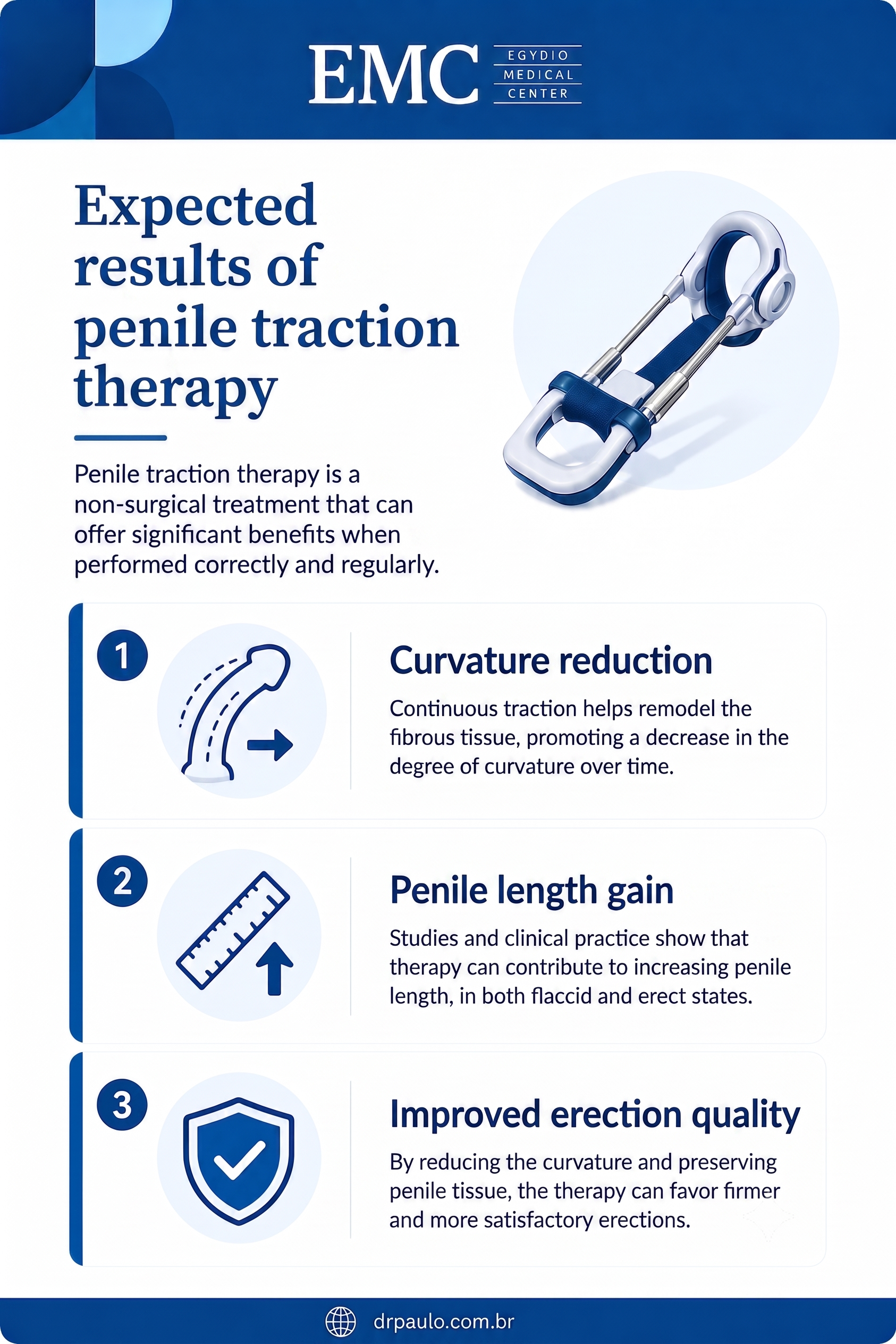
What are the limitations of traction therapy?
Limitations of penile traction therapy
| Limitation | What do medical evidences say? |
|---|---|
| Treatment adherence | Effectiveness depends on regular device use. The greater the adherence to medical guidance, the greater the chances of obtaining benefits. |
| Duration of use | Studies show better results in patients who used the device for several hours a day, for months, according to urologist guidance. |
| Variable results | Response to treatment depends on factors such as the stage of Peyronie’s Disease, the severity of penile curvature, the type of device used and the patient’s individual characteristics. |
When to see a urologist?
See a urologist if you notice progressive penile curvature, pain during erection, difficulty maintaining sexual intercourse or erectile dysfunction.
Specialized evaluation allows identifying the stage of Peyronie’s Disease and indicating the most appropriate treatment for each case.
Learn more:
- Surgery for Peyronie’s Disease: Risks and Recommendations
- Sex With Peyronie’s Disease: 8 Tips For A Full Sexual Life
- Penile Fibrosis: Symptoms, Causes and Treatments
- Penis Pain: 12 Causes, Symptoms and Treatments