

Penile fibrosis refers to rigid scars that can cause curvature and affect male sexual performance.
Penile fibrosis is a condition characterized by an abnormal excess formation of fibrous tissue. When this tissue develops in the penis, a man may experience impairments in his sexual life.
Penile fibrosis can be associated with different causes, and diagnosis should be made by a urologist or another qualified health professional. If you notice changes in the penis, seek clinical evaluation. The consultation allows investigation of the condition and discussion of follow-up and treatment options, when necessary.
What is penile fibrosis?
Penile fibrosis is the accumulation of fibrous tissue in the tunica albuginea.
The fibrous tissue is composed mainly of collagen. Under normal conditions, collagen is part of the structure of the tunica albuginea and contributes to its strength and elasticity. But in fibrosis, there is an excess of collagen deposited abnormally and rigidly in the area.
The excess fibrous tissue can reduce the elasticity of the tunica albuginea and limit expansion during erection, contributing to deformities that may be more visible when the “penis is erect. In some cases, the curvature can hinder penetration during sexual intercourse.
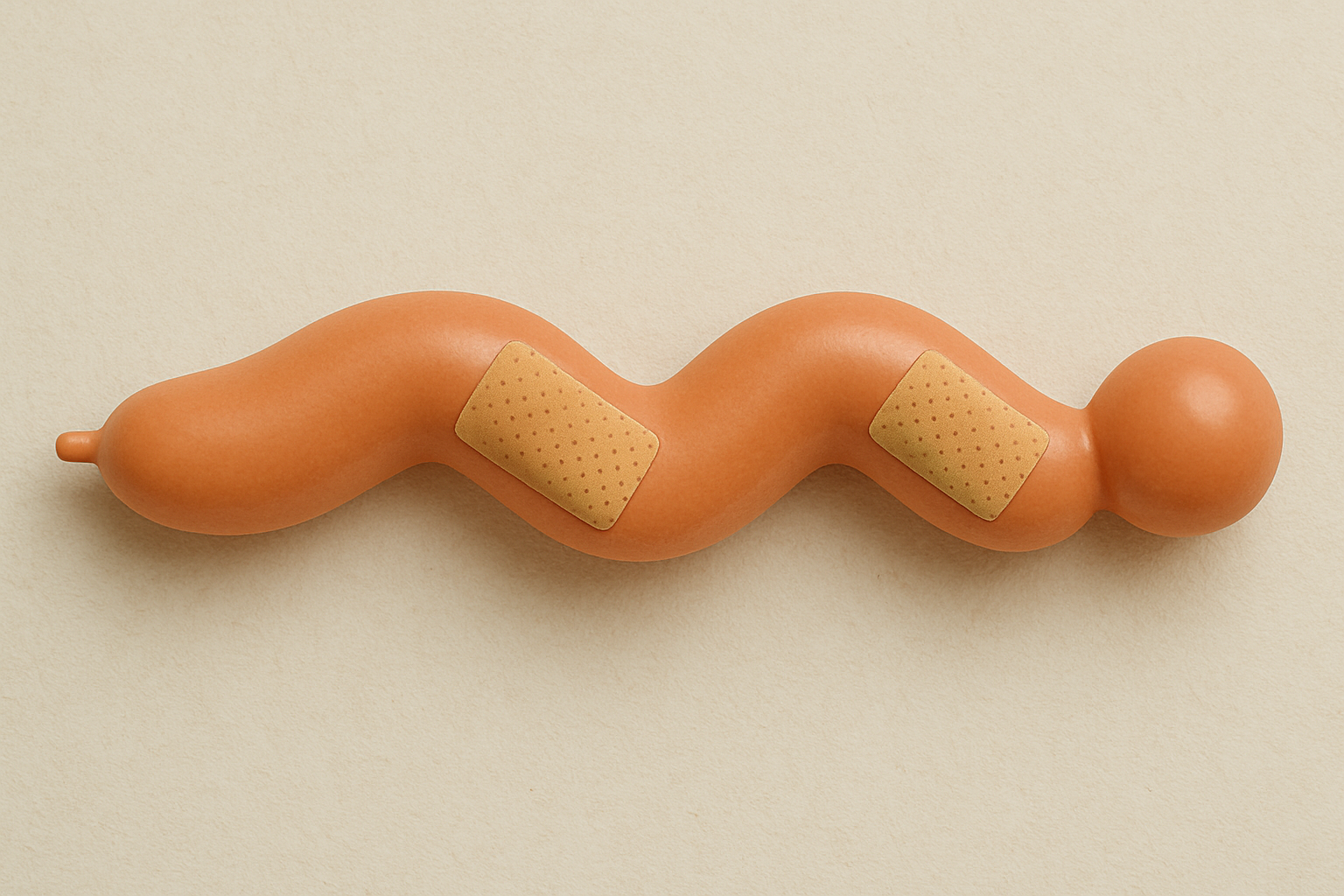
An analogy that helps to understand what fibroses do to the penis is to imagine a balloon with adhesive tape stuck to its surface. When inflated, the area covered by the tape does not expand and becomes deformed.
In some cases, fibrosis of the tunica albuginea can also compromise the maintenance of an erection by impairing blood retention in the corpora cavernosa, impacting penile rigidity and sexual function.
What causes penile fibrosis?
Penile fibroses can be associated with different conditions, including Peyronie’s disease, trauma, and other clinical factors. The relationship between specific activities, such as sexual intercourse, masturbation, penis positioning, or wearing tight clothing, and fibrosis formation should be evaluated individually, as it is not always possible to establish a direct cause.
However, penile fibrosis may also be associated with other conditions, for example:
- Peyronie’s disease;
- Diabetes;
- High blood pressure;
- High cholesterol;
- Excessive force on the penis when sleeping on the stomach;
- Lack of lubrication;
- Pelvic surgeries, such as prostate removal surgery.
Types of penile fibrosis
The main types of penile fibrosis are:
| Type of fibrosis | Characteristics |
| Superficial penile fibrosis | Classic form of penile fibrosis, it affects the tunica albuginea of the penis, causing curvature upward, to the sides and/or downward. |
| Fibrosis intracavernous | It affects the corpora cavernosa, prevents their dilation, leading to loss of vertical rigidity and difficulty with penetration. In general, this penile fibrosis is responsible for penile thinning. |
| Localized penile fibrosis | It can form at a single point of the penis, such as at the base, in the middle or at the tip, resulting in tortuosity or thinning. |
| Diffuse penile fibrosis (2+ sites) | It occurs when fibroses develop in multiple regions, leading to various deformities, such as two or more curvatures and/or thinnings. |
| Plaque calcification | They can occur in various parts of the penis, possibly located on the top, the sides, or the tip of the organ. |
It is important to emphasize that any sign of penile fibrosis should be examined by a urologist and, if necessary, treated.
How to identify penile fibrosis?
The identification of hardened areas or nodules may prompt a clinical evaluation, but palpation performed at home does not confirm nor exclude penile fibrosis. If you notice changes, pain or deformity, see a urologist or another qualified health professional, without attempting to force an erection or manipulate the penis.
In self-examination, one should assess for the presence of changes in the organ, such as hardened areas or nodules, as follows:
- With the penis flaccid: pull the shaft by the glans and palpate it along its entire length.
- With the penis erect: assess whether any deformity has appeared, such as curvature, thinning, or penile shortening.
It is important to note that not all penile fibroses are identifiable through palpable examination. In some cases, there may be loss of elasticity or lesions that are not obvious on physical exam.
If you notice persistent changes, pain or deformity, seek evaluation by a urologist or another qualified health professional, who may request additional tests when necessary.
Common symptoms of penile fibrosis
Knowing the symptoms can help the patient seek medical evaluation early if they notice changes. The main ones are:
- Curvature or deformity of the penis when erect;
- Difficulty achieving or maintaining an erection;
- Pain during erection or sexual activity.
Does penile fibrosis hurt?
Yes. Penile fibrosis can cause pain, depending on the stage of the condition.
When it is in the acute or initial stage, it can cause pain during erection.
The intensity of this pain can vary. Some men may feel only slight discomfort, while others may experience more intense pain.
In the chronic phase, the scar tissue may remain tender or become painful to the touch.
Persistent pain or pain associated with other changes should be evaluated by a healthcare professional. A consultation can help investigate the causes and determine, when necessary, an appropriate course of action.
I have penile fibrosis, now what?
If penile fibrosis is suspected, it is recommended to seek medical evaluation. Depending on the clinical findings, the urologist may consider additional tests, including induced erection tests, to assess the deformity, the extent of the changes and the vascular function of the penis.
When penile fibrosis is mild and does not cause deformity or a relevant change in erectile function, the urologist may recommend clinical follow-up and discuss treatment options according to symptoms and evaluation findings. The effectiveness and indication of medications depend on the diagnosis and the individual situation.
Now, if penile fibrosis has extended, caused a considerable deformity of the penis, or interferes with erection, in some cases medical treatments may not yield a satisfactory response.
What are the treatment options available for penile fibrosis?
There are different therapeutic options for penile fibrosis that can be considered according to the severity of the condition, the stage of the disease, and the impact on sexual function.
Initial stage of penile fibrosis
In the initial stage, penile fibrosis may be associated with pain due to inflammation, which can be relieved with analgesics.
Depending on clinical evolution, the urologist may discuss pharmacological approaches, although the available evidence varies according to the treatment and clinical situation. The combination of colchicine and vitamin E should not be presented as a universal option, and its indication should be assessed individually, according to applicable recommendations.
In some contexts, the intralesional verapamil was studied as an option for Peyronie’s disease, but the evidence regarding its effectiveness is variable and the indication depends on specialist assessment. The results reported in the literature do not allow guaranteeing pain reduction, reversal of curvature, or improvement in sexual function for all patients.
Clostridium histolyticum collagenase, marketed in some locations under the name “Xiaflex“, has been studied for selected cases of Peyronie’s disease. Availability, regulatory approval, and indication may vary, and safety and efficacy should be assessed by the physician according to the clinical scenario and current recommendations.
Additionally, at this stage, the physician may advise the patient to adopt measures that help avoid worsening during sexual activity, such as favoring positions in which the man has greater control of movements, using adequate lubrication, and avoiding forcing penetration.
Related: Learn about 3 types of ointment for Peyronie’s disease and the effectiveness of each
Chronic phase of penile fibrosis
Now, when the curvature progresses or the fibrosis enters the chronic phase and stabilizes, surgical treatment for penile fibrosis may be recommended.
As the fibrotic plaque worsens, the penile deformity can become more pronounced, potentially reaching 90°. In that scenario, maintaining an erection becomes increasingly challenging.
To treat some cases, the surgical procedure may aim to reduce the curvature and improve penile function or anatomy, according to the characteristics of the deformity and individual anatomical limits.
When there is an indication for penile prosthesis, the device should be chosen and sized according to the anatomy, clinical conditions, and the patient’s functional goals.
A penile prosthesis may be considered in selected cases of erectile dysfunction associated with fibrosis, after medical evaluation and discussion of benefits, limitations, risks, and alternatives. The objective of the implant is to assist erectile function, without guaranteeing the same result for all individuals.
However, if the fibrosis stabilizes at an angulation that does not impair sexual life, the recommendation may be to maintain periodic medical follow-up only.
Is it possible to have a normal sex life even with penile fibrosis?
The possibility of maintaining or resuming a satisfying sex life varies according to the extent of the fibrosis, erectile function, symptoms, and response to treatment. These aspects should be discussed with the urologist during the evaluation.
However, it is necessary to assess whether the fibrosis is localized and whether the deformity it causes does not interfere with penile rigidity or cause frequent leaks during penetration.
It is important to discuss with the healthcare professional the precautions related to sexual activity and penile fibrosis. The progression of the deformity and the risk of new trauma depend on the characteristics of each case and cannot be predicted solely by sexual activity.
If the condition does not compromise the penis’s good functionality, the patient may continue life without the need for medical or surgical treatment.
Take an active role in your health with Dr. Paulo Egydio
Penile fibrosis may require evaluation and follow-up, especially when there is pain, deformity, or changes in sexual function. The need for treatment and the risk of complications vary according to the clinical picture.
There are different therapeutic options that may be considered according to medical evaluation. Follow-up allows monitoring the evolution of the fibrosis and discussing appropriate measures when indicated.
If you present any of the symptoms mentioned, seek evaluation by a qualified healthcare professional to investigate the cause and discuss follow-up or treatment options. Management should be defined according to the characteristics of each case.
Do your pre-assessment with the urologist specialist in penile curvature Dr. Paulo Egydio and receive personalized instructions within 24 hours to your email.
Investing in penile health is investing in quality of life and sexual health.