
Learn about habits and care measures that may help reduce the risk of penile trauma associated with inflammation and fibrosis.
Peyronie’s disease is characterized by scarring in the tunica albuginea, the structure responsible for maintaining an erection.
These scars can develop after physical activity, accidents, or during sexual intercourse.
Learn the main causes of Peyronie’s disease and see which measures may help reduce the risk.
What Is Peyronie’s Disease?
Peyronie’s disease is a condition associated with scarring that can occur after more vigorous sexual intercourse, as well as after accidents and during physical activities.
Scarring may lead to a curved penis, but Peyronie’s disease can also cause other deformities, such as narrowing and loss of penile length.
These anatomical changes may affect sexual life, causing pain during erections and making penetration more difficult—or, in some cases, not possible.
How to Prevent Peyronie’s Disease: Is It Possible?
It is possible to adopt measures that may help reduce the risk of trauma during sexual activity and sports—situations that are risk factors for Peyronie’s disease.
During sex, it may help to prioritize comfort and communication and avoid positions/movements with less control, especially if there is pain or discomfort. In sports with a risk of impact, a genital protector may be considered.
However, it is not possible to prevent it completely, because curvature can occur after urologic surgeries due to the formation of fibrosis.
Penile fibrosis refers to areas that become hardened during the healing process. This can reduce elasticity and, in some cases, influence the direction of curvature.
How to Prevent Peyronie’s Disease: 6 Important Tips
1) Penile care
Avoid smoking
Smoking harms blood vessels, making them narrower and stiffer. This reduces blood circulation and may compromise tissue repair, which can favor abnormal scarring such as penile fibrosis.
Quitting smoking may benefit vascular health and is associated with better tissue oxygenation, which supports healing processes. The same logic applies when penetration occurs without adequate lubrication or when the penis is impacted during movement.
In addition, wearing tight clothing or sleeping face down may also bring disadvantages to the genital area.
Avoid tight clothing
Tight pants and underwear increase heat and moisture in the intimate area, which may contribute to the proliferation of fungi and bacteria and raise the risk of infections.
In addition, friction from tight clothing may increase the risk of minor inflammation and can affect local blood flow.
For this reason, choose breathable fabrics and avoid garments that compress the penis and testicles.

2) Do not ignore pain or recent curvature
Persistent pain and recent curvature should not be ignored.
If you notice changes, seek evaluation with a urologist to investigate the situation and discuss the most appropriate approach.
3) Pay attention to early signs
One of the best ways to think about how to prevent Peyronie’s disease is knowing its warning signs. The main symptoms include:
- Penile curvature;
- Loss of penile length;
- Penile narrowing;
- Painful erections;
- Difficulty or inability to penetrate.
If you have started to notice that, during an erection, your penis is more curved than usual, it is time to seek medical evaluation.
Read more: How many degrees define a penile curvature?
Curvature may come with loss of length and/or narrowing, and these deformities can appear in one or more areas.
With these changes, penetration may become more difficult—or even impossible—because the erection may not be rigid enough, which may indicate erectile dysfunction.
Men with Peyronie’s disease may also feel pain when the penis is erect, including at night during nocturnal erections.
Keep in mind that symptoms can occur in isolation. If you notice any of them, seek evaluation with a urologist, as follow-up can help guide next steps and timing for treatment when appropriate.
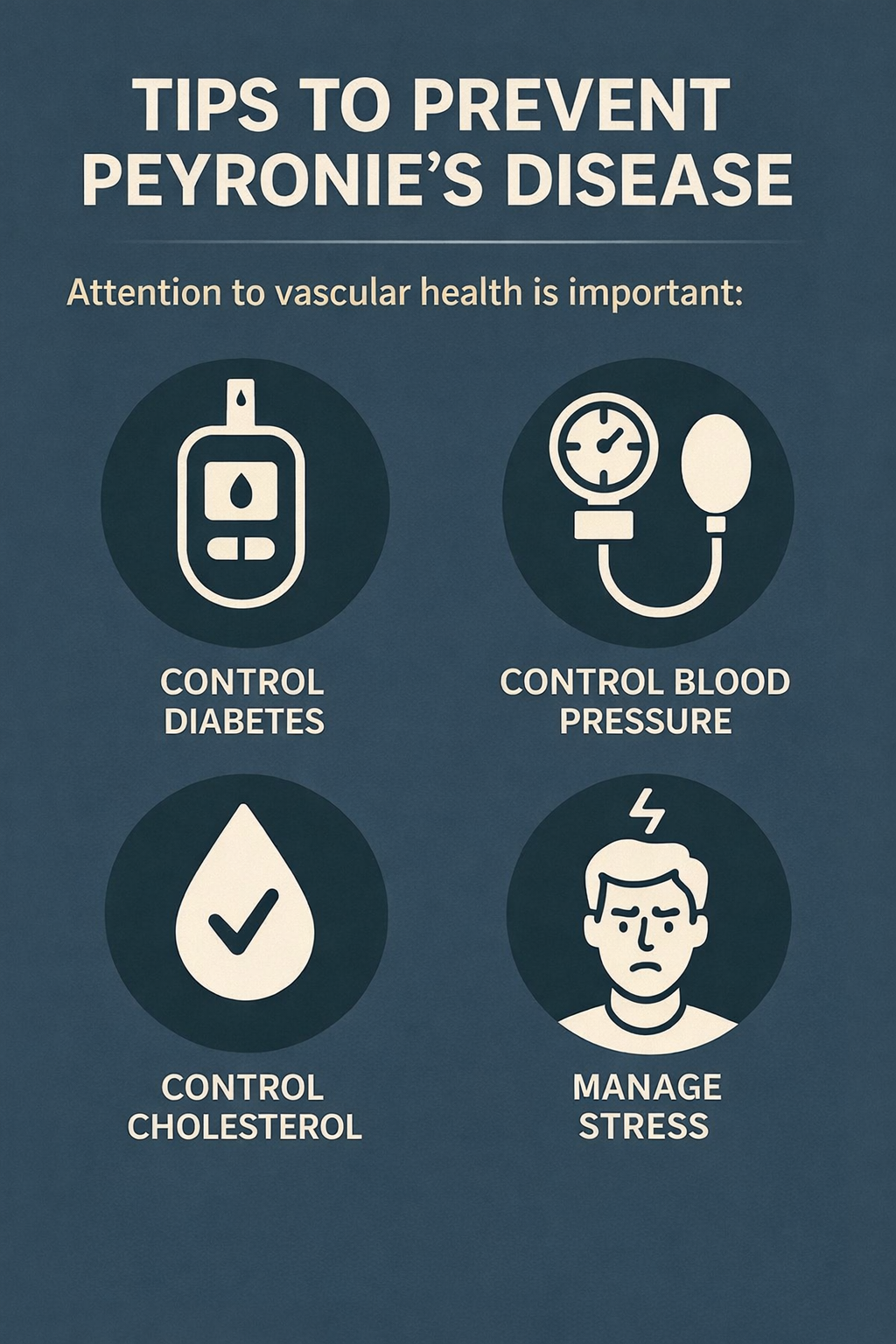
4) Pay attention to vascular health
Diabetes control
Taking care of blood vessels is also important for prevention.
An example is uncontrolled diabetes, which increases the risk of inflammation and compromises the body’s ability to heal.
As a result, minor penile trauma may not heal properly and can evolve into curvature in some cases.
Blood pressure
High blood pressure is also a risk factor for Peyronie’s disease because it makes blood vessels stiffer, impairs blood flow, and reduces the elasticity of penile tissues.
Reduced circulation also affects tissue oxygenation, which can hinder healing even for minor trauma—such as what may occur during sexual intercourse.
Cholesterol
High cholesterol can obstruct arteries, impair blood circulation, and reduce oxygen levels in tissues.
This can compromise the body’s ability to repair small internal injuries in the penis, contributing to the formation of fibrotic plaques.
Manage stress better
Why does managing stress matter when thinking about how to prevent Peyronie’s disease?
People under constant pressure often sleep less and eat poorly—an overlap that increases the risk of conditions that impair circulation and healing, such as high blood pressure, high cholesterol, and diabetes.
Regular physical activity, healthy eating, good sleep, and psychological support are measures that may help manage stress.
5) Avoid repeated penile trauma
Sex without preparation
Sex without preparation can happen when the erection is not firm enough and there is not adequate lubrication, which increases the risk of internal micro-injuries.
In this situation, the penis may also bend or twist during penetration.
Using lubricant and starting intercourse only when the erection is satisfactory are part of penile health care and may help reduce the risk of Peyronie’s disease and other conditions.
Sudden movements
The penis can slip out during very intense movements or rapid position changes. When trying to re-enter, the organ may suffer minor injuries.
Avoiding sudden movements and paying attention to positions in which the man has greater control of movement may help reduce the risk of penile trauma.
Untreated injuries
If an injury occurs with bruising, significant swelling, or severe pain, seek medical care promptly for evaluation.
This is important for early assessment of Peyronie’s disease and may help avoid complications, such as penile fracture.
6) See a urologist at the first sign
Regular checkups are not only a great way to reduce risks related to Peyronie’s disease, but also to support overall health—especially for men over 50.
Read more: Sex after 50 years
A primary care physician or cardiologist can help with prevention, early detection, and control of conditions that become more common over time and may be associated with higher risk, such as diabetes, high cholesterol, and other metabolic changes.
Seeing a urologist is also important. In addition to evaluating prostate health and providing guidance on cancer prevention, this specialist can assess erectile function and identify possible penile changes early.
If you notice any changes in your sexual life, this is also the time to talk openly—your urologist can help identify possible causes and guide the most appropriate next steps.
Schedule your preventive follow-up with Dr. Paulo Egydio
Preventive urologic follow-up should be part of a routine for men’s health and for monitoring penile changes.
Fill out the pre-assessment form and schedule a consultation with Dr. Paulo Egydio to discuss questions about penile curvature and Peyronie’s disease.