
Peyronie’s Disease is a penile curvature that occurs at a certain stage in a man’s life, usually as a result of injuries or micro-traumas that happen during sexual intercourse. In more severe cases, for example, the penis can even form an “L” shape due to its tortuosity.
The disease is characterized by the formation of scars in the tunica albuginea, the tissue covering the penis’s erection mechanism, and usually manifests itself through fibrosis. Over time, this scar reduces the penile tissue’s elasticity, resulting in a deformity that is only noticeable during an erection. If left untreated, this curvature tends to evolve over time, making sexual relations very difficult or even impossible, besides causing pain during erection.
Every man should always be attentive to the anatomy of his penis. The habit of visiting a urologist regularly, starting from puberty, is extremely important to ensure a healthy and proper sexual life. But the reality is that most men do not have this habit, and only become worried about their health when they notice that something is wrong. A problem that is usually noticeable to the naked eye is the penile curvature. When it is stable, it does not compromise the erection, nor does it make sexual relations difficult — it is sufficient to observe it and take some precautions to prevent it from worsening. However, when the penis becomes more twisted, to the point that it hinders or entirely prevents sex, it is necessary to seek medical help.
The following image illustrates this situation and some details of penile anatomy:
The good news is that this problem is treatable. Learn everything you need to know about Peyronie’s, including prevention methods and treatments, by following the contents of this page.
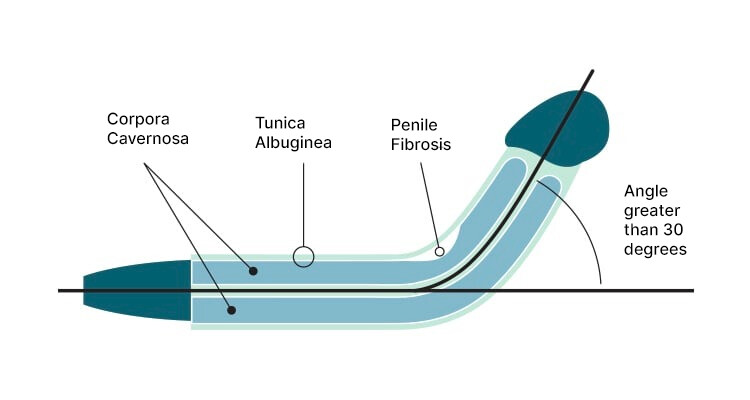
If your penis used to be straight but is becoming curved, it’s a sign that something is not right with the health of your genitalia. This is also a strong indication that the problem might be Peyronie’s Disease.
Peyronie’s Disease cannot be cured, but it can be alleviated, or even avoided when diagnosed early. And to understand what is happening with your penis, it is important to know the symptoms. Upon noticing any of these signs, seek medical help to increase the chances of effective treatment.
An accentuated penile curvature usually presents problems when it exceeds 30 degrees. If the curvature progresses and makes sexual intercourse impossible for the patient, it is time to seek the expertise of a specialist. If the curvature causes pain to either you or your partner during intercourse, it also indicates that penile health is compromised. Feel free to ask Dr. Paulo any questions to receive specific guidance tailored to your condition, ensuring your concerns are addressed promptly and discreetly.
Penile curvatures can only be noticed during an erection because it is at this moment that the tissues are fully stretched. This plays an important role in the shape of the penis. The desirable situation is that all of the tissues should have the same elasticity rate.
In some cases, the deformity is mild and stable, which does not prevent the man from having sexual relations, nor does it bring any kind of embarrassment. But when the curvature begins to worsen, there lies an indication of Peyronie’s Disease.
In these situations, it is important to seek help as quickly as possible to undergo the necessary treatment and prevent the curvature from worsening, which could lead to sexual and psychological problems.

The position where the fibrosis is located inside the penis will directly impact its anatomy. This is because it causes a difference in the elasticity of the penile tissues, which can cause or accentuate the curvature to the sides, downward, or upward, toward the navel. If this fibrosis is not treated, the penis will continue to bend to a point that completely prevents penetration.
Just as fibrosis affects the curvature of the penis, it also causes its reduction, thinning, and even narrowing. For this reason, it’s important to treat not only the fibrosis but also all impacts caused on the penis’s anatomy. In these cases, it is possible to make relaxation incisions to expand the tissues — allowing the recovery of the lost dimensions.
Having fibrosis that hinders blood circulation makes it quite possible that a man with Peyronie’s Disease also faces difficulties in maintaining an erection, or even achieving one in the first place. This must be assessed before undergoing surgery to treat the fibrosis, as, in cases where erectile dysfunction is linked to the disease, the placement of a penile prosthesis will be necessary for the man to regain his sexual life. This also aims to prevent the penis from developing new fibrosis and curving again in the future.
With a curved penis, penetration becomes a less comfortable act for both the patient and their partner. The pronounced curvature causes the back-and-forth movement to provoke pain or discomfort in the other person, as the penis is not in its natural anatomy, suitable for sex.
When Peyronie’s Disease does not entirely prevent sexual relations, it can significantly restrict the possibilities of positions and movements performed. The man will have to be constantly concerned to find a way where fitting is possible, in addition to taking extra care not to cause further penile traumas, which could worsen the curvature even more.
Questions? Send your question to Dr. Paulo and receive specific guidance on your condition, simply and discreetly.
There are clinical and surgical treatments that vary according to the stage of the disease. To determine the most suitable at each moment, it is important to consider a careful evaluation by a specialized urologist, who has experience and keeps himself updated on the topic.
The clinical treatment for Peyronie’s Disease can be done through oral medications, gels, ointments, or injections. They increase the blood circulation in the penis and stabilize the progression of the curvature.
Regardless of the medical approach, these are the options most recommended by the ISSM (International Society for Sexual Medicine). However, due to other factors that go beyond the curvature, such as erectile dysfunction and loss of penile size, the simple use of medications may bring only palliative results, which do not fully cure the condition.
It’s worth noting that clinical treatments are generally indicated for the inflammatory phase of the disease when the fibrotic plaques and the penile deformities caused by them have not yet stabilized. The medications aim to help these deformities not reach more critical levels, affecting both the curvature and the reduction and thinning of the penis.
After the stabilization of the penile curvature, a new assessment will be made to determine if the disease has caused any damage to the functionality of the patient’s penis. At this point, according to various scientific studies in the area, the use of medications has not shown significant improvements.
The result of this comprehensive examination, already in the healing stage of the fibrosis, will indicate the necessity, or not, of surgical intervention.
Remember that the diagnosis should be obtained through an examination after an induced erection, using medications, to evaluate not only the penile curvature but also the ability to achieve and maintain an erection.
When Peyronie’s Disease reaches the second phase, also known as the scarring phase, clinical treatment probably will no longer be effective. In this case, a surgical procedure is recommended.
The surgery can address the pronounced curvature and the reduction of the penis caused by Peyronie’s Disease. Additionally, it can correct the narrowing and erectile dysfunction issues. Usually, the procedure is performed with local anesthesia, and the patient is discharged from the hospital on the same day.
Questions? Send your question to Dr. Paulo and receive specific guidance on your condition, simply and discreetly.
The insertion of a penile prosthesis is recommended to correct penile fibrosis, increased penile curvature, and erectile dysfunction. It aims to provide additional axial rigidity after curvature correction, preventing new traumas and fissures from occurring.
Due to a lack of information or even prejudice, many men are resistant to getting a penile implant, but this is what may allow the full functionality of the penis and the return to an active sexual life without health concerns. The prosthesis is usually implanted during the same surgical procedure used to treat Peyronie’s Disease, so it is not something that brings more discomfort or requires more time from the patient. It’s also essential to highlight that different types of prostheses are available. They can be malleable, articulated, or inflatable — and the appropriate model should be chosen alongside the urologist after a detailed in-person evaluation and discussion about the patient’s preferences.
Knowing about different penile implants, as well as how they work, is important if you might need this kind of treatment someday. Besides the patient’s preference, other factors are also considered, like medical conditions, lifestyle, and costs.
The malleable penile prosthesis, also known as a semi-rigid prosthesis, offers good rigidity and flexibility of the penis. Composed of two rods – metallic filaments surrounded by silicone – they help disguise the constant state of erection by keeping the penis flexible, allowing it to be gently positioned downward or to the sides. During sex, just put it in the upright position, and you are ready to initiate intercourse. This implant model has the benefit of not containing liquids, hence no leakage issues, unlike inflatable models — making the need for replacement very rare.
For the inflatable penile prosthesis, the biggest advantage is the ability to inflate and return the penis to flaccidity when most convenient. This makes many men consider it the most discreet option. However, it operates in a way that requires more attention. With it, men produce an erection by manipulating a pump, located in the scrotum, containing saline solution. When activated, the fluid travels through the cylinders implanted in the penis, activating the hydraulic system, causing them to inflate. After sexual activity, simply activate the pump again and press the penis downward for a few seconds so the fluid returns to the reservoir, and the member returns to the resting position. This model also has a variation with two or three volumes, which presents more fluid exchange in the system and greater flaccidity when deflating the prosthesis.
Lastly, many doctors treat Peyronie’s with only clinical methods, which may be based on anti-inflammatories, pain relievers, and other medications to increase blood flow to the penis. But remember that this is a palliative method, useful in the initial stage of the disease and milder cases of erectile dysfunction.
When clinical treatments do not meet the patient’s expectations, the insertion of a prosthesis and surgery combined with penile reconstruction is generally considered.
Questions? Send your question to Dr. Paulo and receive specific guidance on your condition, simply and discreetly.
The treatment of Peyronie’s Disease involves more than just straightening the penis. This is because the fibrosis and scars that form on the tunica can have consequences beyond a possible curvature. The objective of the method of geometrically calculated incisions is to expand the tissues that have been affected by the disease — reconstructing them to the limits of the nerves and urethra. In addition, in some cases, Peyronie’s Disease may make the penis thinner. The incisions can widen the thinned area to maintain a good balance between size and girth.
This balance between size and girth must be maintained to ensure the penis has good rigidity and penetrative capability.
Published by Urologist Dr. Paulo Egydio, the geometric principles applied to penile surgeries — referred to in the urological field as the Egydio Technique — aim to correct curvatures and recover the size and diameter of the penis, up to the utmost limits of the nerves, vessels, and urethra. This method is generally directly proportional to the patient’s goal, as it is rare for a man to cope well with the reduction of the penis size, and recovering it is as important as treating the disease itself.
Utilized since 1998, the Egydio Technique generally aligns well with the goals of patients, contrasting with traditional methods which often propose a different concept, which usually causes the reduction of penis size.
Dr. Paulo Egydio has been refining this surgical strategy for over two decades. Consequently, this procedure was chosen by 75% of the audience, comprised of doctors from 100 different countries at AUA19, as the most recommended procedure for a patient with severe Peyronie’s Disease associated with Erectile Dysfunction.
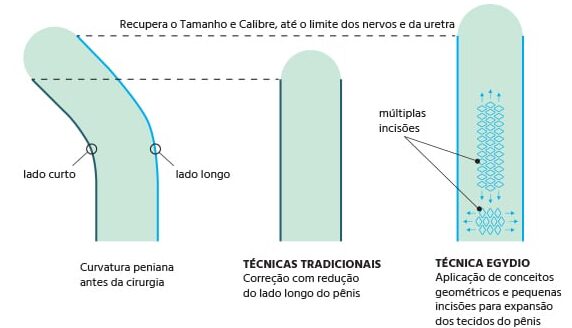
The surgical method through multiple incisions involves expanding the tissues of the penis to recover size and girth. Notice there are various surgical methods capable of providing a straight and functional penis; it is extremely necessary to speak with a specialist to determine which treatment is most suitable for your case.
Currently, Dr. Paulo uses the tissue expansion method through multiple incisions in the tissues, without the use of grafts, aiming to make the penis functional, straight, and with its dimensions recovered — within the limits of the nerves and the urethra.
The deformities in the penis caused by Peyronie’s Disease can be upwards, downwards, or sideways. Sometimes they also occur on more than one plane, causing a reduction and thinning of the penis. For this reason, it is essential to conduct a detailed evaluation of the penis before determining the treatment. A functional exam, with artificially induced erection, will provide specific information to assist the healthcare professional in making a good treatment approach for your case.
If the professional corrects the size of the tissues without the geometric principle, basing it on the plicature on the smaller side to correct the curvature, it may result in a smaller penis. It is common to hear reports from patients who lost penis girth size after Peyronie’s surgery.
To avoid this kind of situation, it is important to ask the healthcare professional which surgical method they will use to correct the deformity and what the consequences of this procedure will be concerning the penis’s dimensions.
The pre and post-operative stages of surgery for Peyronie’s disease require some care to ensure the patient fully recovers. However, it is essential to clarify that not every man with a curved penis needs treatment. If the patient is diagnosed with Peyronie’s Disease, the treatment doesn’t necessarily have to be surgical. Surgical treatment is generally indicated for patients in whom the curvature makes sexual relations difficult or impossible.
As every surgical process raises questions about its pre-operative preparations and concerns about hospitalization and anesthetics, it is important to know the preparations for the procedure, how it is conducted, and the care that must be taken post-operatively.
Once diagnosed, the patient is referred for an ultrasound with Doppler of the cavernous bodies, which evaluates the functionality of the penis after an induced erection and also checks the condition of any fibrosis, the blood circulation within the penis, and the degree of curvature.
If Peyronie’s Disease-associated erectile dysfunction is identified, the placement of a penile implant may be indicated to solve the condition in the same procedure. Of course, this option will only be considered for patients who have already tried the use of medications to stimulate erection but haven’t had satisfactory results.
All this study is necessary for the doctor to have a detailed overview of the penile curvature and plan the step-by-step of the surgery. After that, it is just a matter of scheduling the date for the procedure and waiting.
The procedure does not require extensive preparations. Like every surgery, it will be necessary to perform blood tests, urine tests, and a cardiac evaluation to prevent any mishaps.
Glucose levels must be controlled to prevent healing difficulties — and consequently the risk of infection. The doctor also instructs the patient about cleaning the pubic region with antibacterial soap, which should be done for two days, consecutively, before the surgery. Besides, fasting for eight hours is required, for both solid and liquid foods.
At this stage, all that is left to do is to have a good night’s sleep and relax, as everything will be under control.
The procedure to correct Peyronie’s curvature is not lengthy. The surgery lasts between 2 and 3 hours — performed with only sedation and local anesthesia. Generally, the patient is admitted to the hospital early in the morning, and it is possible that by early afternoon, they have already been discharged to go home.
The shaving of the pubic hair is done in the surgical center by the doctor and their team. Therefore, there is no need to worry about this, as they will take the utmost care to ensure that there is no risk of infection.
Post-operative care for Peyronie’s Disease is also not complicated. The return to the doctor happens on the same day of the surgery, in the afternoon. In this appointment, the doctor will evaluate the surgery’s outcome and give the final instructions to ensure the best possible healing.
The penis will be bandaged, and there’s no need to remove the bandages for the first five days. After this period, the bandages should be changed daily for another five days. Due to the simplicity of the bandage exchanges, the patient doesn’t need to return to the doctor for this to be carried out. It can be done alone, in a few minutes.
There are three stages for the patient to return to normal life: between 7 and 10 days, it’s possible to return to work (if it doesn’t require physical effort); from 30 days, physical activities can be resumed — and from 45 to 60 days, sexual activity can be resumed after medical evaluation.
*This estimate may vary from case to case, according to each patient’s body recovery.
The recovery process is further simplified because the surgical stitches are absorbable, preventing the patient from having any discomfort in the future or during sexual relations. In about two months, the stitches will all have naturally fallen off.




Knowledge is the first step in carrying out a treatment, and there is nothing better than learning from an expert on the subject: Dr. Paul Egydio. The Peyronie’s Disease Guide is available for download and can also be consulted topic by topic below.