

Penile fibroses are rigid scars that can cause curvature and affect male sexual performance.
Penile fibrosis is a pathological condition characterized by an above-normal formation of fibrous tissue.
But why is it so important? During the erection process, the smooth muscle tissue of the corpora cavernosa relaxes, allowing blood to flow into the organ. Without the tunica albuginea — a fibrous and elastic layer that surrounds the corpora cavernosa and helps “trap” the blood — the erection is not maintained. That’s when the problem of erectile dysfunction can arise.
Penile fibrosis can arise for several reasons, but the diagnosis must be made only by urologists. Therefore, if you notice anything in this regard, seek help as soon as possible. Early diagnosis can help avoid future problems, including the need for surgery.
The fibrous tissue we’re discussing is composed mainly of collagen. It provides the normal “elasticity” that helps at the time of erection.
What is penile fibrosis?
Penile fibrosis is the accumulation of fibrous tissue in the tunica albuginea. As the excess fibrous tissue reduces the tunica albuginea’s ability to expand, deformities are usually visible only when the penis is erect.
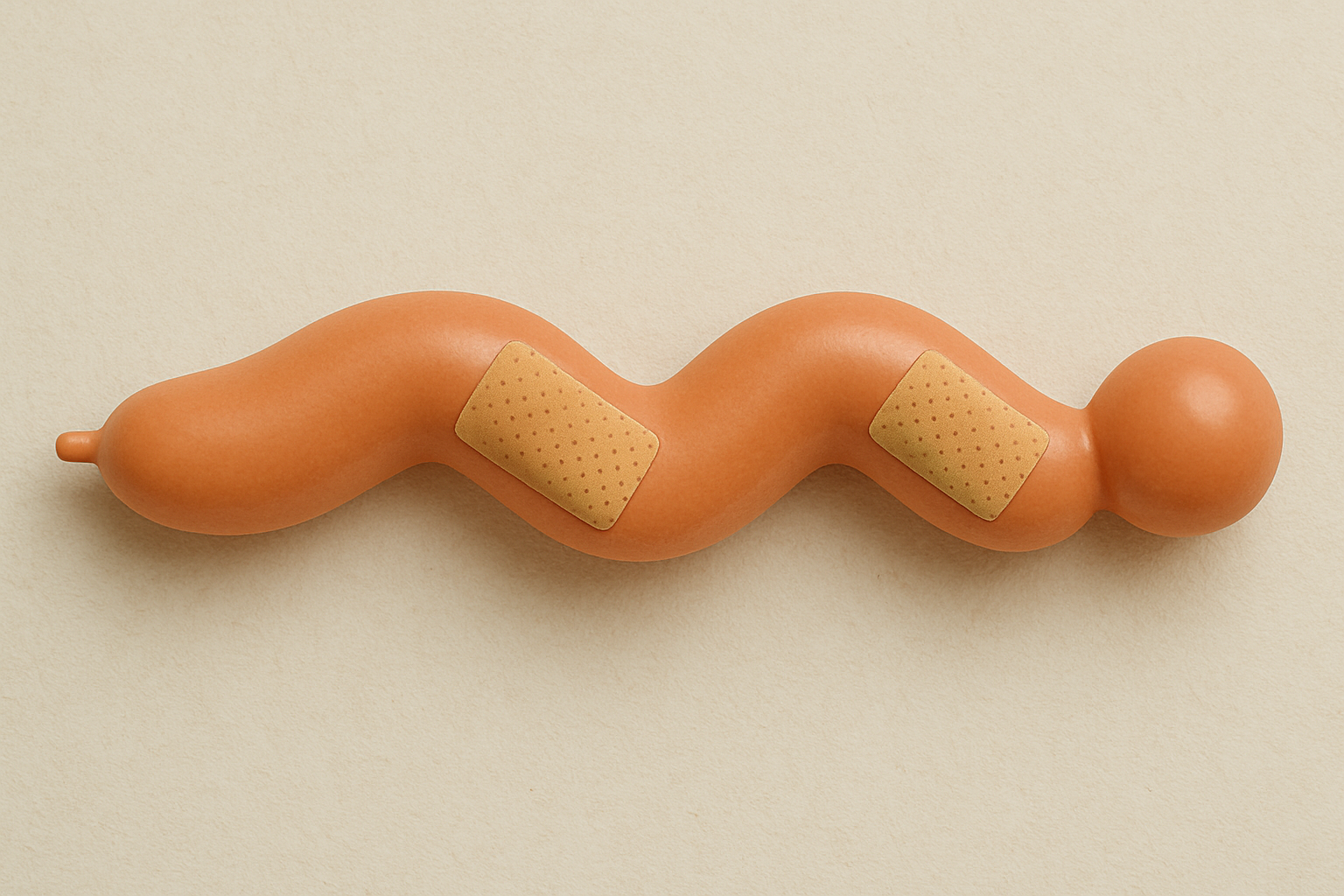
An analogy that helps explain what fibroses do to the penis is to imagine a balloon with a strip of adhesive tape stuck to its surface. When inflated, the area covered by the tape does not expand and becomes deformed.
A penis with fibroses becomes curved, and the degree of curvature can vary.
This, in fact, determines whether a man’s sex life will be affected. In severe cases of penile fibrosis, a curved penis may make penetration difficult or even prevent it during sexual intercourse.
What causes penile fibrosis?
Penile fibroses can develop after an injury or trauma to the penis, such as falls, sports accidents, during more vigorous sexual activity, and even during masturbation.
However, penile fibrosis can also be associated with other conditions, such as:
- Peyronie’s disease;
- Diabetes;
- High blood pressure;
- High cholesterol;
- Excessive pressure on the penis when sleeping face down;
- Lack of lubrication;
- Pelvic surgeries, such as prostate removal.
Wearing tight underwear can also make the penis curve. If the penis is positioned to the side and becomes erect, tight underwear increases the risk of injury.
Another factor that favors the formation of fibroses is keeping the penis to the side. If a man has an erection and forces it laterally, this can also form scars inside the penis.
4 types of penile fibrosis
The main types of penile fibrosis are:
| Type of Fibrosis | Characteristics |
| Superficial fibrosis | Affects the tunica albuginea of the penis, causing curvature upward, sideways, and/or downward. |
| Deep fibrosis | Located in the corpora cavernosa, it prevents their dilation, leading to loss of vertical firmness and difficulty with penetration. In general, this fibrosis is responsible for penile narrowing. |
| Localized fibrosis | May form at a single point on the penis — base, shaft, or tip — resulting in tortuosity or narrowing. |
| Diffuse fibrosis (2+ points) | Occurs when fibroses develop in multiple regions, leading to several deformities, such as two or more curvatures and/or narrowings. |
| Multiple calcifications | May occur in various parts of the penis, located on top, sides, or tip. |
Fibroses can also be divided into superficial and internal. The superficial ones are responsible for penile curvature because they affect the elastic tissue, reducing one side.
There are also internal penile fibroses. In addition to penile tortuosity, they present an even more serious consequence for sexual activity: impaired blood circulation inside the penis, which limits flow and directly interferes with erectile capacity and sexual performance.
It is important to emphasize that any sign of penile fibrosis should be examined by a urologist and, when appropriate, treated.
How to identify penile fibrosis?
It is possible to perform a self-exam by palpation with the penis erect or not. However, consulting a urologist is most appropriate in the presence of stronger symptoms.
| Type of self-exam | How to perform and what to look for |
| Flaccid penis | Gently pull the glans and palpate along the entire length (sides, top, and bottom). The goal is to find thicker tissue at the base of the penis. |
| Erect penis | Assess whether there is tortuosity or narrowing in the area where fibrosis has developed. |
During palpation, you should look for any changes in the organ, especially nodules.
It is important to note that only 70% of cases with penile fibroses are identifiable through a palpable exam. In 30% of cases, there is only loss of elasticity, and scar tissue cannot be found in the self-exam.
Pain during erection can also indicate that something is wrong and requires medical care.
Therefore, upon noticing any of these signs, seek a urologist as soon as possible.
Common symptoms of penile fibrosis
Knowing the symptoms of penile fibrosis is essential to prevent more serious problems. The main ones are:
- Difficulty achieving or maintaining an erection;
- Pain during erection or sexual activity;
- Curvature or deformity of the penis when erect.
Does penile fibrosis hurt?
Yes. Depending on severity, it can cause pain.
Note that pain intensity may vary. Some men may feel mild discomfort, while others may experience sharp pain.
Penile fibrosis can result in penile pain for several reasons:
- During erection: fibrous tissue does not expand like normal penile tissue, which can cause pain when the penis becomes erect.
- Due to deformity: the curvature or deformity that can accompany fibrosis may also lead to discomfort or pain during sexual activity.
- In the scar tissue: the formation of scar tissue can be sensitive or painful to touch.
Pain should not be ignored, and consulting a urologist is the best way to understand the causes for an appropriate diagnosis and treatment plan.
I have penile fibrosis — now what?
Those who have or develop penile fibrosis can lead a normal life after appropriate treatment.
When visiting a urologist, an induced-erection test may be performed to assess penile vascularization and the type and stage of existing fibrosis.
If the fibrosis is mild and does not deform the penis to the point of impairing erection, the condition may be managed with medications to prevent worsening and larger consequences.
If the fibrosis has spread, causes considerable deformity, or impairs erection, pills and medications may not bring the desired effects.
What treatment options are available for penile fibrosis?
There are effective treatments for penile fibrosis, and seeking medical guidance at the first symptoms may help prevent progression. This can avoid the need for more complex treatments later on.
From there, the best treatment for penile fibrosis depends on the phase it is in. See below:
Mild fibroses
Mild fibroses do not cause severe deformities or significant erectile dysfunction. Therefore, non-surgical management combining colchicine and vitamin E may be considered to help prevent progression of existing fibroses and delay new scarring.
Medical management of penile fibrosis may also include intracavernosal injections of verapamil.
In the review “Intralesional verapamil for the treatment of Peyronie’s disease,” the authors noted that most men report a reduction in sequelae of penile fibrosis, such as less pain, partial curvature reversal, and improved sexual function.
Another option is Xiapex injections (currently unavailable in Brazil). According to the study “Xiapex for treating Peyronie’s disease,” these injections are considered safe and effective as a first-line treatment for Peyronie’s.
Related: Learn about 3 types of ointments for Peyronie’s disease and their effectiveness
Severe fibroses
When fibroses progress or calcify, surgery for penile fibrosis may be necessary.
As the fibrotic plaque worsens, penile deformity increases — sometimes up to 90 degrees — and maintaining an erection becomes more challenging.
To treat such cases, surgery aims to restore penile dimensions — including length and girth — through alignment performed up to the limit of the nerves, using small geometrically calculated incisions.
In addition to treating fibroses, during surgery the physician may implant a penile prosthesis of the largest suitable size and girth (respecting the anatomy after restoration).
The implant is intended to provide sufficient penile rigidity for sexual intercourse and is one of the alternatives used in erectile dysfunction associated with fibrosis.
Is a normal sex life possible even with fibroses?
Yes. With appropriate treatment and/or surgery indicated by a urologist, many patients can maintain an active, healthy sex life.
However, it is necessary to assess whether the fibrosis is localized and whether the deformity does not interfere with rigidity or cause frequent “slippage” during penetration.
It is also important for the patient to care for sexual health so that fibroses do not worsen and cause more serious issues, such as narrowing and pronounced tortuosity, or injuries that lead to additional fibroses.
If the condition does not compromise penile function, the patient may continue without medication or surgery.
Take an active role in your health with Dr. Paulo Egydio
Penile fibrosis is a complex condition that requires attention and appropriate management to avoid serious complications.
Fortunately, there are several treatment options, and early evaluation may help prevent the condition from progressing to more complicated stages.
If you have any of the symptoms mentioned, it is time to seek a specialist to work toward a healthy and safe sex life. Specialized follow-up is essential for proper care.
Start your pre-analysis with urologist Dr. Paulo Egydio, a specialist in penile curvature, and receive personalized guidance by email.
Investing in penile health is investing in quality of life and sexual health.