

The inflatable penile prosthesis is a device that can treat severe erectile dysfunction. It allows the patient to manually inflate and deflate the penis in order to simulate an erection. Check out details about the implant, how it works and how the surgery is done.
The inflatable penile prosthesis is indicated for men who have not achieved success with other erectile‑dysfunction treatments or who have experienced severe side effects.
Activation occurs by squeezing a pump housed in the scrotum that transfers saline from the reservoir to the cylinders implanted in the penis. Learn more about how the inflatable penile prosthesis works and about the surgery.
What is an inflatable penile prosthesis?
The inflatable penile prosthesis is a type of penile implant that is indicated when erectile‑dysfunction treatment has not worked or has resulted in serious side effects.
This model has cylinders implanted inside the penis, a saline reservoir and a pump inserted in the scrotum. To begin sexual activity, the man squeezes the pump so that the saline reaches the cylinders, making the penis rigid.
Who is the penile prosthesis indicated for?
The inflatable or hydraulic implant is recommended for patients with erectile dysfunction who have not obtained satisfactory results, or who had severe side effects, when trying other methods. In addition, the implant can also be indicated in selected cases of penile deformities, which are common in Peyronie’s disease.
Keep in mind that age is not a determining factor for implantation of the prosthesis. Therefore, it is indicated not only for older men but also for younger men.
When is this type of prosthesis prescribed?
An inflatable prosthesis for erectile dysfunction is prescribed when the man has not had satisfactory results with treatment, or in the presence of severe side effects.
The implant can also be indicated in selected cases of penile deformities, as assessed by a physician, something that can occur in Peyronie’s disease.
Remember that age alone does not determine implantation. Therefore, it can be recommended for older men as well as for younger men.
Difference between inflatable and semirigid (malleable) prostheses
The difference between the inflatable and the semirigid prosthesis lies in the degree of control and in appearance.
The inflatable model allows the man to control rigidity because he can inflate and deflate the device whenever he wishes. In addition, it gives the penis a more discreet appearance, which is one of the advantages of the inflatable penile prosthesis.
The semirigid prosthesis, also called malleable, keeps the penis slightly rigid, which can cause some discomfort, especially in the first days after surgery, something that can be managed with slightly snug boxer briefs.
What are the types of inflatable penile prosthesis?
There are two inflatable penile prosthesis types: 2‑piece and 3‑piece. See the differences:
- 2‑piece prosthesis
The 2‑piece inflatable penile prosthesis has a pair of cylinders implanted in the penis and a reservoir positioned in the scrotum. To return the penis to the flaccid state, the patient simply bends it downward.
- 3‑piece inflatable prosthesis
In addition to the components of the 2‑piece prosthesis, the 3‑piece inflatable prosthesis also has a pressurization pump. To deactivate this model, the man only needs to press the pump.
This type of prosthesis offers two possibilities: the Standard model and the Narrow model.
The Standard model is indicated for men with long and thick penises, because the cylinders are larger and narrower, and provide more vertical resistance. The Narrow model is aimed at smaller or thinner penises, because the implant has narrower and shorter cylinders.
Prosthesis anatomy: cylinders, pump and reservoir
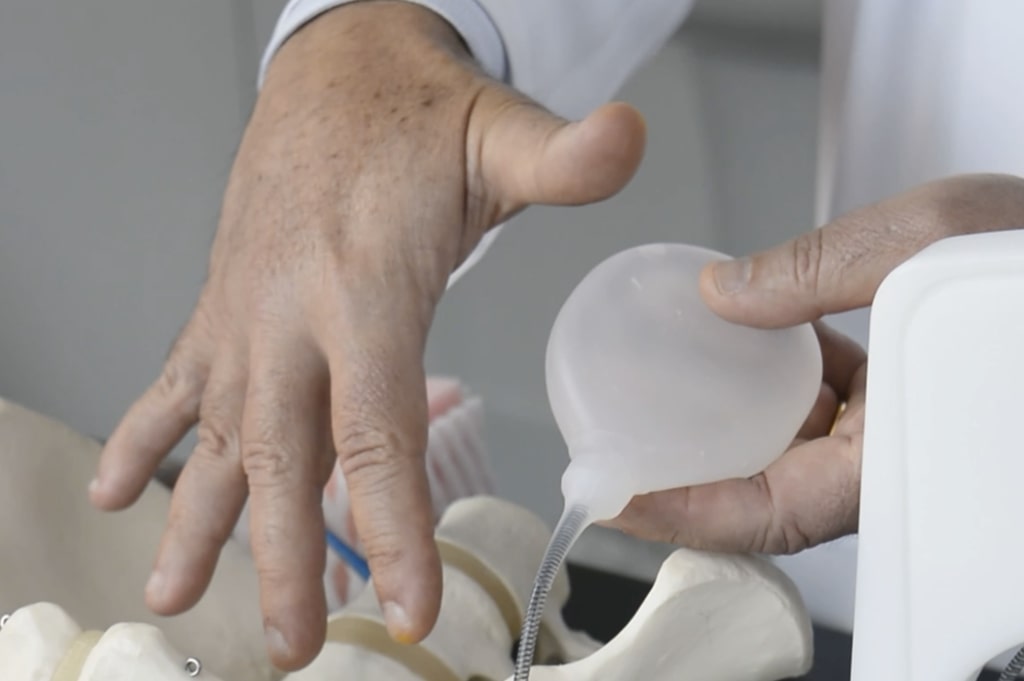
The inflatable penile prosthesis is made up of the following parts:
- Pump
The pump, or “pump”, is positioned in the scrotum and is responsible for transferring fluid from the reservoir to the cylinders and vice versa. This is the component the man must squeeze to obtain an erection.
- Cylinders
The cylinders are tubes inserted inside the penile shaft that receive fluid from the reservoir of the inflatable penile prosthesis. These components provide the rigidity needed for sexual intercourse.
Proper function depends on the correct choice of cylinders, considering penile anatomy and surgical technique.
- Reservoir
Located in the pelvic region, in the lower abdominal area, the reservoir of the inflatable prosthesis is not palpable or noticeable.
It is filled with saline, which is transferred to the cylinders when the pump is squeezed, producing penile rigidity.
- Extenders
If the chosen cylinder is shorter than the penis length, the specialist can use extenders—pieces that fit onto the cylinder to increase its length.
However, extenders are not recommended because they can compromise prosthesis firmness, increasing the risk of bending during penetration and impairing implant function.
How is prosthesis implantation surgery performed?
The surgery to implant the penile prosthesis usually lasts about an hour and a half, but may vary according to case complexity and surgeon experience. The procedure is done under sedation or general anesthesia. Through an incision made below the glans corona, the surgeon introduces the prosthesis cylinders into the corpora cavernosa.
In cases of deformity, retraction or penile volume loss, performing penile reconstruction along with prosthesis implantation is fundamental. Without this step, the penis may present noticeable shortening or tapering, compromising not only aesthetics but also the stability and functional performance of the prosthesis.
Reconstruction can restore or even improve penile length and diameter, offering more satisfactory and safer results for the patient.
To avoid complications and drain fluids, a catheter and a drain are inserted. The patient is usually discharged within one day, but the drain may remain in place for up to two days.
During recovery, light activities are allowed after seven days and more intense activities after 21 days.
Sexual activity should be postponed for 60 days.
How does the inflatable penile prosthesis work?
Once every component is in place and has passed the functional test, the next step is learning how to operate the device.
To activate the prosthesis and achieve an erection, the man simply squeezes the pump. The penis stays erect until the release valve is pressed, allowing it to return to a flaccid state.
How much does an inflatable penile prosthesis cost?
The average cost of an inflatable penile prosthesis ranges from US$8,000 to US$15,000.
Is the inflatable prosthesis covered by health insurance?
The inflatable penile prosthesis surgery is not on the mandatory list of Brazil’s National Supplementary Health Agency (ANS).
Therefore, many patients file lawsuits, and courts often rule in their favor—especially in cases of prostate cancer or severe diabetes—supporting the physician’s indication.
How long does an inflatable penile prosthesis last?
The lifespan of an inflatable penile prosthesis is usually 10–15 years.
Replacement may be required in cases of pain, penile tapering, insufficient rigidity, partial correction of Peyronie’s curvature, loss of sensitivity or inadequate follow‑up.
Advantages of the inflatable penile prosthesis
Below are the main advantages of choosing this device.
Discretion
It offers a discreet solution that can be handled easily and is suitable for men with vascular conditions that impair penile blood flow.
Malleability
The prosthesis can be positioned comfortably inside underwear while keeping a natural profile.
Improved sexual life
By eliminating the need for oral drugs or injections, the device allows many patients to resume sexual activity.
Natural feel and comfort
Modern materials provide flexibility and a realistic feel during intimacy and daily activities.
Quality of life and self‑esteem
Successful implantation can contribute to psychosocial aspects such as confidence and self‑esteem.
Patient satisfaction
Many men report improved rigidity and relationship satisfaction after receiving an inflatable prosthesis.
An inflatable penile prosthesis can help restore confidence and sexual life
With appropriate medical follow‑up, the prosthesis is a therapeutic alternative to restore erectile function in selected cases.
Dr. Paulo Egydio is a urologist focusing on penile curvature and penile‑prosthesis implantation.
Still have questions? Contact us on WhatsApp and we will be happy to help.
Read more:
- I’ve had a bent penis since young, could it be Peyronie’s Disease?
- How to Cope with a Prostate Cancer Diagnosis?
- How to Restore Rigidity and Correct Peyronie’s Disease
- Is Peyronie’s Disease Contagious? Get the Facts!
- 11 Myths and Facts About the Prostate Exam Revealed
- 20 Myths and Truths About Men’s Health Debunked
- https://drpaulo.com.br/en/myths-and-truths-about-prostate-cancer/
- Peyronie’s Disease: What Does Non-Surgical Treatment Look Like?
- Peyronie’s Disease Surgery – Clinical or Surgical Treatment?
- Prostate Cancer – How to Prevent and Consequences of Treatment