
Want to know how to straighten the penis? There are effective clinical and surgical treatments—such as shock-wave therapy, medication and operative techniques (Nesbit, Egydio and Stage). The choice depends on the type and severity of the curve, so medical guidance is essential. Learn more!
Many people look for ways to straighten the penis, but at first this is a normal condition as long as it does not hinder sexual intercourse or affect male self-esteem.
However, when the curvature hampers penetration—making the penis slip out easily during movement or fold during intercourse—it is essential to seek medical help.
Many men with curvature issues may have suffered trauma to the penis. Healing of these injuries often leads to deformities such as tortuosity, narrowing and loss of length.
Below, learn what penile curvature is, why it occurs, when medical intervention is needed, and how to straighten the penis with the most appropriate treatments for each case.
What is penile curvature?
In penile curvature, the penis bends during erection. It is important to note that the male member is naturally slightly curved.
The problem arises when this curve is pronounced, causes pain and impairs intercourse. Penile curvature occurs when there is an imbalance between the two sides of the tunica albuginea, the membrane that surrounds the corpora cavernosa.
Because of this change, during erection only one side of the penis stretches. The deviation may point to the right, left, upward—or even be a combination. 
What makes the penis bend?
The penis can bend due to Peyronie’s disease, a condition marked by fibrous tissue forming inside the shaft.
This tissue can cause a pronounced bend noticeable during erection, leading to pain and difficulty with intimacy.
However, Peyronie’s is not the only cause. Penile curvature can also result from trauma during sports, falls, vigorous sex or traffic accidents.
If these injuries are not treated properly, they may lead to internal scars that harm the corpora cavernosa and alter the erect anatomy of the penis.
Throughout this article you will see how to treat Peyronie’s disease.
Read also: Is a curved penis normal? Understand possible causes and treatment options
Is there a specific age when curvature develops?
There is no specific age at which penile curvature begins to develop in men. During puberty the body undergoes many changes, including development of the sexual organs.
From that point, some penile curvature may develop due to rapid tissue growth. This can be completely normal and is usually no cause for concern.
Peyronie’s disease, on the other hand, tends to appear between ages 40 and 60, but it can occur in younger men because of local injuries.
Other individual factors, such as medical history, lifestyle and genetics, can also influence curvature development.
When does penile curvature become a problem?
Penile curvature varies among individuals and, in most cases, is not a concern. In some situations, however, the condition becomes problematic when it causes:
Pain and discomfort
When the curvature reduces quality of life—causing discomfort and pain during sex—it signals that something is wrong.
This anatomical change may stem from several issues, including Peyronie’s disease. Only a urologist can diagnose the cause and determine the best treatment for penile curvature.
Difficulty during intercourse
When the penis is bent, it is common to face problems during intercourse. One is penetration difficulty, because the shaft can slip out during the act.
Impact on male self-esteem
Many patients with penile conditions report discomfort or even pain, compromising sexual satisfaction and directly affecting self-esteem.
Difficulty during sex and insecurity about appearance have a strong emotional impact and may lead some men to avoid intimacy.
Types of penile curvature
There are two main kinds of penile tortuosity: Peyronie’s disease—also called acquired curvature—and adolescent or congenital curvature..
Before explaining them, it is essential to note that they can only be seen when the penis is erect, because tissues are stretched.
Peyronie’s disease (Acquired curvature)
Peyronie’s disease occurs because injuries or micro-traumas leave scars in the tunica albuginea.
These scars form after repeated trauma; the most common cause is intercourse, when the penis bends or slips out and strikes the partner when it is re-inserted.
Micro-traumas can also occur during nocturnal erections. If a man sleeps face-down, the impact encourages these injuries. The accumulation of scar tissue can lead to:
- Nodules or lumps on the penis;
- Pain in the penis during erection;
- Erectile dysfunction;
- Structural changes such as narrowing or shortening;
- Pronounced curvature.
Adolescent curvature (Congenital curvature)
The adolescent curvature is called congenital because it is present from birth, and generally this deviation does not cause complications.
Men in this situation are usually monitored by a urologist to check curvature progression.
If there is discomfort, pain or sexual difficulty, specialised medical guidance is essential to assess whether surgery is required to straighten the penis.
How to straighten a bent penis?
When it comes to penile curvature, it is important to understand that not every bend needs treatment.
If the curve causes discomfort or hampers sexual activity, however, treatment options are available.
Penile curvature can, in many cases, be managed with different approaches—clinical or surgical—depending on individual medical evaluation. Below are the most recommended:
3 clinical treatments for a bent penis
Treatments are available for both Peyronie’s disease and congenital curvature. They may be surgical or non-surgical depending on the case.
For congenital curvature, medication is not an option because the man is born with the deviation.
1. Lithotripsy or shock-wave therapy
Lithotripsy is one technique used to straighten the penis. This non-surgical treatment applies shock-waves to prevent fibrosis progression.
This article on shock-wave therapy for Peyronie’s disease reviews seven studies with 475 patients from 1999 to 2023.
The authors concluded that low-intensity shock-waves have potential to reduce curvature and pain.
They emphasise, however, that more clinical trials are needed to confirm long-term success.
2. Vacuum penile pump
The vacuum penile pump is a cylindrical device into which the penis is inserted through a ring at the base. The tube connects to a manual or electric pump.
Negative pressure creates an erection. Even as therapy, the pump can cause complications such as new fibroses that may worsen the condition.
Therefore, it should only be used under medical supervision.
3. Medicinal treatment
Medication is indicated in the acute phase of Peyronie’s disease, before the curvature stabilises. Success depends on early diagnosis.
Are there exercises to correct penile curvature?
Exercises such as Kegel may help support pelvic floor strength, promoting overall genital health, although they are not prescribed specifically to correct curvature.
3 surgical techniques to correct the penis
In more severe cases surgery is required to straighten the penis. Here are the most used techniques:
1. Surgery with the Nesbit technique
The Nesbit technique equalises both sides of the tunica albuginea by shortening the longer, more elastic side of the penis.
Although it straightens the penis, it shortens the organ by 0.5 – 5.0 cm depending on curvature. 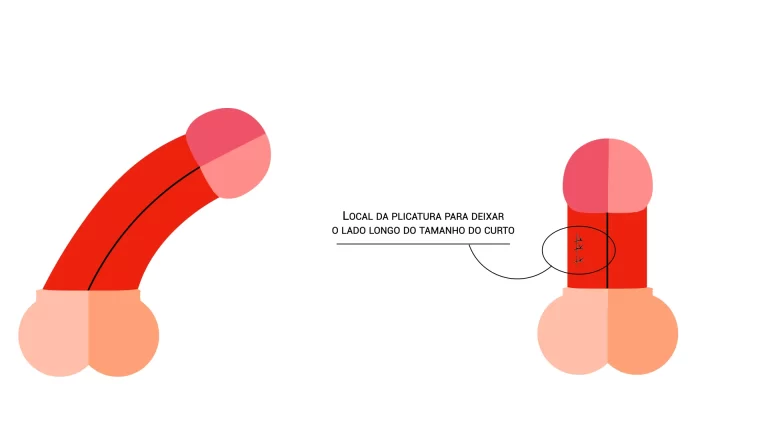 Non-absorbable sutures can also cause discomfort or pain during intercourse.
Even so, it remains the most traditional method, used by most surgeons—be sure to discuss all effects before choosing it.
2. Surgery with the Egydio technique
Patients often ask how surgical methods differ. The Egydio technique lengthens the shorter side to match the longer one.
This technique stands out because it lengthens rather than shortens—an approach suited to certain patient profiles.

3. Surgery with the Stage technique
The Stage technique is used only for certain congenital curves, complementing Egydio surgery to leave the penis as straight and as long as possible within scientific limits.
It involves shallower incisions in the tunica albuginea and is often a final refinement when needed.

Can the curvature return after treatment?
Beyond asking whether “penile curvature can be cured,” many men wonder whether it can return. Even after treatment, the penis may bend again.
Recurrence may relate to the original cause, new injuries or the technique used. That is why follow-up after surgery is so important.
With ongoing monitoring, the specialist can spot complications early and act promptly.
Contact Dr. Paulo Egydio
If you are concerned about any abnormality in your penis, now is the time to act. Sexual health is an important part of overall wellbeing.
Schedule a pre-assessment now with Dr. Paulo Egydio and take the first step toward better penile health.