

A penile prosthesis may be necessary after prostate cancer, as some men develop erectile dysfunction as a result of treatment.
Prostate cancer occurs when cells in the gland grow abnormally. According to the Brazilian Society of Urology, the number of deaths is expected to increase by 85% worldwide.
After diagnosis, questions arise about how radiation therapy and surgery can impact sexuality.
In some cases, a penile prosthesis may be considered as a treatment option for erectile dysfunction.
Below, we present information about prostate cancer and penile prosthesis, including when it is indicated and important considerations about treatment.
How does prostate cancer treatment affect sexual life?
Any surgery on the pelvic organs can affect the nerves responsible for vasodilation and erection, compromising blood flow.
The procedure can also cause scar tissue formation in the pelvis, interfering with the erection mechanism.
These factors can contribute to the occurrence of erectile dysfunction after prostatectomy, a complication that can vary in frequency, and the risk may be related to the surgeon’s experience.
In addition, the psychological impact of prostate cancer treatment can significantly affect sexuality.
Why can erectile dysfunction occur after treatment?
Erectile dysfunction is one of the possible consequences of prostate cancer treatment and can occur for several reasons:
Erectile nerve damage
The nerves responsible for erection are located close to the prostate. Since the surgery involves removing the gland — and sometimes adjacent tissues — there is a risk of compression or damage to these nerves.
Vascular changes
During the procedure, small blood vessels in the region need to be cut or cauterized, which can temporarily reduce blood flow.
Furthermore, the inflammation caused by the surgery can impair the dilation of the vessels, decreasing the amount of blood needed for an erection.
Psychological factors
Prostate cancer treatment can affect self-image and generate anxiety, contributing to psychogenic erectile dysfunction.
According to an article published by UCLA Health, the recovery of erection can take up to 2 years, depending on age, overall health, and the possible impairment of the erectile nerves.
Prostate cancer and penile prosthesis: what is the relationship?
Some men may experience erectile dysfunction after prostate cancer, as the nerves and vessels responsible for erection are located near the gland and can be affected by surgery or radiation therapy.
In some cases, erectile function is not fully recovered. In this context, the question arises: “Can someone who had prostate cancer get a penile prosthesis?“
The answer is yes. A penile implant after prostate cancer can be considered as a treatment option when erectile dysfunction treatment failed and does not respond adequately to oral medications, injectables, or vacuum devices.
Read also: Chemotherapy causes impotence: know what to do
Types of penile prosthesis
| Feature | Malleable Prosthesis | Inflatable Prosthesis |
|---|---|---|
| Structure | Flexible silicone-coated rods | Cylinders implanted in the corpora cavernosa; pump in the scrotum; reservoir (3 volumes ) |
| Types | Only one model | Two volumes (cylinders + pump) / Three volumes (cylinders + pump + reservoir) |
| Penis position | Semi-rigid, manually adjustable | Flaccid or rigid, controlled by the pump |
| Achieving erection | Manually position upwards | Activating the pump to inflate the cylinders |
| Discretion and daily comfort | Adjustable, but always semi-rigid | Completely flaccid when deactivated (more discreet) |
| Maintenance | Simple, low complexity | Requires attention to the pumping mechanism and valves |
| Common indication | Patients who desire simplicity or have difficulty manipulating a pump | Patients seeking a more natural erection and complete flaccidity |
Is the penile prosthesis safe?
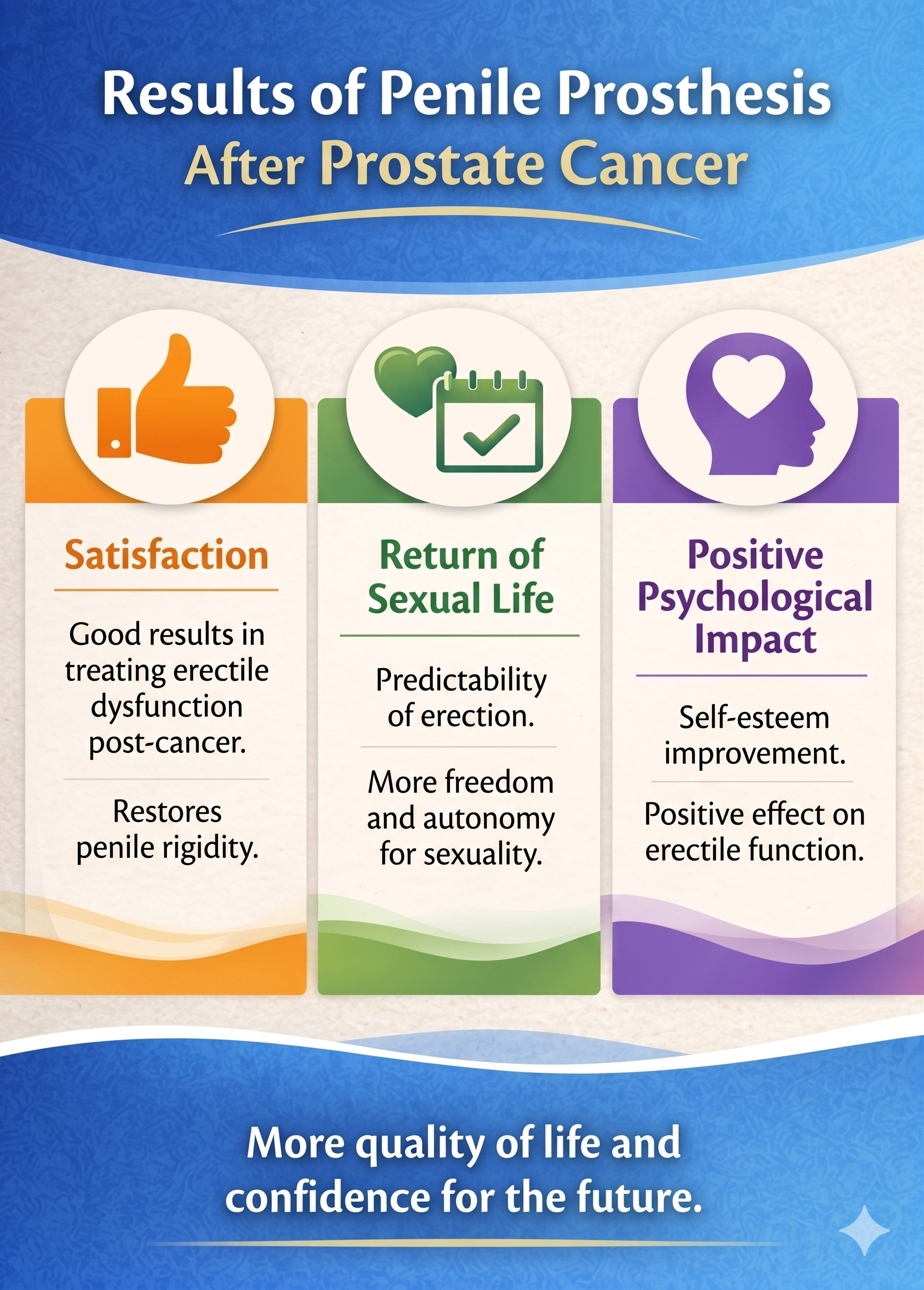
When properly indicated and performed, it presents an acceptable safety profile and reports of satisfaction in many patients.
When properly indicated, it can contribute to the restoration of penile rigidity, potentially favoring sexual function in certain cases.
Furthermore, the materials used in manufacturing the device are resistant and biocompatible, which reduces the risks of complications.
Results of penile prosthesis after prostate cancer
Related: Saliva test for prostate cancer could transform early diagnosis of the disease
Importance of follow-up with a urologist
The success of the procedure depends on individualized evaluation by a urologist specializing in penile prosthesis.
The choice of prosthesis must be made according to the individual needs of the patient, and post-surgical follow-up is important for the success of the procedure.
A penile implant after prostate cancer is a treatment option for sexual dysfunction resulting from oncological treatment.
Fill out the pre-analysis form to schedule your consultation with the penile prosthesis specialist, Dr. Paulo Egydio, PhD in Urology, with specializations at the Mayo Clinic and the Cleveland Clinic Foundation.
Also take the opportunity to subscribe to Dr. Paulo Egydio’s YouTube channel, where he answers questions about men’s sexual health.