The penile pump works, but its results depend on medical indication. The device can help men with erectile dysfunction, surgical recovery, and some cases of Peyronie’s Disease.
The penile pump is a device used mainly in the treatment of erectile dysfunction and in penile rehabilitation after prostate removal or in cases of changes in penile blood flow.
In the initial phase of Peyronie’s Disease, it can also be indicated as complementary therapy to help preserve tissue elasticity and reduce curvature progression.
Continue reading to understand when the penile pump works, its main indications, and how to use it correctly.
Does the penile pump work?
Yes, the penile pump can work as a resource to help achieve an erection, but its use should be guided by a urologist.
The device is made up of a cylinder, where the penis is inserted, and a manual or electric pump that removes air from inside the cylinder, creating a vacuum.
The penile pump creates a vacuum around the penis, which temporarily increases blood flow to the penis and promotes an erection.
In which cases can the penile pump be indicated?
In addition to treating erectile dysfunction, the penile pump is indicated as rehabilitation therapy after prostate removal and for men with circulation problems.
The equipment can also be prescribed in the initial phase of Peyronie’s Disease, with the purpose of reducing the curvature caused by the condition.
1) Erectile dysfunction
The penile pump can be used in men with erectile dysfunction, as it creates a vacuum around the penis that promotes blood entry into the cavernous bodies, structures responsible for erection rigidity.
This temporary increase in blood flow also contributes to tissue oxygenation, helping to preserve the elasticity of the cavernous bodies and erectile function.
2) Rehabilitation after prostate surgery
After prostate removal, it is common to experience reduced or absent spontaneous erections during the first months of recovery. During this period, the penile pump can be indicated by the urologist as part of penile rehabilitation.
The vacuum created by the device promotes blood entry into the penis and improves tissue oxygenation, helping to preserve the health of the cavernous bodies during recovery.
3) Peyronie’s Disease
In Peyronie’s Disease, the penile pump can be indicated as complementary therapy, especially in the initial phase, with the aim of helping to preserve the elasticity of penile tissues.
The device temporarily increases blood flow and local oxygenation, which can contribute to maintaining tissue health.
However, the penile pump does not remove scar tissue plaques or directly correct penile curvature. Its use should be individualized by the urologist and may be associated with other therapeutic approaches.
4) Penile circulation problems
Men with erectile dysfunction caused by changes in penile blood circulation can use the penile pump as part of treatment.
The device creates a vacuum that promotes blood entry into the cavernous bodies, helping to achieve an erection. But the penile pump does not correct the cause of the circulatory change and is usually associated with other approaches.
Does the penile pump increase penis size?
No. The penile pump does not permanently increase penis size.
The device creates a vacuum that temporarily increases blood entry into the cavernous bodies, leaving the penis more filled and potentially creating an impression of greater volume. This effect, however, is temporary.
Although it does not promote penile size increase, the pump can help preserve length in specific situations, such as:
- Rehabilitation after prostate removal surgery;
- Peyronie’s Disease;
- Prolonged periods without spontaneous erections.
In these cases, the benefit is related to maintaining the elasticity of penile tissues and preserving penile structure.
A review published in the journal Sexual Medicine Reviews indicates that the penile pump does not increase penis length, but can help preserve or recover part of the length in specific contexts of penile rehabilitation.
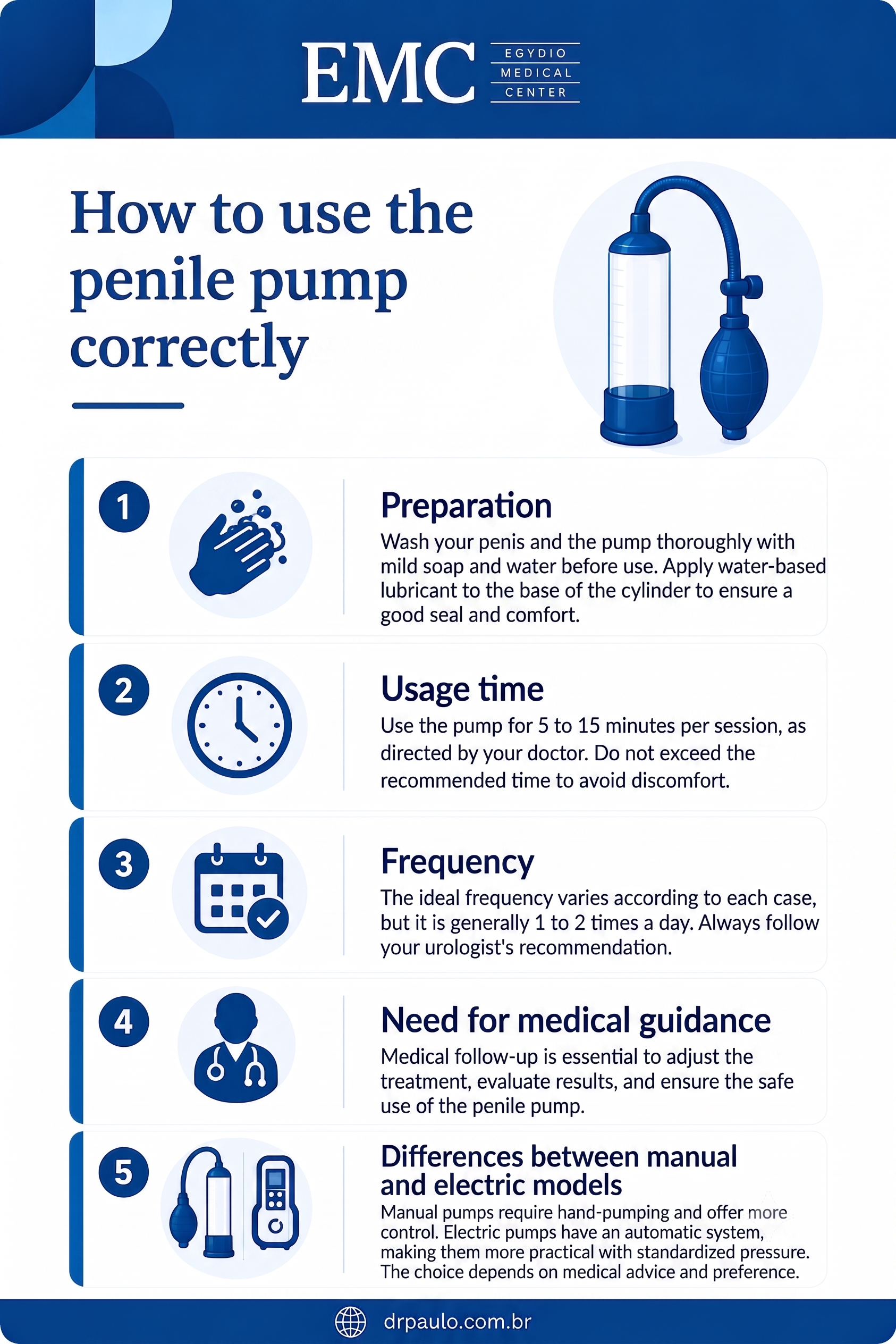
How to use the penile pump correctly?
Who should not use the penile pump?
- Men with bleeding disorders: conditions such as hemophilia can increase the risk of bruising and bleeding due to the pressure exerted by the vacuum on blood vessels.
- Patients using anticoagulants: medications such as warfarin, rivaroxaban, and apixaban can increase the risk of bleeding, requiring medical evaluation before use.
- Presence of intense penile pain: pain may indicate changes that need to be investigated before using the device.
- Penile infections, inflammation, or injuries: pump use should be avoided until these conditions are evaluated and treated.
Before starting to use the penile pump, it is important to have an evaluation with a urologist to check if the device is appropriate for your case.
What are the side effects of the penile pump?
Bruising
Purple spots can appear due to rupture of small superficial blood vessels.
Pain or discomfort
Incorrect device positioning or excessive pressure can cause discomfort during or after use.
Edema (swelling)
Vacuum pressure can promote fluid accumulation in the region.
Tissue damage
Increased pressure or prolonged use does not improve results and can increase the risk of damage to penile blood vessels and tissues.
Changes in circulation
When used with a constriction ring to maintain erection, the band should not remain for more than 30 minutes, as prolonged use can compromise circulation and cause damage.
Temporary loss of sensitivity
The constriction ring can temporarily reduce sensitivity by compressing blood vessels and nerves in the region. In most cases, sensitivity returns after ring removal. To reduce risks, the penile pump should be used according to urologist guidance and following manufacturer recommendations.
Is it worth using a penile pump?
When can the penile pump be indicated?
| Situation | Can it help? | How can it help? |
|---|---|---|
| Mild erectile dysfunction | ✅ Yes | The penile pump promotes blood entry into the cavernous bodies, helping to achieve and maintain erection in selected cases, always with medical guidance. |
| Post-prostatectomy | ✅ Yes | Can be part of penile rehabilitation after surgery, increasing tissue oxygenation, preserving the elasticity of the cavernous bodies, and contributing to the recovery of erectile function. |
| Peyronie’s Disease in initial phase | ⚠️ Can be part of treatment | In some patients, it can contribute to tissue oxygenation, preserve penile elasticity, and help reduce length loss when used as part of the treatment indicated by the urologist. |
| Permanent penis enlargement | ❌ No | The penile pump does not promote permanent increase in penis length or thickness. Its effect is temporary and is related to the momentary increase in blood flow. |
When to see a urologist?
See a urologist if you experience frequent difficulty achieving or maintaining an erection, pain during penile pump use, bruising, swelling, or other side effects related to the device.
Medical evaluation is important to confirm whether the penile pump is indicated for your case and to guide correct use, increasing treatment safety and effectiveness.
Fill out the pre-analysis form to schedule a consultation and receive guidance on erectile dysfunction treatment.