
Some sexual positions can increase the risk of penile fracture when the erect penis undergoes bending or impact. Understand which situations — including the sexual positions most associated with penile fracture — are most linked to the trauma, the warning signs, and what to do in the event of an injury.
Penile fracture is the rupture of the tunica albuginea, a strong layer of tissue that surrounds the corpora cavernosa, structures that fill with blood during erection. Studies indicate an association between penile fracture and certain sexual positions, but the main mechanism of injury is a sudden bending or impact on the erect penis.
Learn about the positions studied, the warning signs, and the importance of seeking medical care when a fracture is suspected.
What is penile fracture?
The penis has no bones, but the term “penile fracture” is used to describe the rupture of the tunica albuginea, the membrane that surrounds the corpora cavernosa.
The guideline “EAU – Urological Trauma” emphasizes that the injury can also affect the corpus spongiosum and the urethra, structures adjacent to the corpora cavernosa. This trauma normally occurs when the penis is erect and suffers a sudden bending during sexual intercourse, when the penis slips out of the vagina or anus and strikes the partner’s perineum or pubic bone.
The accident can also occur during masturbation due to excessive pressure.
Can penile fracture affect erectile function?
It can, but that does not mean that every man who suffers a penile fracture will develop erectile dysfunction. This complication was described in a 2025 systematic review, which included 24 studies and 3,213 patients.
The “erectile dysfunction” can occur when the injury compromises structures involved in erection. Changes during healing can also affect penile function. Medical evaluation allows investigation of possible sequelae and to recommend appropriate follow-up.
The course varies according to the severity of the injury, the structures involved, and the treatment received. Therefore, medical follow-up is important to assess recovery of erectile function and identify possible complications.
Which sexual positions are most associated with penile fracture (sexual positions most associated with penile fracture)?
There is no specific position that necessarily causes a penile fracture. However, some studies link certain positions to a higher risk of trauma. More important than the name of the position is the mechanism of injury — that is, the movement or impact that can abruptly bend the erect penis.
When considering sexual positions most associated with penile fracture, focus on the injury mechanisms described below.
On all fours (doggy style)
The hands-and-knees position (doggy-style) appears among the sexual positions most associated with penile fracture in a meta-analysis published in 2024. The researchers identified a statistical association between that position and the cases analyzed.
This does not mean, however, that it necessarily causes the injury or that it is the highest-risk position in all situations. The most relevant mechanism is sudden bending or impact to the erect penis.
Man on top (sexual positions most associated with penile fracture)
The man-on-top position also showed a statistical association with penile fracture in the 2024 meta-analysis. As with other positions, trauma can occur when the erect penis slips out during penetration and suffers a sudden bending or an impact.
The association found in the study does not allow prediction of the individual risk for each sexual encounter.
Woman on top and variations of the ‘cowgirl’ position (sexual positions most associated with penile fracture)
Positions in which the partner is on top, including variations of the cowgirl position, have been associated in some studies with cases of penile fracture during sexual activity.
The risk is related to the possibility of the penis slipping out during penetration and suffering a sudden bend or an impact against the partner’s perineum or pubic bone.
Why do some positions increase the risk of penile fracture?
During erection, the corpora cavernosa are filled with blood and the tunica albuginea remains under tension. When the erect penis undergoes a sudden bend or impact, this layer can rupture.
The intensity of movements during sexual intercourse can contribute to trauma. However, the main mechanism of injury is impact or sudden bending of the erect penis.

What are the symptoms of penile fracture?
The most characteristic signs of penile fracture include:
- a cracking sound in the penis or a feeling of tearing;
- sudden pain;
- immediate loss of erection;
- swelling;
- deformity or change in the shape of the penis.
In more severe cases, there may be difficulty urinating or the presence of blood in the urethra. A systematic review published in 2023 analyzed 15 studies on penile fracture including 1,671 patients.
Of these, 65 had urethral injury, some with complete urethral rupture. Although uncommon, the authors highlight the severity of urethral injury associated with penile fracture.
Is it possible to have penile trauma that is not a penile fracture?
Yes. Not every trauma causes rupture of the tunica albuginea, the condition that characterizes penile fracture. There is a condition called false penile fracture, in which a trauma can present signs similar to those of a true fracture, but without rupture of the tunica albuginea.
Because the manifestations can overlap, it is not possible to safely differentiate the two conditions based only on symptoms. A 2023 meta-analysis highlights that false penile fracture is a rare urological condition characterized by an injury without rupture of the tunica albuginea.
After penile trauma, it is important to seek medical attention promptly if symptoms such as pain or swelling occur. The absence of a cracking sound or hematoma does not rule out a penile fracture, so signs should be evaluated by a health professional. Be aware of sexual positions most associated with penile fracture.
Penile fracture and other injuries: what is the difference? sexual positions most associated with penile fracture
| Condition | What happens | Possible signs | Management |
|---|---|---|---|
| Penile fracture | Rupture of the tunica albuginea of the corpora cavernosa | Snap, pain, loss of erection, hematoma, deformity | Urgent urological evaluation |
| Penile trauma without fracture | Tissue injury without rupture of the tunica albuginea | Pain, hematoma, or swelling | Medical evaluation to determine severity |
| False penile fracture | Trauma that mimics a fracture, but without rupture of the tunica albuginea | May present with pain, hematoma, and changes in erection | Medical evaluation and, when necessary, tests |
| Associated urethral injury | Urethral trauma accompanying the penile injury | Blood from the urethra, difficulty urinating, or other urinary symptoms | Specialized investigation and treatment |
Does a suspected penile fracture require urgent medical evaluation? (sexual positions most associated with penile fracture may influence risk)
A suspected penile fracture requires prompt medical evaluation, because in some cases the injury may be associated with complications when diagnosis or treatment are delayed.
A 2023 review describes better outcomes associated with surgery performed within the first 24 hours in certain contexts. However, the authors also state that a surgical approach can be considered when the patient seeks care after that period, according to clinical assessment.
What to do in case of suspected penile fracture (including sexual positions most associated with penile fracture)
When a penile fracture is suspected, acting quickly is important to prevent the injury from progressing without appropriate assessment. If there are signs such as sudden pain, a popping sound, or swelling after trauma during sexual intercourse, follow these guidelines.
Stop sexual intercourse immediately
Stop sexual intercourse immediately. Do not continue penetration after an injury or if you notice suspicious signs.
Do not try to manipulate the penis
Do not attempt to reposition the penis, correct a deformity, or induce another erection to assess the injury. Also do not try to confirm or rule out a fracture on your own.
Seek medical care
In the presence of a popping sound, sudden pain, loss of erection, hematoma, or deformity, seek urgent urological care. Do not attempt home remedies such as ointments or compresses.
How is the diagnosis made
The diagnosis of penile fracture is based on clinical evaluation, imaging studies, and investigation of possible urethral injury.
Clinical evaluation
In the clinical evaluation, the urologist investigates how the trauma occurred and looks for signs such as a popping sound in the penis, sudden pain and loss of erection, as well as hematoma, penile deformity and difficulty urinating, which may indicate a urethral injury.
Imaging studies
Imaging tests, such as ultrasound and magnetic resonance imaging, may be requested when there is diagnostic uncertainty after clinical evaluation. These tests help identify a rupture of the tunica albuginea and differentiate a true penile fracture from other injuries.
Investigation of the urethra
When there are signs of urethral injury, such as difficulty urinating or blood at the urethral meatus, the physician may request specific tests to assess urethral integrity.
Does penile fracture require surgery? (sexual positions most associated with penile fracture)
When a penile fracture is diagnosed, EAU recommendations indicate considering surgical treatment with repair of the rupture of the tunica albuginea, taking into account the clinical picture, to treat the injury and reduce the risk of some complications, such as changes in erectile function and penile curvature.
Although the literature points to the benefits of surgery for penile fracture performed within the first 24 hours, the procedure should also be considered for patients who seek care after that period.
What can happen if penile fracture is not treated?
Penile fracture can be associated with complications when the diagnosis is delayed or when treatment is not carried out properly.
| Possible consequence | What it means |
|---|---|
| Penile curvature | The healing process can change the shape of the penis and cause an acquired curvature. |
| Erectile dysfunction | The injury may compromise erectile function, especially in more complex cases or when associated with other injuries. |
| Fibrosis or plaques | Scarring changes may occur during recovery. |
| Pain or discomfort | Some people may experience persistent symptoms after the trauma. |
| Urethral injury | In some cases, the fracture may be associated with a urethral injury, requiring specific investigation and treatment. |
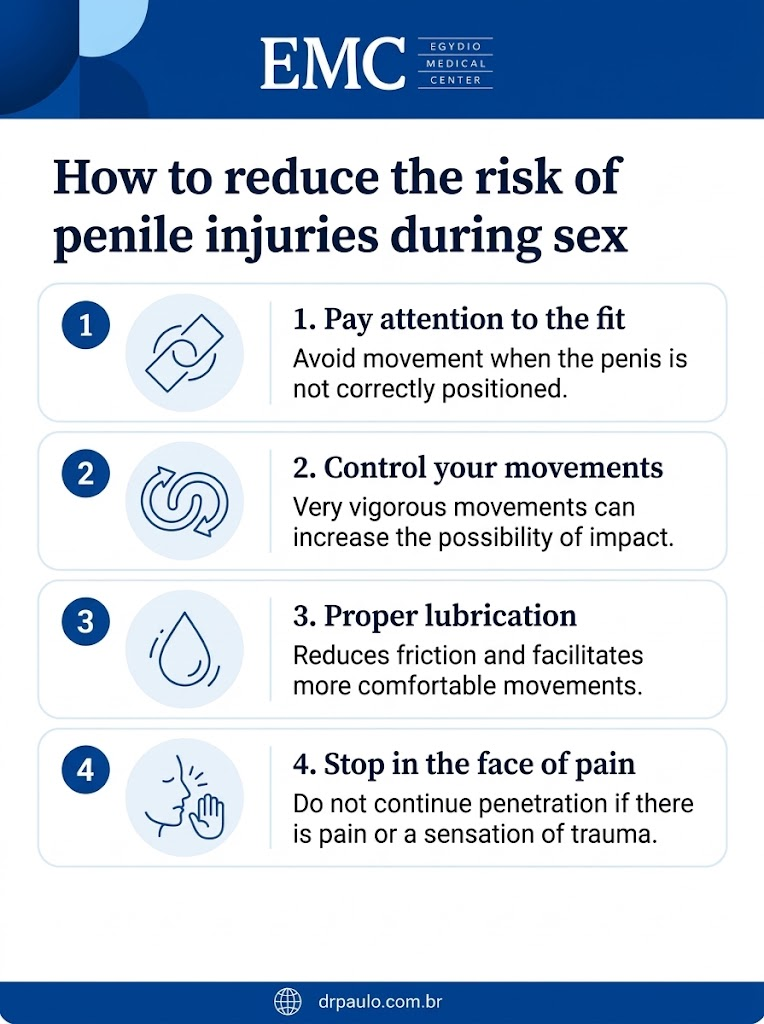
How to prevent penile fracture during sex? (sexual positions most associated with penile fracture)
Although it is not possible to eliminate the risk completely, some measures can help reduce it during sexual activity. The following precautions can be considered:
- pay attention to alignment during penetration;
- avoid movements that increase the chance of the penis slipping and suffering an impact;
- reduce the intensity if there is loss of control of movement;
- use adequate lubrication;
- stop penetration if there is pain;
- take special care during positions in which there is a greater chance of bending or impact of the erect penis, paying attention to sexual positions most associated with penile fracture.
When to seek medical care? Consider sexual positions most associated with penile fracture.
Knowing when to seek medical care is important both in the face of a possible penile fracture and during recovery; be mindful of sexual positions most associated with penile fracture when assessing risk.
Some signs require immediate evaluation, while others may indicate the need for follow-up with a urologist after treatment.
After trauma
Seek immediate medical attention for:
- a cracking sound;
- sudden pain;
- immediate loss of erection;
- significant swelling;
- hematoma;
- deformity;
- blood through the urethra;
- difficulty urinating.
After treatment
Seek follow-up care if the following appear:
- new curvature;
- difficulty achieving an erection;
- persistent pain;
- changes in sexual function;
- urinary changes.
If you suffered trauma to the penis and experienced a popping sound, pain, hematoma, deformity, or immediate loss of erection, seek urgent medical attention.


