

Plication Techniques for Penile Curvature Include Some Modifications from the Knowledge Introduced by Nesbit. Discover Which Ones.
Due to the presence of fibrosis or the congenital formation of the penis, the member can present some degrees of tortuosity.
The curvature can occur in any direction and leads to a reduction in penile size. In some cases, the man may experience thinning and face erectile dysfunction.
To treat the condition, surgery with one of the plication techniques for penile curvature may be necessary when clinical options or other types of surgical interventions are not suitable for your case.
Physical and Psychological Consequences of Penile Curvature
It is very important for a man with penile curvature to seek help.
The curvature tends to make sexual life difficult. Due to anatomical issues, the curvature makes penetration more challenging, causes the penis to slip out frequently, and limits movements during penetration. Depending on the degree of deformity, penetration may be unfeasible.
Moreover, when the condition is accompanied by erectile dysfunction, the penis loses the firmness necessary for penetration.
The damages at the moment can make men feel anxious, depressed, and avoid intimate relationships and contact with other people, among other negative feelings and behaviors.
Treatments Recommended for Curvature Correction
When seeking a urologist, it will be possible to verify if it is feasible to correct the penile curvature with medications or injections, or if the condition represents a surgical case.
If surgery is necessary, the surgeon will perform exams to understand the particularities of the patient’s penis and then think of the best technique for the case.
There are at least 16 surgical techniques for penile curvature. Next, you will learn about three of them: the plication techniques for penile curvature.
1. Yachia Technique
This technique was developed by urologist Dr. Daniel Yachia in 1990.
It involves making a vertical incision on the albuginea tunica on the long side of the penis. Subsequently, a horizontal suture is made to align the penis, equalizing the long side to the shorter side.
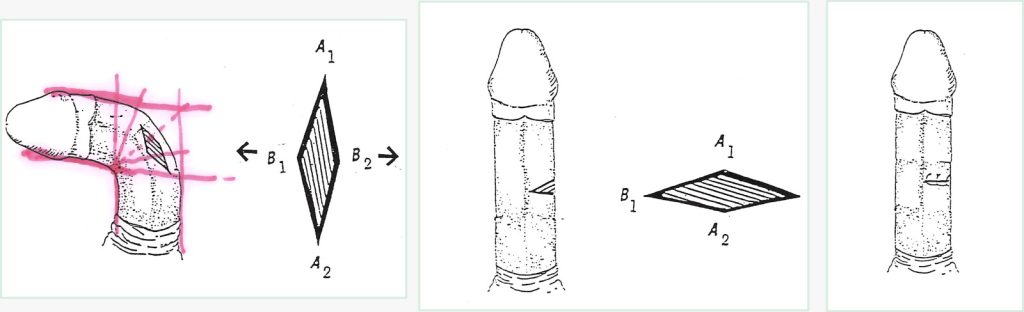
The surgery does not require the removal of penile tissues, unlike the Nesbit technique or the Kêlami-Nesbit technique. However, there is also no refinement to determine the best point to make the cut to produce the best possible alignment.
On the other hand, after analyzing 10 cases treated with the technique, Dr. Yachia concluded in his study that both the neurovascular bundle and the corpora cavernosa were less susceptible to injuries during surgery, representing an advantage for the technique by preserving sensitivity and filling of the member.
2. Lue Technique
In the technique proposed by Dr. Tom F. Lue in 2002, the correction of penile curvature is also made on the long side of the penis, without the need to perform excision of tissues.
The technique is executed from parallel penile plications at 16 or 32 points, while the penis is erect, made with suturing thread and the help of a needle. This will form folds that align the penis.
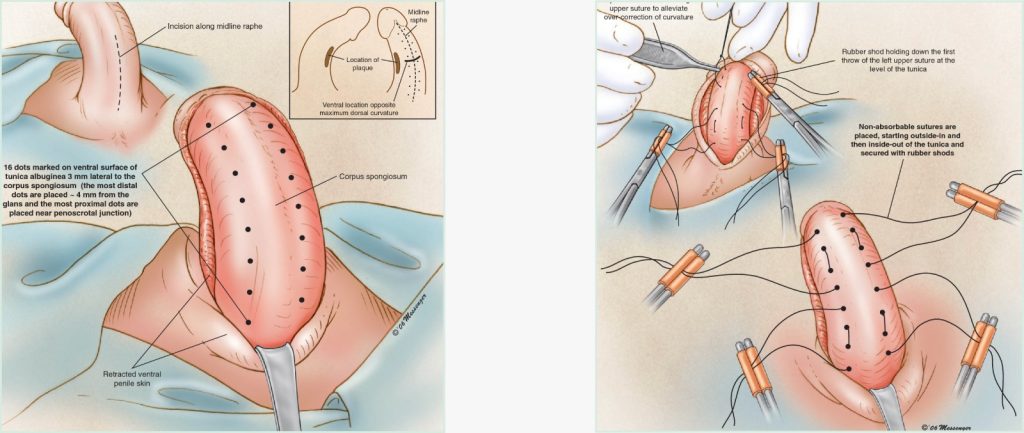
The surgery is less invasive, as there are no cuts in the albuginea tunica. Additionally, it is possible to redo the point if the alignment is not satisfactory.
In his study, Dr. Lue showed that, six months after the surgery, 93% of patients had straight erections, and 7% reported nearly straight erections, considering 132 patients observed.
Besides shortening the penis, another drawback is that the thread used is not absorbable. Over time, it can be bothersome and/or form small nodules.
3. Essed-Schroeder Technique
The third of the plication techniques for penile curvature is called the Essed-Schroeder technique.
In the procedure, four plications are made with the surgical thread.
The points are made on the long side, right in the area opposite to the greatest curvature, equalizing this side to the shorter side.
When the curvature is upward or downward, the penis receives two symmetrical points from each side. For lateral curvatures, the points are given asymmetrically.

As this technique is also performed on the long side of the penis, after the surgery, the size of the member will be reduced. Furthermore, due to the use of strong and non-absorbable threads, it will be necessary to live with them, which can be bothersome.
Upon following up and interviewing 23 patients for almost 3 years after the surgery, the study that analyzes the Essed-Schroeder technique recorded that the penis of 17 men continued to be aligned. On the other hand, 15 patients complained about penile shortening (average of 1.8 cm) and two had plication nodules as a side effect.
Is There a Better Surgery for Penile Curvature?
It is not possible to determine which is the best surgical technique for the treatment of penile curvature. Everything will depend on the particularities of the patient’s condition.
Plication techniques for penile curvature are not always the most suitable option to treat Peyronie or congenital curvature in all men.
Despite being minimally invasive, as they do not involve the removal of tissues, and ensuring penile alignment, the techniques of Essed-Schroeder, Lue, and Yachia have disadvantages, mainly due to the permanence of the surgical thread inside the penis.
Over time, more advanced techniques and new treatments for penile curvature have emerged and currently represent more modern options for the conditions, such as the Egydio Technique.
At the same time, plication techniques for penile curvature should not be disregarded, as they are still effective for some patients. The urologist will be able to identify if one of them is the best for your case.
Therefore, contact us and schedule your consultation. Without penile curvature, you can have a healthier and more pleasurable sexu…
Read also
- What is penile fracture?
- Surgery for Peyronie’s Disease: Risks and Recommendations
- Egydio’s Technique: Peyronie Disease Treatment
- Does the Egydio Technique Work for Every Penile Curvature?
- Implante de Prótese Peniana | Dr. Paulo Egydio
- Does Small Penis Exist? Check When Size Is a Concern
- 7 Simple Habits to Prevent Prostate Cancer
- Can People with a Penile Prosthesis Play Sports?
- How to Enlarge the Penis: Understanding the Options
- 6 Causes of Penis Fissures: Treatments and Care Tips