
The penile frenulum is a band of tissue that connects the underside of the glans to the foreskin. When it is short or not very elastic, it can cause pain, tension, fissures and bleeding during sexual activity.
The penile frenulum contributes to the movement of the foreskin and can be more or less elastic among men. In some situations, however, excessive tension can cause discomfort, make foreskin retraction difficult, or promote tears.
Below, learn how to identify changes in the penile frenulum, what problems can occur, and when to see a urologist.
What is the penile frenulum?
The penile frenulum is a small band of tissue located on the underside of the glans.
It connects the glans to the inner surface of the foreskin and helps control the movement of the foreskin during retraction and return to its original position.
The penile frenulum also has many nerve endings and can contribute to sexual sensitivity. However, pleasure and sexual response depend on various factors, not just this structure.
What is the purpose of the penile frenulum?
The main function of the penile frenulum is to contribute to movement of the foreskin and limit its excessive retraction.
During erection or sexual activity, the foreskin moves and the penile frenulum follows this displacement.
When the tissue has adequate elasticity, this movement usually occurs without pain or excessive tension.
How to tell if the penile frenulum is normal?
There is no single measurement that determines whether the penile frenulum is normal. Assessment considers its elasticity, the movement of the foreskin and the presence of symptoms.
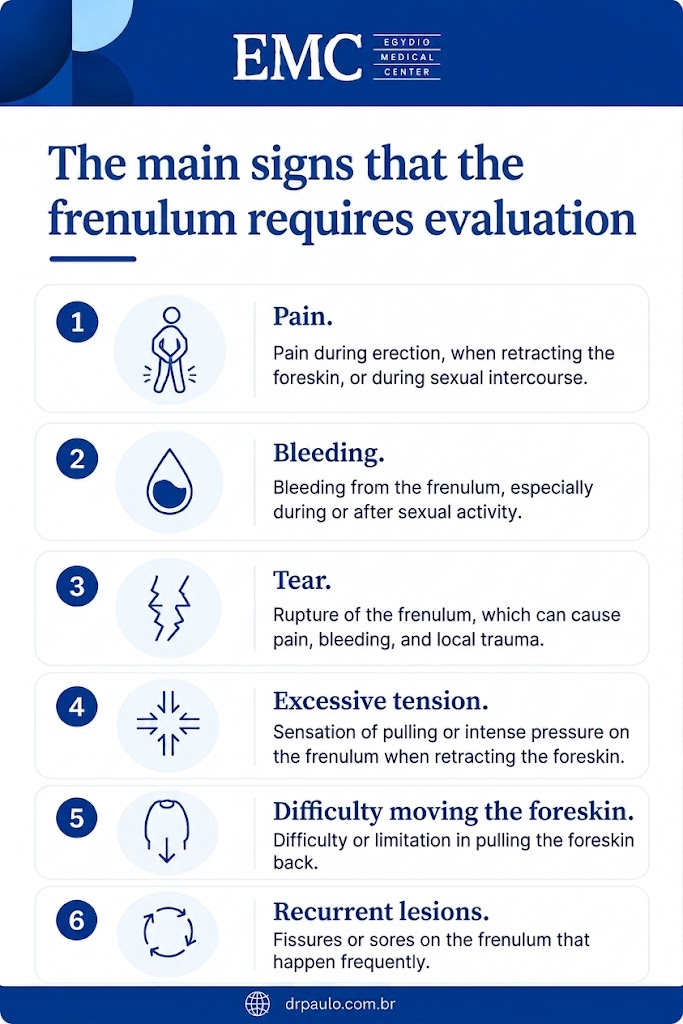
In general, signs that deserve attention include:
- pain when retracting the foreskin;
- excessive tension during erection;
- glans pulled downward when the foreskin is retracted;
- fissures or sores on the penile frenulum;
- bleeding during or after sexual intercourse;
- recurrent ruptures;
- difficulty moving the foreskin.
What can be normal and what deserves attention about the penile frenulum?
| Situation | What it may mean |
|---|---|
| Frenulum without pain or tension | Generally, there is no obvious functional alteration |
| Foreskin moves normally | Good foreskin mobility |
| Pain when retracting the foreskin | There may be tension or another alteration |
| Glans is pulled downward | This can occur when the penile frenulum is short |
| Bleeding during sex | It may indicate injury and warrants evaluation |
| Recurrent ruptures | They may be related to a short or inelastic penile frenulum |
What is a short penile frenulum?
The most common signs include:
- pain during erection;
- discomfort during sexual intercourse;
- tension when retracting the foreskin;
- glans pulled downward;
- difficulty retracting the foreskin;
- small fissures in the penile frenulum;
- bleeding after sexual activity;
- recurrent ruptures.
Not all of these symptoms mean the penile frenulum is short. Therefore, urological assessment is important to identify the cause.
Is a short penile frenulum the same as phimosis?
No. Short penile frenulum and phimosis are different conditions, although they may occur simultaneously.
A short penile frenulum is related to the size or elasticity of the frenulum, located on the underside of the glans.
Phimosis occurs when the foreskin cannot be adequately retracted, usually due to narrowing of the preputial ring.
Thus, a man can have a short penile frenulum, phimosis, or both conditions at the same time.
Can the penile frenulum rupture?
Yes. A short penile frenulum or one subjected to excessive tension may suffer a tear or rupture, especially during sexual intercourse or masturbation.
When this happens, pain, bleeding, and a small wound may appear on the underside of the glans.
If there is pain in the penis after a rupture, especially accompanied by persistent bleeding, it is important to seek medical evaluation.
Why can the penile frenulum rupture?
Rupture can occur when the penile frenulum is short or has low elasticity and is subjected to greater traction than it can withstand.
The sexual intercourse and masturbation can cause this type of trauma to the penile frenulum, especially when there is intense retraction of the foreskin or excessive friction.
A rupture of the penile frenulum can also heal and leave the tissue less elastic, increasing the risk of new tears in some cases.
What to do in case of penile frenulum rupture?
In case of penile frenulum rupture:
- Stop sexual activity;
- Apply gentle pressure with gauze or a clean cloth if there is bleeding;
- Avoid manipulating or trying to approximate the skin;
- Keep the area clean;
- Seek medical attention if the bleeding is heavy or does not stop, if there is significant pain, or if the injury appears extensive;
- Avoid sexual intercourse until the penile frenulum has healed and you have guidance from a professional.
Treatment depends on the extent of the lesion and the characteristics of the penile frenulum. Recurrent ruptures should be investigated by a urologist.
Can a short penile frenulum make the penis crooked?
A short penile frenulum can make the glans appear pulled downward, especially during erection and foreskin retraction.
This traction can give the impression that the penis has a curvature. However, this is different from a structural curvature of the penile shaft.
Therefore, when there is doubt about a penile curvature, medical evaluation is important to determine the origin of the alteration.
Is a short penile frenulum the same as Peyronie’s disease?
No. They are different conditions.
- A short penile frenulum involves the frenulum located between the glans and the foreskin.
- Peyronie’s disease is related to the formation of scar tissue in the tunica albuginea, and can cause an acquired curvature of the penis.
Although both situations can affect the appearance of the penis during erection, their causes and treatments are different.
How is the diagnosis of penile frenulum problems made?
The diagnosis is made by a urologist, usually through evaluation of symptoms and physical examination.
The clinician may observe:
- the movement and retraction of the foreskin;
- the elasticity and tension of the frenulum;
- the position of the glans during retraction;
- the presence of fissures, scars, or other lesions;
- a history of pain, bleeding, or ruptures.
In some cases, the evaluation also helps differentiate a short penile frenulum from conditions such as phimosis or changes that may cause penile curvature.
How to treat a short penile frenulum?
Not every short penile frenulum requires treatment. When there is no pain, lesions, ruptures, or functional limitation, observation may be sufficient.
When the penile frenulum causes symptoms or recurrent ruptures, the urologist can assess different treatment options according to the characteristics of the case.
Frenuloplasty for the penile frenulum
The frenuloplasty is a surgical procedure that may be indicated to lengthen the penile frenulum when it is short and causes tension or symptoms.
It may be considered in situations such as:
- pain during sexual activity;
- excessive tension of the penile frenulum;
- functional difficulty;
- recurrent fissures;
- repeated ruptures of the penile frenulum.
The indication depends on medical evaluation and the anatomical characteristics of each patient.
When to consult a urologist about the penile frenulum?
Seek urological evaluation if you have:
- pain during erection;
- pain or discomfort during sexual intercourse;
- bleeding in the penile frenulum;
- rupture of the penile frenulum;
- recurrent fissures or lesions;
- difficulty retracting the foreskin;
- excessive tension in the area;
- glans pulled downward during retraction;
- questions about the anatomy or function of the penis.
Changes in the penile frenulum can have different causes and do not always require surgery. Individualized assessment helps identify the problem and define the most appropriate management.
Do you have doubts about the appearance or function of the penis?
If you experience pain, bleeding, recurrent ruptures, or difficulty retracting the foreskin, seek urological evaluation with a qualified professional.