

Penile curvature is a condition in which the penis shows an abnormal inclination during erection, which can be caused by genetic factors, trauma or diseases such as Peyronie’s. There are treatment options available, which must be indicated according to case severity and individual medical evaluation. Discover the available treatments.
Penile curvature occurs when the penis shows an abnormal inclination or bend during erection. This can happen due to several factors such as genetics, scars in penile tissue or diseases that provoke certain curvatures. Many men may feel uncomfortable seeking medical help or even discussing the subject with their partners. But it is important to understand that penile curvature is not uncommon and can happen to anyone. It is also worth remembering that the penis can change as the years go by. Sometimes a curvature that is considered normal up to a certain point can become more pronounced over time. Therefore, it is important to know when to seek medical help to ensure that sexual health is not affected. Below, see everything you need to know about penile curvature, the most common causes and the treatments available.
Is it normal to have a bent penis?
Yes, it is normal to have a bent penis. In fact, it is even rare to find a 100% straight penis. However, it is important to highlight that there is a limit for the angle to be considered usual. Tolerance for a normal penile curvature angle involves biomechanical concepts. First, it is necessary to understand that the penis is a hydraulic cylinder. Only when it is pressurized inside can we notice the deviation, if any. According to the relationship between length and caliber (diameter) of each penis, this curvature can be acceptable or not. But only a urologist, together with the patient, can reach this important conclusion.
What causes penile curvature?
Penile curvature can be caused by a variety of factors. In some cases, it is simply a natural characteristic of the body, since some people are born with a slightly curved penis. However, there are other reasons that can explain penile curvature. Trauma and injuries, for example, which can occur due to vigorous physical activities, accidents or even during sexual intercourse, can cause an abnormal bend during erection. When the member has an accentuated curve, there are two possible causes: Peyronie’s disease, which is the acquired curvature resulting from the accumulation of micro-traumas over a lifetime, or congenital curvature (also known as adolescent curvature), a deviation the man has been aware of since puberty/adolescence. There is yet another possibility: an initial congenital curvature may predispose the penis to injuries that trigger Peyronie’s disease. 
Peyronie’s disease
Peyronie’s disease affects 10% of men, according to the American book Peyronie’s Disease, to which Dr. Paulo Egydio contributed. The deviation is caused by fibroses (scars) that form when trauma or micro-trauma occurs, most often during sex, without the man even noticing. Poor-quality erections, diabetes and patients who have undergone prostate surgery, for example, are more susceptible to penile deformities. In Peyronie’s, a penis that was always straight begins to show some tortuosity—upwards, downwards, sideways or multidirectional—and other symptoms such as loss of length, caliber or rigidity. 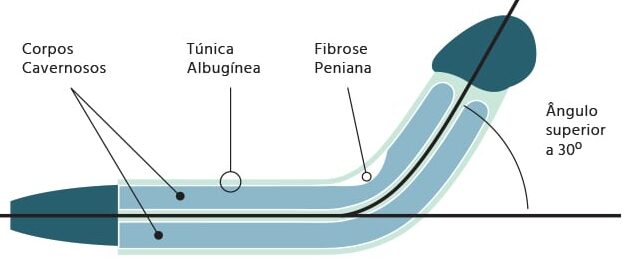
Symptoms
Peyronie’s disease affects penile health, causing a series of uncomfortable symptoms such as:
- Abnormal curvature during erection;
- Hard nodules or plaques in the penis;
- Erectile dysfunction;
- Pain during erection;
- Difficulty having sexual intercourse due to curvature or pain;
- Decreased penile rigidity during erection;
- Perceptible penile shortening.
Diagnosis
Diagnosis of Peyronie’s disease can be made through a physical examination by a urologist to assess curvature, nodules or hard plaques. The professional should also review the patient’s full medical history, including any recent penile injuries or previous surgeries that may be related to the disease. In some cases, additional tests such as penile ultrasound may be needed to provide detailed images of the penile tissue and help with accurate diagnosis.
Most indicated treatments
There are several treatment options available to help relieve symptoms and improve quality of life. If the patient is showing initial symptoms of the disease, the doctor may prescribe specific medications to treat Peyronie’s. However, in more advanced cases, penile prosthesis implantation surgery or penile reconstruction may be necessary.
Congenital Curvature (Adolescent Curvature)
Congenital curvature is not a deviation acquired over time. It is present from birth and affects between 4 and 10% of the population, according to a publication in The Scientific World Journal. Adolescent curvature is usually recognized during puberty, when teenagers become interested in a sexual life and the penis becomes erect. Parental support is very important for diagnosis.
Symptoms
One of the main characteristics of congenital curvature is the abnormal bend of the penis that is present from birth or becomes evident during adolescence. The main symptoms are:
- Curvature during erection: the penile bend generally becomes more apparent during erection, ranging from a slight inclination to a more pronounced curve.
- Asymmetry or discomfort during erection: in some cases, congenital curvature can lead to penile asymmetry or cause discomfort during erection.
- Sexual difficulties: depending on curve severity, some men may experience difficulty having comfortable or satisfactory sexual intercourse.
Diagnosis
Congenital curvature can present in different forms and combinations, potentially causing problems when greater than 30 degrees. Most patients notice the issue during intercourse. So stay alert! If you have penetration difficulties and pain, are limited to a few positions with short movements so the penis does not slip out causing pain and discomfort to your partner, this may be your diagnosis.
Most indicated treatments
Each case of congenital curvature is unique, and the most appropriate treatment can vary depending on curve severity and the patient’s individual needs. After examinations, the urologist may recommend medications and exercises for milder cases. However, in more severe or persistent situations, surgery may be necessary to correct the curvature.
Surgery for penile curvature correction
In both Peyronie’s disease and adolescent curvature, patients often delay seeking medical help, whether due to lack of knowledge or embarrassment. Thus, when they arrive at the office and after all examinations, they may receive an immediate surgical indication. In a single surgical procedure, it is possible to treat the curved penis, lack of vertical rigidity and associated problems such as shortening, thinning of the member and erectile dysfunction. There are methods used during surgery and it is important that the patient knows how to straighten the penis with each of them. Get to know some below:
Nesbit Technique
When intervening on the long side—technique called plication—a kind of fold is made on that side of the penis. In this way, the long side will be matched to the short side, but, due to tissue tightening, the penis length will be reduced compared with the original size.

Penile graft surgery
When the surgeon operates on the short side, he can lengthen the affected side, avoiding the loss of length caused by plication.
To do so, he may use grafts, since by making the incisions, “defects” are created on the short side of the penis that need to be corrected. The issue is that grafts are not always suitable: there are more than 20 types, healing is not so good, there is risk of infections and graft tissue size does not allow the penis to be lengthened to the vessel limit during the operation.
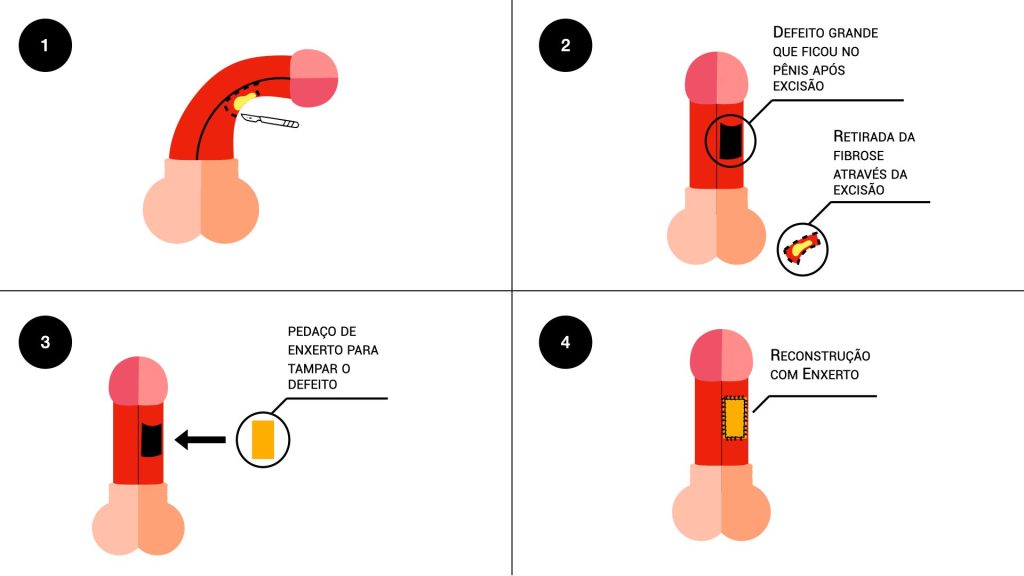
The solution to operate on the short side without the need for a graft is to make smaller, multiple incisions, geometrically calculated directly on the tunica albuginea. This causes tissues to expand, straightening the penis, and then regenerate. The incisions are also made in the opposite direction of deformities such as shortening and hourglass narrowing, up to the limit of the nerves and urethra.
Inside the Egydio Technique
The Egydio Technique is a surgical procedure developed by Dr. Paulo Egydio. This technique is used to correct penile curvature caused by Peyronie’s disease or other conditions that affect penile structure. During the procedure, the fibrous plaques responsible for the deformity are removed through incisions in the fibrous tissue. The penis is then reshaped and reconstructed to ensure a normal appearance and function. The Egydio Technique has been used by specialists as a surgical alternative for correcting penile curvature, with good results in selected cases, as reported in the medical literature. The procedure is performed with care and precision, and patients are closely monitored during the postoperative period to ensure the best possible recovery.
Frequently asked questions
How important is an early diagnosis?
Early diagnosis is important to prepare you for future treatment and prevent the curvature problem from progressing to a more serious case such as Peyronie’s disease. Many young people have no idea what a normal penis is. Often they only discover some curvature deformity after already suffering traumas. Therefore, it is essential to take a careful look at your inseparable companion to ensure its proper functioning.
How do you know if the curvature is acceptable or needs treatment?
To determine whether penile deviation is acceptable or not, it is necessary to check penetrative functionality, which is directly related to vertical rigidity of the member. Vertical rigidity is essential for the penis to overcome resistance, being able to penetrate the partner without difficulty and provide pleasurable sexual intercourse for both. The ratio between length and caliber contributes positively to vertical resistance. Ideally, the longer a penis, the bulkier it should be, thus tolerating curvature better. When there is a disproportion between length and caliber, a smaller degree of curvature more easily causes loss of vertical resistance. For example, if your member is long but thin, a smaller degree of penile curvature will already cause resistance loss. Conversely, a penis of the same length but larger diameter with the same curvature angle may not be impacted by rigidity loss. If you have a curved penis but, considering the length-caliber relationship, this curvature does not cause loss of vertical resistance or hamper penetration capacity, this deviation does not need treatment. In these cases, the patient can lead a full sexual life despite the curvature, but must have periodic follow-up with the urologist. Now, if you have a disproportion between penis length and caliber and present loss of vertical resistance, you have penetrative dysfunctionality. Penetration may even occur with hand help, but during movement the penis tends to slip out easily. In these cases, you need a urological evaluation to define the most appropriate treatment. In other words, treatment is not indicated only considering the penile curvature degree, but rather the biomechanical impairment, according to the anatomical characteristics of each penis.
How to measure the degree of penile curvature?
The curvature angle in Peyronie’s disease or congenital curvature must be measured by a urologist for an accurate reading. Therefore, when you notice your penis has begun to bend, seek medical help immediately. In the office, the doctor will perform some exams with the penis pressurized, which allow checking not only whether the member is curved but also whether it has lost rigidity and whether fibrosis is present. However, it is very important that the patient is not fixated on a number. The main concern for penile curvature is whether it causes penetrative dysfunction—that is, it hinders penetration and makes the penis slip out easily during intercourse, especially when there is not a good length-caliber relationship. In general, a normal penile curvature is 20 degrees for most men. A curvature of 30 degrees tends to start causing problems for male sexual health. There are situations in which the deviation stabilizes at this angle, producing conditions that can be manageable or treatable with medication. The big issue is that if there is no stabilization, tortuosity can continue to evolve and reach 45 degrees. In severe cases, the penis reaches a curvature of 90 degrees! The urologist’s interpretation will depend not only on the curvature degree but on a series of biomechanical conditions such as length, caliber, deviation direction, whether there is narrowing, among others. This set of information will define what treatment a curvature that compromises penetrative function deserves. For example, did you know that downward curvatures are less tolerated? They impact vertical resistance more considerably. Sometimes a smaller degree of this type of deviation may already indicate surgery.
What is the most indicated treatment for penile curvature?
The most indicated treatment for penile curvature depends on the patient’s diagnosis. For mild penile curvatures that do not cause significant discomfort, conservative treatment can be an initial option. This may include the use of penile traction devices, shockwave therapy, medications or therapies. For more severe or persistent penile curvatures, curvature-correction surgery may be necessary. There are several surgical techniques available, including the Egydio Technique. In 2019, Dr. Paulo Egydio had the opportunity to discuss the best individualized technique for a hypothetical severe case of a 90-degree bend associated with narrowing, loss of length and erectile dysfunction, during the Survivor Debate, a panel promoted by the American Urological Association (AUA). The 5,000 urologists present had to vote on the best strategy to treat the fictitious patient. Among the options brought by the three debaters were drug treatment, surgical treatment and surgery with the Egydio Technique, defended by Dr. Paulo. More than 70% of voters agreed that treatment with the Egydio Technique was the best option for the case presented. Of course, no treatment is undertaken without individualizing according to the patient’s penile anatomy, but the Egydio Technique is quite effective for many cases seen in offices. Therefore, if you are a patient, talk to your doctor.
Is it possible to prevent penile curvature?
Although not all causes of penile curvature can be avoided, some measures can help minimize the risk. Preventing penile injuries, maintaining an active and healthy sexual life, performing regular self-exams, maintaining a healthy lifestyle and seeking medical guidance when necessary are important steps to prevent penile curvature.
Does penile curvature affect sexual function?
Depending on severity and characteristics, penile curvature can indeed significantly affect sexual function, interfering with penetration and the quality of sexual relations. In addition, in some cases, penile curvature can cause pain during erection or discomfort for the partner. Therefore, if you are experiencing difficulties or discomfort during sex due to penile curvature, it is important to seek medical guidance to explore treatment options and improve your sexual quality of life. Penile curvature can be treated in many cases. Consult a urologist for evaluation of your condition. Regain your confidence and make the most of your intimate life.
- 9 Main Causes of Male Impotence and How to Treat Them
- How to Improve Your Erection?
- Check Out 12 Practices to Get a Firmer Penis
- Medication-Related Erectile Dysfunction: Available Treatments
- Top 5 Male Libido Supplements According to Studies
- Erectile Dysfunction: What It Is, Main Symptoms and Treatments
- Sexologist or Urologist: Which Specialist to Consult First?
- Penis Pump and Penile Injections